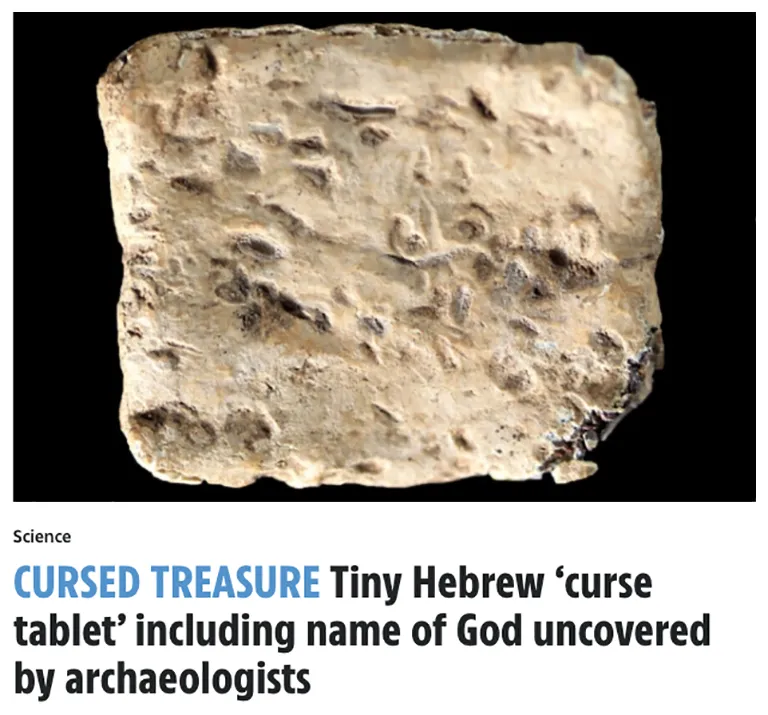
Not so fast!

Chris Sinkinson  |  Features  |  defending our faith
Date posted:  1 May 2022
Share Add       
Not so fast!

How one news outlet carried the news

In March 2022 an announcement was made, carried by many news outlets, that could have enormous value for apologetics.

A tiny lead tablet (or amulet), discovered at an archaeological site, seems to cast light on the period of Joshua. If the artefact has been accurately interpreted it will certainly be an important discovery but, for various reasons, it is worth being cautious.

The tablet is a tiny 2cm x 2cm folded metal amulet with no obvious evidence of an inscription. It is folded, the inscription being on the inside, and it cannot be opened without damaging it. The text itself could only be read using a special photographic technique. Studying the results, the text seems to be curse text, written in the earliest form of Hebrew script (often called Proto-Sinaitic).

The translation of the inscription has striking parallels to the Biblical account of the curses declared by the Israelites on Mount Ebal where the tablet was found (Deut. 27:13).

Cursed, cursed, cursed, cursed by the God Yahweh; You will die cursed; Cursed you will surely die; Cursed by Yahweh – cursed, cursed, cursed.

It was on Mount Ebal that the Israelites pronounced blessings and curses upon themselves, in a covenant renewal ceremony at the time of the conquest (Josh. 8). The form has the very Hebrew style of ‘parallelism’ and the use of the Biblical name for God, Yahweh is most striking. While there are other possible examples of the name Yahweh being used in Egyptian inscriptions, this would be the earliest example from the land of Canaan itself.

Scott Stripling, the archaeologist who has made the announcement, dates the artefact to the Late Bronze Age, c.1400–1200 BC, and has used it in defence of an early date for the Exodus. His team have described it as the ‘most important inscription ever found in Israel’. Written using a stylus on a lead surface, Stripling points out it is an example of what is referred to in Job 19:24. If his interpretation of its contents is generally accepted then it will certainly be among the most important archaeological finds that connect directly to the Bible.

But there are reasons to reserve judgment. First, the context of the find is complicated. In the 1980s an early altar was excavated on Mount Ebal. There has been continued debate over when the altar was constructed – stone structures can be difficult to date. The tablet was recovered in the piles of earth from those earlier excavations by wet sifting. Establishing a fixed date for something found out of context like this is notoriously difficult.

A second problem arises with the interpretation of the text itself. An image of the complete inscription has not yet been published. This means that there has been no wider scrutiny of the script itself or its possible translation. There have been many examples in the past where later scholarship has dismissed the initial reading of an ancient text. Sadly, this has often spoilt the value of apologetics books that have been too quick to endorse an initial interpretation.

This gives rise to a third problem, which is the way such an important find has been published. Scholars have objected to an announcement to the press preceding any peer-reviewed publication. The artefact has made The Sun newspaper before it has appeared in any academic journal. Some might say that this criticism reflects the wounded pride of academics, but there is more at stake here. It is through peer observation and debate that claims are properly scrutinised. Until this has been done, we should be cautious in using this as evidence in apologetics. It may prove to be the find of the decade. But let’s wait and see.

Share
< Previous article| Features| Next article >
Read more articles on:   apologetics
Read more articles by Chris Sinkinson >>
Features
The New Testament’s P45

The New Testament’s P45

Have you ever held a P45 in your hand? Most likely you have, and it is the document you were …

Features
Migration – lessons ancient and modern

Migration – lessons ancient and modern

I’m writing this from the island of Crete where I am filming with the Christian Television Association. It’s a land …

Looking for a job?

Browse all our current job adverts

Search

New here?

Register and get three free articles each month!

Register