John Calvin’s aversion to being remembered

Michael Haykin  |  Features  |  history
Date posted:  1 Dec 2018
Share Add       
John Calvin’s aversion   to being remembered

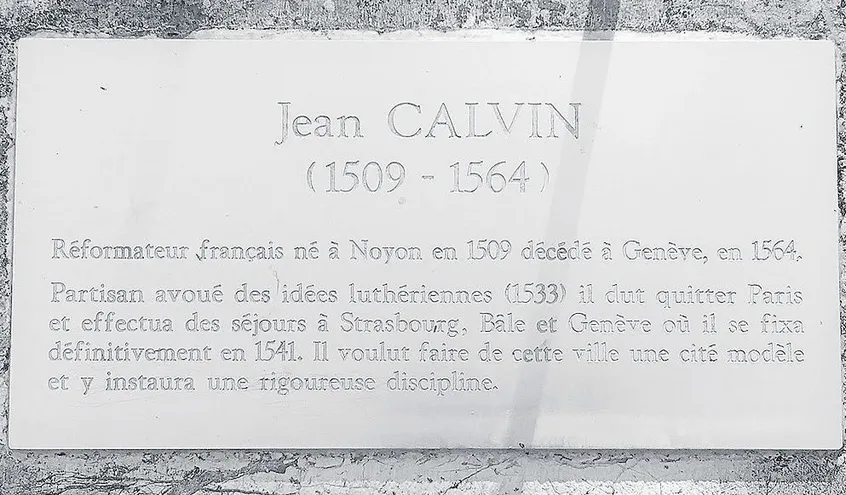
Calvin’s grave plaque

Of all the 16th-century Reformers, John Calvin (1506–1564) was the most reluctant to discuss details of his life in works destined for public consumption.

As he told Cardinal Jacopo Sadoleto: ‘I am not eager to speak about myself.’ He had, as historian Heiko Oberman once aptly put it, a ‘dislike of self-disclosure.’

From his hand, for example, there are really only two major sources for details about his early life, namely, sections from his Reply to Sadoleto (1539), which need to be used with caution since they are not explicitly autobiographical, and those from the Preface to his Commentary on the Psalms (1557). Occasional remarks here and there in other passages in the works of Calvin help fill in some of the gaps of his early life, as do the two memoirs of the French Reformer by his close friend and ministerial colleague, Theodore Beza.


Unmarked grave

True to form, Calvin specified at the close of his life that he wanted to be buried in an unmarked grave, a wish that was followed. Calvin had had his fill of the reprehensible way that the medieval world had decked out the gravesites of their heroes and hero-ines, their ‘saints,’ and the way that those locales had become centres of pilgrimage that actually obscured true Christianity. Calvin’s mother, Jeanne Cauvin, had been steeped, it appears, in the relic-visitation all too common in the late Middle Ages and taken her son to visit some of them.

But if you go to Geneva today, as I did recently, you can walk over to the city’s Cimetière de Plainpalais and find the gravesite marker (#707) and plaque for the famous Reformer. There, after recording his place of birth, at Noyon in France in 1509, and his 1564 death in Geneva, the plaque simply states:

A declared partisan of Lutheran ideas (1533), he had to leave Paris and stayed in Strasbourg, Basel and Geneva, where he definitively settled in 1541. He wished to make this town a model city and established a rigorous discipline here.

Uncaptured quintessence

None of the statements on this plaque about Calvin’s theological orientation, the main urban centres of his life, his passion for Geneva, or his concern for discipline, are untrue, but they fail to capture the quintessence of the man.

Having undergone an evangelical conversion – referred to here as the embrace of ‘Lutheran ideas’ – in the early 1530s, he did end up finally in Geneva in 1541. An earlier stay in the city from 1536–1538 had been interrupted by an expulsion – he went to live in Strasbourg for three years and pastored what became L’église du Bouclier now on Rue du Bouclier. And under Calvin’s pastoral leadership the city did become a focal point for Reformed worship and thinking throughout Europe. As Calvin once commented to the Zurich Reformer Heinrich Bullinger in 1549: ‘When I consider how very important this corner [i.e. Geneva] is for the propagation of the kingdom of Christ, I have good reason to be anxious that it should be carefully watched over.’

The glory of God

But the heart of Calvin’s life is missing from this brief memorial in the Genevan cemetery. That heart was nothing less than the glory of God as it has been revealed in the life and ministry of Jesus Christ. As Calvin once wrote to a Christian landowner on the island of Jersey around the year 1553: ‘it is a sacrifice well pleasing to God … to dedicate our life to the glory of him who has ransomed us at so costly a price.’ And 11 years later, Calvin, then on his deathbed, told his longtime friend Guillaume Farel: ‘I draw my breath with difficulty and expect each moment to breathe my last. It is enough that I live and die for Christ, who is to all his followers a gain both in life and in death.’

Calvin had been right to be wary of tombstone memorials.

Share
< Previous article| Features| Next article >
Read more articles by Michael Haykin >>
Features
The martyrdom of Cyprian

The martyrdom of Cyprian

The church in North Africa was a leading centre of Christianity throughout the Ancient World. It was only with the …

Features
Martyrdom and schism

Martyrdom and schism

Tertullian (c.160/170–c.220) had a genuine knack for pithy sayings that stick in the mind. For instance, there is his well-known …

About en

Our vision, values and history

Read more

Give a subscription

Our monthly newspaper is the perfect gift for those who love to think deeply

Give here