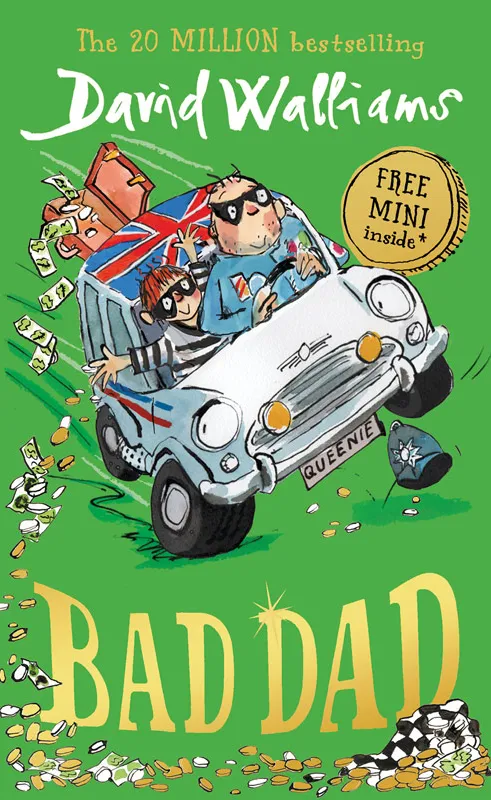
Youth minister, Ed Drew, reviews David Walliams’ bestseller
It was the second-bestselling book of 2017 – only Jamie Oliver beat him!
David Walliams’ recent children’s book, Bad Dad, features a Rolls Royce in a high-speed car chase, a break-in to return stolen cash and a gay female vicar who marries the hero’s aunt.
David Walliams came to the attention of the British public through his work as a comedian. Little Britain, in partnership with Matt Lucas, was his breakthrough sketch show. He is now a children’s publishing phenomenon. In 2017, he was the author of five of the top 20 bestselling books in the UK. That’s out of all books, not just children’s books. He is the author of all of the 2017 top five bestselling children’s novels!
Encouraging kids to read
Walliams started writing his first children’s novel as he finished Little Britain. The last of the Harry Potter novels had been published the year before. Walliams explained that, in comparison to Harry Potter: ‘I wanted to do something different. I thought let’s set something in the real world, with real emotions, that challenges people.’ He has also said: ‘Most of all I want these books to be enjoyed by kids, because I feel like I just want to encourage kids to read.’ What a great goal! He is succeeding. There are a lot of children reading Bad Dad. How could a Christian parent help their child to read it with their eyes open to the world it vividly depicts?
Bad Dad is the story of Frank, a child who loves his car-racing dad very much. His dad is imprisoned for being the getaway driver in a bank robbery. As the title hints, this is a novel exploring the line between right and wrong. Addressing the judge in court towards the end of the story, Frank asks:‘Would a bad dad want to put food on the table for his son? Would a bad dad want to scrape money together to buy his son a present for Christmas?’
Deriding Christians
Frank, the young hero, is depicted as sympathetic and kind. But Walliams is neither sympathetic nor kind to Christians. The vicar is despised by Frank’s dad: ‘Whatever you do, don’t let that blasted woman in!’ Church is an institution to be feared, ‘[Dad] hadn’t been to church since he was a child, and the thought filled him with dread.’ The vicar’s efforts at ministry are seen as pathetic: ‘Every day the vicar would stuff a new leaflet through the letterbox. She would dream up more and more bizarre ways to encourage people to come to church.’ But despite her efforts, Sunday services are invariably empty: ‘Reverend Judith had not been able to conjure up many worshippers, even though it was Fathers’ Day. There was just one old dear sitting halfway back, her faulty hearing aid letting off a high-pitched whistle.’
Christians are portrayed as unpopular and socially awkward, church is pitifully unpopular and heroic people stay well clear of both.
Gay marriage
Walliams presents Frank’s single aunt with pity for her situation: ‘The lady had never been married, nor to Frank’s knowledge ever had a romance. He guessed she hadn’t had many hugs in her life.’ While the aunt acknowledges: ‘My whole life has been ruled by fear. Maybe that is why I’ve never been kissed.’ Eventually in the last pages of the book she marries the female vicar. Celibacy has been presented as sad, pitiful, restricted and loveless, and same-sex marriage as a natural, freeing and fulfilling experience.
Walliams expects the worst of Christians. Raj, the lovable shopkeeper in The Boy in the Dress, observes: ‘You know the irony, Dennis? … Those people who are so quick to judge, be they teachers, or politicians or religious leaders or whatever, are normally up to far worse themselves!’
How will we respond?
Will Christians be as judgmental, as hypocritical and as unloving as Walliams expects us to be? There is an alternative. We can read this book with our children, particularly over-eights, as an opportunity to discuss these issues and opinions that surround us in our modern world. We can take the chance to explain why we choose to be different to Walliams’ characters, while also showing kindness and respect to those who we disagree with.
When we see Aunt Flip’s sad and lonely singleness, we can ask our children about our single friends. How do we care for them? How does our church family love single people? Are they more sad than our married friends?
This might be the first time that we have discussed homosexual marriage and relationships with our children. We might prefer not to. If we don’t, others will. But what do we say?
Tim Keller wrote in The Reason for God: ‘For a love relationship to be healthy there must be a mutual loss of independence … For a Christian, it’s the same with Jesus. The love of Christ constrains. Once you realise how Jesus changed for you and gave himself for you, you aren’t afraid of giving up your freedom and therefore finding your freedom in him.’ We can explain to our children that as Jesus made hard decisions for us, that made his life harder, so we make hard decisions for him that make our lives harder. We choose to live the way he asks us to. It is better for us and for others that we do. Sometimes it is harder. Sometimes it is not how we would choose.
Walliams portrays Christians as odd and the church as pathetic. We can tell our children that many of our churches are almost empty, and some of our brothers and sisters are a little odd – we are all a little odd! But there is more to say. The writer to the Hebrews (10.24-25) encouraged his readers: ‘And let us consider how to stir up one another to love and good works, not neglecting to meet together, as is the habit of some, but encouraging one another, and all the more as you see the Day drawing near.’
We could turn to these verses and ask why it tells us to keep going to church. Some did stop meeting together, but why will we keep going? One day ‘the Day’ will come when Christ returns to bring his friends to Heaven. What will that gathering be like? Will it feel embarrassing? We want him to find us still encouraging one another and meeting together.
Putting it all back together
At the end of this novel, Frank’s father has been released from prison, he has forgiven his mother for walking out on the family, the gangsters are in prison and his aunt is happily married, leaving Frank to say to his father: ‘I’ve got nothing left to wish for. All I ever wanted, all I ever needed, was you. My dad.’
Walliams, in this fictional novel, finishes the story with everything put back together. That’s how children’s novels should finish. Life rarely reflects these fictional novels. Parents would do well to turn straight to Jesus, the one who really can put everything back together. He is the one who came for the poor, the imprisoned and the hurting. Dennis would identify with all of these. This is no fiction – there will be a day when many children who live under horrendous burdens will know total freedom, through faith in Christ.
When faced with the next wildly popular children’s author, let us not leave his books unread. David Walliams’ books allow our children to hear the voices of society in language they hear all around them. Let us offer them biblical answers to Walliams’ aggressive agenda in gentle language that they can understand.