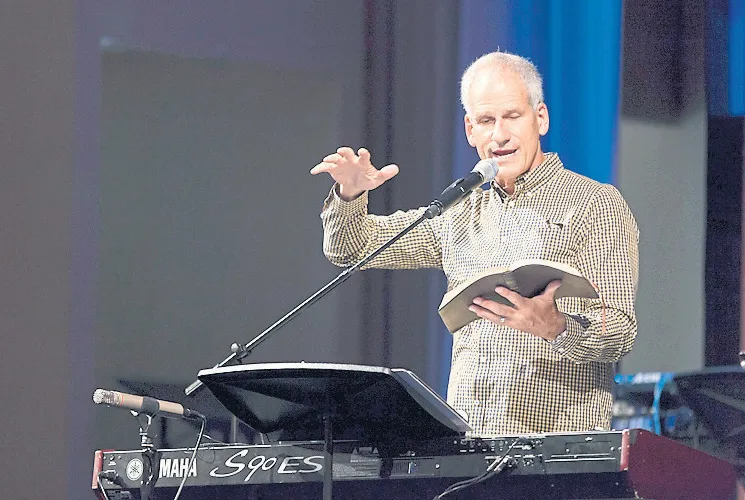
With the True Worshippers Conference in Bristol in September, en fired some questions at Bob Kauflin
en: Tell us what the Sovereign Grace group of churches stand for and something of your own background in music.
BK: Sovereign Grace is a family of churches based primarily in the United States, but with congregations in the UK, Australia, Mexico, Canada and South Korea. We’ve existed for about 35 years, which is how long I’ve been involved. We’re connected primarily through relationships, a statement of faith, and seven shared values. Among other things, those values include Reformed theology, gospel-centered doctrine and preaching, a continuationist pneumatology, complemen-tarian leadership in the home and church, and a commitment to church planting.
While we are a family of churches, we thank God for every church or denomination that boldly seeks to proclaim God’s Word, preach the gospel and live out the implications of both.
I studied classical piano growing up and majored in piano performance at Temple University in Philadelphia. After that I was part of the Christian band GLAD for eight years and have been leading music in the church since 1976 and pastoring since 1985.
en: How did your connections with the UK come about?
BK: Our primary connection is through Grace Church Bristol, the Sovereign Grace church led by my good friends Nathan Smith and Peter Bowley. Additionally, I’ve had the joy through the years of getting to know UK leaders and songwriters like Tim Chester, Mike Reeves, Dave Gobbett, Stuart Townend, Matt Searles and others. I should also add that my wife, Julie, was born in Walton-on-Thames, so I have a strong personal connection to the UK!
en: The conference is titled ‘True Worship’.How do you define worship? And what are the myths about worship?
BK:Broadly speaking, worship is the act of giving ourselves to love, pursue and obey something or someone. More specifically, Christian worship is the enabled response of God’s redeemed people to his self-revelation that exalts God’s glory in Christ in our minds, affections and wills in the power of the Holy Spirit. More simply put, worship is using everything we are to magnify everything God has revealed himself to be in Christ. Our worship is most evident in our expressions of love, adoration, gratefulness and obedience.
Myths about worship abound. The most common is that worship is merely music and singing. Music is a part of worship, but it was never meant to be the heart of worship. Also, we think worship begins with us, when in reality, we can’t worship God apart from his revealing himself to us and enabling us to give him glory. That misconception causes us to think of worship primarily as the things we do (singing, praying, serving, preaching, giving, etc.), rather than as our response to what God has done through the substitution-ary sacrifice of his Son. We also tend to think of worship as acts or moments, when the greater emphasis in Scripture is an ongoing attitude of honour, reverence and service to God (Romans 12.1-2; Hebrews 13.15-16).
en: You are based in the US. What can the UK church learn from the US church and vice versa?
BK: Interacting with Christians from other cultures helps us see more clearly where our practices and understanding are influenced more by our culture than our Bibles. And that’s a very good thing. But this question is difficult to answer because the ‘US church’ includes a wide assortment.
Generally speaking, I hope that UK churches can benefit from the wealth of American resources and our practice of the-ologically informed expressiveness (as opposed to American emotionalism). Among other things, I think the American church can learn much from the faithful expository preaching of the UK church, its critical eye towards sensationalism and a celebrity culture, and a church history that dwarfs what we’ve had in America.
en: What would you see as the strengths and weaknesses of contemporary worship?
BK: The contemporary worship phenomenon has benefited the church in many ways. We have thousands of new songs. Many of those songs communicate in more culturally relevant, musically accessible, lyrically memorable ways that enable people to ‘feel the truth’ more readily. Tens of thousands of young musicians and songwriters are eagerly developing their gifts to serve their local churches. Thankfully, the recent popular focus on the topic of worship has resulted in an exponential increase in the number of books that explore worship from a scholarly and biblically faithful perspective.
On the downside, worship is often equated almost exclusively with singing. In our gatherings, performance is often valued over participation, instrumental skill over godly character, and musical experiences over truth experiences. The writers of our songs are more often singer-songwriters than pastor-theologians. I think all these effects are a result of the church lacking discernment in determining which parts of our modern music culture are helpful for the church and which are temptations to worldliness.
But in spite of all these negatives, I believe God is behind the rise of new songs for the church, and I’m grateful that we can use modern expressions without abandoning the rich heritage of our past.
en: Do you have any advice / encouragement for smaller churches with less than professional musicians?
BK: Absolutely. One of my burdens is to encourage and equip the significant number of church musicians who volunteer their time each week to serve. Even in America, 80-90% of our congregations have volunteer musicians. Their meetings look nothing like what we often see on YouTube or Instagram, but God can be honoured just as well.
Each Sunday, every church worships God by the same means. We have the Word of God which discerns the thoughts and intentions of the heart and performs its work in those who believe (Hebrews 4.12; 1 Thessalonians 2.13). We have the gospel of Jesus Christ, which is the power of God to save (Romans 1.16). We have the Holy Spirit who brings conviction of sin and empowers the members of the church with gifts for the glory of Christ (John 16.8; 1 Corinthians 12.7-11). Whether our church has 50 or 5,000 people in attendance, we have every reason to believe our meetings can be life-transforming encounters with the living God as we gather in his presence!
en: If there was one thing you would like to highlight about why go to the conference, what would it be?
BK: First, I should mention that this conference is actually two conferences. On Thursday, 22 September, the day before True Worshippers, we’re hosting ‘Entrusted with the Gospel’, a one-day conference to encourage and equip pastors and church leaders. This will be the third event Sovereign Grace has sponsored in the UK, the first two being the WorshipGod conferences in Bath. One of the singular benefits of our times together has been the opportunity to fellowship with, learn from and encourage like-minded church leaders who are seeking to serve their churches faithfully. I don’t know of any leader who can’t benefit from concentrated time reflecting with others on how we can exalt Christ more effectively and joyfully in our local churches. In addition, you’ll have the opportunity to hear from two of my long-time friends, C.J. Mahaney, author of The Cross Centered Life and my current pastor, Jeff Purswell, dean of the Sovereign Grace Pastors College.
en: What can our readers be praying for you personally?
BK: At this season of my life my greatest concern is that I use my time wisely. I have many opportunities and all of them seem like good ones! My first commitment is to my local church, Sovereign Grace Church of Louisville, and the broader family of churches in Sovereign Grace. But God continues to give me the privilege of serving in other contexts. I don’t want to do more or less than what he has gifted and called me to do. That means saying no to opportunities that on the surface seem reasonable and good. But doing them can keep me from fulfilling other, more strategic, commitments. And as always, I appreciate prayers that I honour Christ in my roles as a husband to Julie, a father to my children, and a grandfather to their kids. Thank you for asking!
I’m greatly anticipating fellowshipping again with brothers and sisters from the UK as we join together in proclaiming a Saviour whose glories know no measure.