
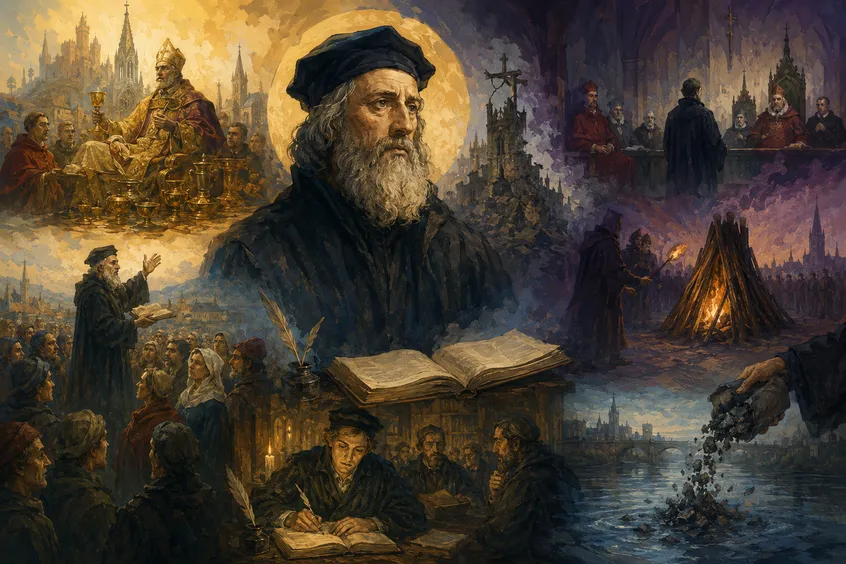
Have you ever wondered why heretics were burned in England during the 15th and 16th centuries? We can thank John Wycliffe for that. He is probably England’s greatest rebel, having a far larger impact on society than most other possible claimants to the title like the quasi-mythical Robin Hood or anti-Norman Hereward the Wake.
Wycliffe’s writings about the abuses of the Church, its hypocrisy and misuse of power, shocked the nation and the king to such an extent that a new law was written into the statute books: De heretico comburendo.
The law banned unlicensed preaching and the teaching of any doctrine contrary to the Catholic faith. If you were suspected of this crime, you were required to hand in any heretical books and writings within 40 days. Refusal to comply or recant meant you could be handed to secular authorities for burning, as William Sawtrey was in 1401.
This is all because of John Wycliffe, who died in 1384, but whose writings and ideas lived on. He touched a real nerve because, 30 years after his death, the Council of Constance decreed that Wycliffe’s bones should be dug up, burned and thrown in a river. That’s not the kind of splash he would have chosen to make at the start of his academic career, but that was his lot.
John Wycliffe
Wycliffe was a Yorkshireman who went to Oxford as a teenager in the early days of the university. He rose through the academic world to become Master of Balliol College, writing long and difficult Latin treatises which are still not widely read today. But these works had an enormous impact, not least because of the times at which they were written. The 14th century was an age of mayhem and catastrophe in England. There was a serious famine in the 1320s, the Black Death in the middle of the century, the Hundred Years’ War (which drained England financially), and finally the Peasants’ Revolt in 1381 resulting in the execution of the Archbishop of Canterbury, Simon Sudbury.
Sudbury’s successor, Courtenay, did not take kindly to Wycliffe’s teachings, which many partially blamed for the uprising. Wycliffe was duly summoned to a synod in Blackfriars so his teachings could be examined – and declared heretical or erroneous. By this stage, Wycliffe was too sick to attend, but he had powerful enemies in the Church.
The medieval Church
And this was a problem since the Church sat at the centre of everything – because it was so wealthy, politically powerful, and deeply entangled with the state. This, said Wycliffe, was part of the problem. One thing he relentlessly criticised was the immense wealth of the Church.
The medieval Church had accumulated enormous riches over centuries: land, rents, and influence. Wycliffe looked at all this and thought something was off. Christ, the King of kings, had not lived like a prince. So why should bishops and clergy?
The Church argued that those in a “state of grace” had been entrusted by God with wealth and authority. Wycliffe turned the argument upside down. If the Church was obsessed with money, perhaps that proved it was not in a state of grace at all.
Wycliffe was appealing to Scripture, which is fine if you know what it says, and that was the second thing; Wycliffe thought that ordinary people should know what the Bible said. That sounds obvious now, but in Wycliffe’s world, the Bible existed almost exclusively in Latin and was handwritten, expensive, and inaccessible. Wycliffe constantly appealed to Scripture, and his followers became associated with English translations of the Bible. This is over a century before Tyndale came along with his translation.
Scripture
Naturally, the authorities hated this idea. Ordinary people, they believed, could not be trusted with Scripture. They would misunderstand it, start strange sects, and undermine the authority of the Church.
Wycliffe, however, thought that was pretty rich coming from the Church, which had become corrupt, spiritually lazy and had undermined its own authority. He even argued that the Black Death was not God’s judgement on ordinary sinners, but on a corrupt Church. Ouch.
But the thing that really condemned him was the central doctrine of the medieval church: transubstantiation, the doctrine that, during the Mass, the bread literally became the body of Christ. It had been agreed in 1215 by a Lateran Council and, by Wycliffe’s time, had become central to the authority of the medieval priesthood. Wycliffe was a realist, not a nominalist (don’t ask). He said the bread remained bread, although Christ was present. (I said, don’t ask). In the 14th century, this was dynamite.
Wycliffe’s ideas never fully went away and the Lollards, followers of Wycliffe’s teaching, were burned throughout the 15th century – although Lollardy was not directly responsible for the Reformation, which came from a providential dynastic oddity and ideas from the continent.
But what was the origin of those ideas?
Wycliffe’s ideas had spread into Europe and were taken up by Jan Hus in Bohemia, who was eventually burned at the Council of Constance, which condemned Wycliffe. Martin Luther later read Hus and admitted at the Leipzig Disputation in 1519 that he was a Hussite. Lutheranism then returned to Cambridge and, from there, into the bones of England.
And yet Wycliffe himself is mostly forgotten. Perhaps that is because he sits awkwardly between worlds. He was not fully Protestant. A proto-Protestant? He is sometimes called the “Morning Star of the Reformation,” but he still believed many traditional medieval doctrines.
But Wycliffe questioned things people thought unquestionable: the wealth of the Church, the control of Scripture, and the authority of priests. That was enough to terrify the medieval Church. Which is why, decades after his death, they dug him up and burned his bones.
In today’s tumultuous times, we would do well to learn from Wycliffe, his learning and, crucially, the courage of his followers who paid the ultimate price for sound doctrine.
To watch a half-hour video about John Wycliffe on James' YouTube channel, visit: youtu.be/wIa0Ln9-Dx8


The liberty of exclusivity: Choice, freedom and Jesus
I was born in the mid-1970s when there were three television channels in the UK: BBC1, BBC2 and ITV. That …