
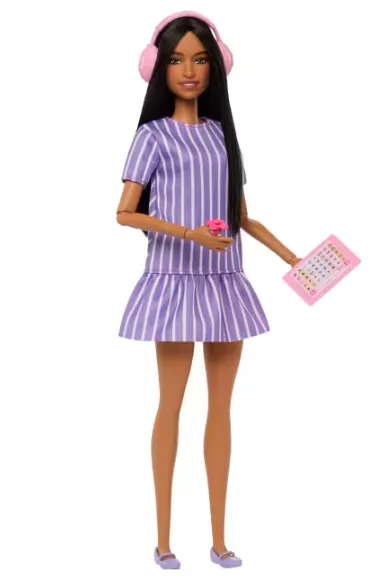
Mattel has created an "Autistic Barbie."
The doll was launched on 11 January, but is already receiving very polarised reviews.
To quote Mattel’s website announcement, the doll has very specific features: “Body: The autistic Barbie doll features elbow and wrist articulation, enabling stimming, hand flapping, and other hand gestures that some members of the autistic community use to process sensory information or express excitement.
"Eye Gaze: The doll is designed with an eye gaze shifted slightly to the side, which reflects how some members of the autistic community may avoid direct eye contact.
"Accessories: Each doll comes with a pink finger clip fidget spinner, noise-cancelling headphones and a tablet. Fidget Spinner: The doll holds a pink finger clip fidget spinner that actually spins, offering a sensory outlet that can help reduce stress and improve focus. Headphones: Pink noise-cancelling headphones rest on top of the doll’s head as a helpful and fashionable accessory that reduces sensory overload by blocking out background noise. Tablet: A pink tablet showing symbol-based Augmentative and Alternative Communication apps (AAC) on its screen serves as a tool to help with everyday communication.
"Sensory-Sensitive Fashions: The doll wears a loose-fitting, purple pinstripe A-line dress with short sleeves and a flowy skirt that provides less fabric-to-skin contact. Purple shoes complete the outfit, with flat soles to promote stability and ease of movement.”
Mattel was advised by an American autism charity to try to broadly represent autism.
What does autism 'look' like?
Autism doesn’t have a "look." Most of the time you wouldn’t even know if a person has autism!
As it’s often said, autism is a very wide spectrum, from those who have very high-support needs, through to those who have very few. It was always going to be hard for Mattel to represent this huge spectrum.
Feedback from many autism groups and autistic people shows the doll to be marmite - you either love it or hate it and there is very little middle ground.
The loudest voices from the "hate it" side say either: “I’m not like that and I don’t want this caricature of autism representing me.” Or: “This doesn’t realistically represent the very high support needs of my child.” The latter often give a strong description of their child’s needs.
The "love it" camp comes from all ages, with many autistic girls saying: “At last, something that represents me.”
Response
Watching the feedback roll in is interesting. The discussion around the doll being "too autistic" or not representing the high-support needs shows that the doll has hit the middle ground.
I’ve often heard it said about contentious output, that if feedback is half and half good and bad, then you’ve done well by hitting the middle ground.
This doll is not designed to represent all autism, just like "Wheelchair Barbie" doesn’t represent all wheelchair users. I have a Barbie who uses a wheelchair and I could pick holes in how badly fitting the old-fashioned-looking wheelchair is; but it’s not about detail, it’s about representation.
It’s about shouting to the world that "we exist."
It’s about making us visible.
It’s the same with "Autistic Barbie." Aside from the fact it needs to sell and pay its way, this is about recognisable representation. A lot of the fine detail of this doll is representative, but not all are represented by it - not all use a communication app on a tablet device, not all use a fiddle toy.
Some of the worry is about how the general public sees those with low-support needs. Autistic people already receive many "but you don’t look autistic" type comments and only see those with high-support needs as "real" autism. But on the other side of the debate, families who deal with the very high needs of their own child often feel erased with the changing language around neurodivergence.
So I can see clearly what all those in the debate are saying.
What do you think?




How to support a church friend facing disability
Last month, I wrote about supporting through the onset of disability; I wanted to continue that theme for a while. …