
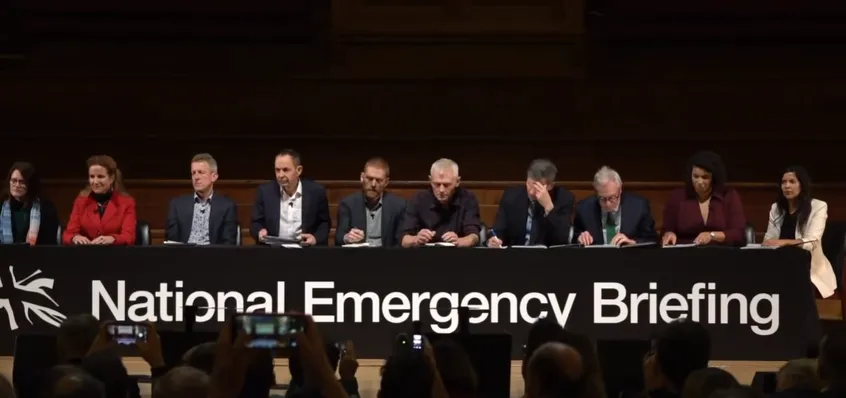
The tail-end of last year saw over 1,200 politicians and leaders from business, faith, culture, sport and the media gather at Westminster Central Hall for the National Emergency Briefing on the climate and nature crisis.
Ten of the UK’s leading experts – including leading climate scientists at top British universities (Oxford, Manchester, Exeter, Newcastle, Lancaster and UCL), many of them global leaders in their fields, and a former lieutenant-general in the British army – briefed them on the latest implications for health, food, national security and the economy. (You can find recordings of the event at www.nebriefing.org/) What, I wondered as I watched, might be an Evangelical response?
These are certainly serious people, talking of serious matters. And all extremely concerned at the way things are going. In some ways, though, there was little new in the briefing – a similar briefing was given four years ago to the then Prime Minister, leading to his “one minute to midnight” speech ahead of COP26 in Glasgow. The briefing simply reflected what has long been the global scientific consensus, and the need to act too has long been urgent. One thing though was new: the change of focus. The briefing was not on tropical coral reefs, nor polar bears, nor people living in Africa and Asia, but on us here in UK.
Delegates heard about the temperature rises we’re facing in the next 20, 50, 100 years. They heard how climate change is now recognised by the British military and NATO as a “threat multiplier”, “worsening existing risks and creating entirely new ones” – think food systems, migration patterns, humanitarian emergencies. They also heard how it affects UK food security. And perhaps most worryingly how changes to Atlantic Ocean currents are “more likely than not” to lead to a fundamental shift in the UK climate – away from the generally mild weather we know (and love?), to long freezing winters and boiling summers. The UK, it turns out, is not immune to climate change.
So that’s the new thing: spotting that our politicians may not be too bothered about wildlife or people in other countries (or believe the electorate aren’t) the organisers appealed instead to two things: national interest and fear.
But that’s not where we as Evangelicals start, is it? We start from the cross of Christ, His blood shed for the reconciliation of us humans and all creation. We start from the resurrection, the beginning of the renewal of all things. From the restoration of our original creation-mandate. From love for our neighbour, the beaten, the bruised, the imperilled, whether near or far. From a vision of the world made new. These are distinctively Evangelical foundations for a response.
And as to our response? It might be tempting – in the face of an uncertain future – to make for the lifeboats, to abandon ship. Too often we have heard and perhaps heeded that misguided call. The true Evangelical response though is to remain at our posts, working not in mutinous rebellion (nor, just as bad, reclining as passengers on a cruise-liner), but as redeemed crew awaiting the return of our true captain – and calling on our mutinous shipmates to do the same. Working, in other words, for the good of our neighbour and the flourishing of the earth, in the sure knowledge that one day, in the twinkling of an eye, the whole world will be restored.
In truth the changes we need, if we are to avoid the ugly future we glimpsed in the briefing, are well-known. I’ve written about this previously in en (May 2025). We have all we need. The changes, on the one hand, are not that onerous and, on the other, are actually hugely positive in lots of ways. Isn’t the Evangelical response then to find ourselves among the early-adopters, those working for the flourishing of creation, those urging our leaders to act for the good of the world? Isn’t this what our society so desperately needs? Not a National Emergency Briefing, but to see the people of the creator-redeemer God living and working in a way that authentically anticipates the day when He makes all things new?




I'm a Christian, and I'm Green - here's why
en does not support any one particular party. However, we are interested in evangelicals within each of our political …