
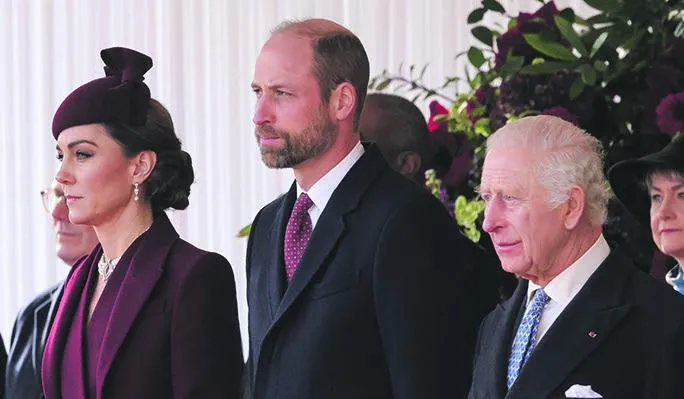
Recently, King Charles hosted a reception at Buckingham Palace for cancer charities and issued what was described as a “heartfelt message” to fellow cancer sufferers. He spoke of the “daunting and at times frightening experience” for cancer sufferers and their loved ones.
The Royal Family has been touched with cancer in recent years, with both the King and the Princess of Wales undergoing treatment which has mercifully proved to be successful. They have allowed a far greater measure of openness with the public about their diagnosis and treatment than was the case when Queen Elizabeth II was on the throne and a greater privacy and distance was maintained.
There is no doubt that the public has taken the King to their hearts because of his illness, and many have been helped and encouraged to know that the monarch is suffering in the same way that they are. It has made him more human and has enabled him to connect with them and for his words of encouragement to cancer sufferers to come with genuine authenticity and sympathy. He said that his experience of living with cancer had shown that “the darkest moments of illness can be illuminated by the greatest compassion.”
There is no doubt that we warm to a monarch who genuinely understands the life we experience, with all its challenges and difficulties, and not just a monarch who is aloof and removed from them. Whilst we might want a monarch with the power to alleviate our suffering rather than merely share in it, history shows that monarchs who did enjoy absolute power were rarely compassionate towards their subjects and, in many cases, exploited and oppressed them. We might think of Louis XVI enjoying life at Versailles whilst his people starved, or of Tsar Nicholls II who lacked empathy with his people. A king with absolute power but no compassion will likely be self-serving, and overthrown rather than loved and served.
This is why it is such an encouragement that the Scriptures assure us that God is sovereign and all-powerful but at the same time compassionate and able to sympathise with our suffering and struggles. Unlike King Charles, He is not just a constitutional figurehead who has no power to act on His own, but He is able to save and rescue His people from their suffering. He can heal, forgive and resurrect. He chooses to act for the good of His people because He has compassion for us and our weaknesses. Throughout the Old Testament, God repeatedly reveals Himself as the gracious and compassionate God, and this is the basis for His people’s prayers and confident hope that He will keep His covenant promises to them.
The New Testament reveals the full depths of God’s compassion and understanding. The eternal Son of God takes to Himself a human nature, enters our world, and in that human nature, He experiences human suffering. He is tempted by sin, feels the weight of sin as He willingly becomes sin for us, is forsaken by His Father as He drinks the cup of wrath on the cross, and tastes death for us. Much remains mysterious, but we can say of Christ our King that He is ‘a man of suffering and familiar with pain’ (Isa.53:3). In some incomprehensible way, the second person of the Trinity has experienced our suffering and endured our punishment.
The fact that He has suffered and His openness about His suffering means that He is not aloof, but approachable. He does not just understand our suffering, but His experience of it means that we know He is willing and able to help us in it. Hebrews reminds us that He is our great high priest. He has met our greatest need by removing sin and dying in our place, and is now serving at the right of His Father, supplying us with the grace to stand firm in faith in the midst of suffering. As Hebrews 4:14-16 declares: ‘Therefore, since we have a great high priest who has ascended into heaven, Jesus the Son of God, let us hold firmly to the faith we profess. For we do not have a high priest who is unable to empathise with our weaknesses, but we have one who has been tempted in every way, just as we are – yet he did not sin. Let us then approach God’s throne of grace with confidence, so that we may receive mercy and find grace to help us in our time of need.’
The author of Hebrews wants us to grasp one simple thing. Because Jesus has lived a true human life and suffered in His human nature, body and soul alike, we can come to Him with confidence that He will understand and help. This is the very kind of king we need. In this fallen world marred by sin, we will suffer. We need a king who has the power to save and the compassion to help.
This is the king we have. We are not called to bear suffering with stoicism on our own, nor to trust in an absolute monarch who is aloof and unmoved by our plight. We should instead cry out in prayer to the One who is able to empathise with our experience because He has faced it Himself, and who is able to help us to endure it and bring us safely into His eternal kingdom where there will be no more suffering, pain or death.







Our greatest need is to be filled by the Spirit
Does your church mention Pentecost? Many churches, especially those that do not follow the liturgical year, barely mention it at …