Ok, I’ll admit it: I’m excited for the Barbie Movie.
That’s right: in what promises to be the film of the summer, Mattel’s classic doll is being given the cinema treatment. As I write the soundtrack is already all over the radio. Directed by Greta Gerwig, and starring Margot Robbie as Barbie and Ryan Gosling as Ken, the trailer promises that ‘if you love Barbie, this is for you’, and that ‘if you hate Barbie, this is for you.’ Since that encompasses just about any woman millennial or older, the filmmakers are on to a winner.
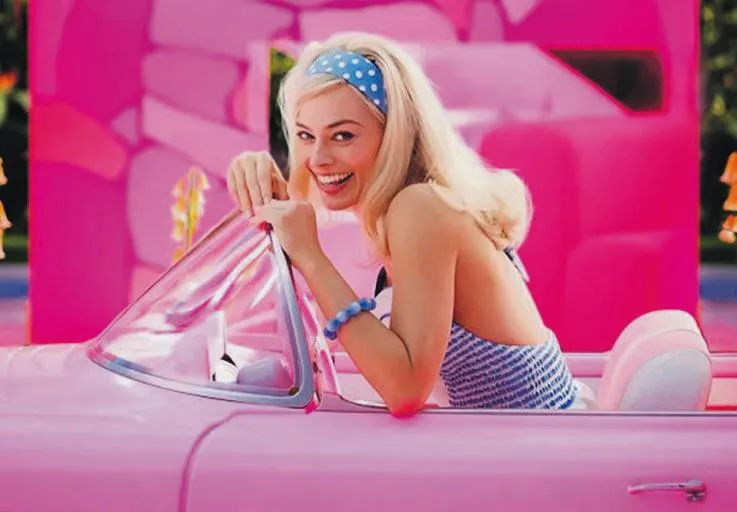
And they clearly know how to play to the audience. The trailer is big on nostalgia factor, with plenty of knowing in-jokes. Opening in a perfectly pink ‘Barbie land,’ it shows Barbie floating down from the top floor of her dream house and into her convertible car, as if carried by an invisible seven-year-old’s hand. In another scene, Ken says to Barbie: ‘I thought I might stay over tonight.’ ‘Why?’ she replies. ‘Cause we’re girlfriend and boyfriend.’ ‘To do what?’ asks Barbie, innocence unfeigned. There’s a cricket-chirping pause before Ken replies: ‘I’m actually not sure.’ (Of course, they miss out the part where your worldly-wise cousin uses the dolls to reveal to you exactly what boyfriends and girlfriends do, more or less – or was that just me?)

But when Barbie starts suffering from intrusive thoughts about death – and, shock horror, flat feet – she must go into the real world to find the answers. Cue capers involving run-ins with the police and suited company executives, before arriving at an as-yet-to-be-revealed moral of the story.
The real-life suits at Mattel must be hoping the film breathes fresh life into a conflicted brand. The blonde-haired, narrow-waisted, long-legged, permanently-stilettoed figures just don’t wash as well in the 2020s as they did in the 1990s – although even Barbie’s signature body shape has been compelled to adapt in recent years.
Yet there’s still an empowerment message to be mined. A series of film posters play on Barbie’s many careers: ‘This Barbie has a Nobel Prize in physics’; ‘This Barbie is a lawyer’; ‘This Barbie is a diplomat’. ‘Barbie is everything,’ says the strapline under Robbie’s main character. And Gosling? ‘He’s just Ken’. As Britannica’s history of Barbie notes, she’s credited ‘with providing an alternative to restrictive 1950s gender roles. Unlike baby dolls, Barbie did not teach nurturing. Outfitted with career paraphernalia, the doll was a model for financial self-sufficiency.’
The film’s teaser trailer pays homage to this story. The camera pans across a wasteland as a narrator says: ‘Since the beginning of time, since the first little girl ever existed, there have been… dolls. But the dolls were always and forever baby dolls.’ Cue shots of drably dressed girls from the 1950s hosting sedate dolly’s tea parties. ‘Until…’ Robbie’s Barbie descends from the sky – glossy and gigantic, like Nebuchadnezzar’s statue – dressed in the iconic swimsuit of Barbie’s original 1959 doll. The girls are transfixed, the music changes tempo, and they cast away their baby dolls, smashing their heads in slow-motion. A year later the contraceptive pill became widely available and being a woman has never been the same since.
And yet, no matter how many high-powered careers Barbie was liberated to have – or how much her body shape morphed to modern mores – there’s a certain irony in the fact that she couldn’t help but underscore the reality of a stubbornly sexed world. She remained a girl’s toy that girls liked playing with in a particularly girl-like way.
Years ago I read an article about a new toy that aimed to get more girls interested in engineering by tying building tasks to characters and stories. Girls don’t typically want to build in the abstract, the founder said: the way to improve their spatial skills was to capitalise on their strong verbal skills, and create stories that would engage their interest. That was certainly the appeal of Barbie for me: not the brushing hair or changing clothes, but the complex storylines that I would spend hours acting out in miniature. And now, two decades later, I would venture to say that it’s not just words and stories in their own right that girls find endlessly fascinating, but ultimately the thing that words create and stories re-create: relationships.
A lot has changed in the way we think about womanhood since Barbie landed in 1959 – so much so that a toy that once appeared as a beacon of liberation now looks much more questionable. At the very least that should give us the humility to recognise that the ideals our culture prizes now are liable to date just as fast. But there remains something fundamental sown into our humanity, that stretches all the way back to Genesis 1: male and female: good, equal, different – in beautiful and mysterious ways that defy our attempts codify them. The world tries its best to suppress these fundamentals (Rom.1:18), but, to borrow an image from Dan Strange’s Plugged In, they’ll keep popping up in surprising ways, like trying to sit on a beachball in the ocean. But for our part, the church can try its best to sit back and marvel.
What stand-up comedy showed me about teaching the Bible
Three weeks, more than 2,000 shows and 2.6 million tickets sold last year. August is the month of the Edinburgh …