
Around the perimeter of Jefferson City Correctional Centre, Missouri, one of North America’s maximum-security prisons, runs what they call a kill fence. It sits between two razor wire fences. It looks innocuous enough until you see the warnings informing you that it carries a lethal voltage. One touch, they say, and it’s lights out.
You have to wonder why it needs the razor wire fencing, let alone the numerous men with machine guns lurking in watchtowers. This seemed to me, as I was ushered through the metal detector, to be quite literally overkill.
As I handed over my phone and other items from my pockets, I tried not to think about the crimes committed by the men I was about to meet. Given the levels of fortifications, they were surely among the most heinous imaginable. They would surely have left multiple victims and their families devastated in life sentences of their own. But what I found inside shattered nearly every assumption I had smuggled in with me.
I was, genuinely, shocked as I spoke to men who had been incarcerated for 30 or 40 years. Many were serving life without parole, which meant they expected to die inside those walls. If ever there were a place designed to produce despair, the Jefferson City Correctional Centre (JCCC) was it. What possible motivation exists to live well in an environment you will never leave? And yet I met man after man who displayed grace, kindness, warmth, and compassion. They seemed to me to be flourishing.
This is attributed to a remarkable vision of the Second Mountain’s Leadership programme, a 22-week initiative run inside the prison in partnership with the Global Leadership Summit, Our Daily Bread and the warden and staff of JCCC. I hadn’t realised it at the time, but in 2019 when I had spoken at the Global Leadership Summit in Willow Creek Chicago about leadership from my experience as a foster father, exhorting people to see those around them as more than the worst thing they have ever done, my words had resonated with a prisoner in Missouri called Bo Cornelius. Bo went on to start Second Mountain and the prison rehabilitation programme that majored on treating both prisoners and custodial staff with grace and dignity.
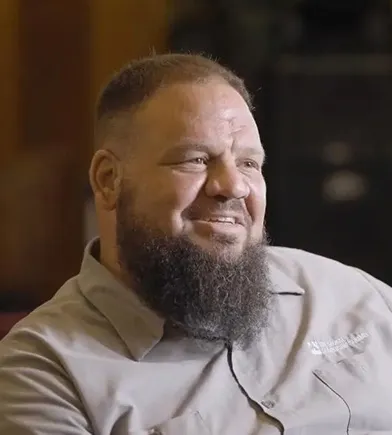
This year I had the privilege of standing alongside Bo, supporting his ambitious vision as he explained it to the 200 people who had gathered in Jefferson County Correctional gym – including wardens from other prisons and members of the Federal Bureau of Prisons from across the USA. They had all come to learn about the programme that was boasting, among other outcomes, a reduction in violent incidents by an unprecedented 40%.
In a place the world had written off, filled with men who had committed unconscionable acts of violence, the grace of the gospel was shining. One young man told me how he had grown up in the foster care system. He was eventually adopted, but the adoption did not protect him from abuse and violence. After one devastating episode, he made some catastrophic choices and murdered two members of his household. He spoke with remorse and regret, and yet also with confidence about the grace and forgiveness of God he had come to experience in prison. Others too told me their conversion and transformation stories.
A culture change in prison where men can find hope and dignity again is possible and I have seen evidence of it not just in the US but here in the UK too, when I visited a remarkable mentoring programme in HMP Isis in London with Lord Michael Hastings.
But there’s still a long way to go, and prayer is much needed for the ministries, chaplains and Christian staff working in prisons to know the blessing and favour of God in the vital work they are doing.
As the UK continues to polarise, there is great opportunity for the grace of God to shine brightly as Christians refuse to allow people to be written off because of what they have done, or because of what has been done to them, or because of where they have come from, or because of how they are perceived by wider society. Thank God that, while we still have breath, we are free to receive the mercy and forgiveness of God, and to lead others to discover that mercy and forgiveness for themselves too.
Krish Kandiah is the author of God Is Stranger: The Surprising Power of Hospitality (Hodder Faith, 2026) and director of the Sanctuary Foundation.



Re-examining the call to love the stranger
In 2015, one image of a three-year-old boy washed up on a beach in Turkey changed the way the world …