As turbulence and uncertainty grip the Middle East, what is Shia Islam – the Muslim ideology which came to power in Iran in 1979, and has dominated it for decades since?
Shia is Islam’s second largest branch, representing 10-15% of Muslims. It originates from a dispute over who should succeed Muhammad after his death in 632. Some thought the next leader of Islam should be chosen by consultation among Muhammad’s companions. This group later became the Sunnis, from “Ahl al-Sunnah” – meaning “people of the tradition.”
Others thought the leadership should stay within Muhammad’s family. They wanted Ali, his cousin and son-in-law to be the next leader. They became known as “Shia,” from “Shi‘at Ali” – meaning “party of Ali.” It is held that Imams, these successors to Muhammad, provide authoritative spiritual and political leadership.
The largest part of Shia Islam, and that which dominates in Iran, is called “Twelver Shiism”. It revolves around the belief that the 12th Imam, Muhammad ibn al-Hasan, born c.870, is somehow still alive but held in “occultation” or a state of concealment. It is believed he will return, inaugurate the end times including the day of judgement, and that Jesus will return then also.
Ruhollah Khomeini, Iran’s first Supreme Leader following the 1979 revolution, dictated that the nation’s head of state, who must be a qualified jurist, should act as a steward and representative of the hidden Imam until he returns, according to Theology in Five on Substack.
The period before the Imam’s return is depicted as featuring injustice and violence, with some depicting conflict in the Middle East as preceding his intervention. Martin Parsons, director of The Lindisfarne Centre for the Study of Christian Persecution, highlighted that such ideology has seen the Iranian regime “dig in” due to their belief that “this is a battle between good and evil”, in which the only “honourable” end point for them is “victory or martyrdom, but not surrender”.
He told en of the lingering dangers: “When the regime are at their weakest, they are also at their most dangerous … So, in at least the short term, things are likely to get worse for Christians in Iran.
“There are no obvious pathways to a transition to a free society. If the bombing removes key government players, there would be a risk of the country descending to being controlled by regional warlords as Iraq did.”
Ramin (name changed for security reasons), an Open Doors expert on Iran, revealed why it is not as easy as simply removing the nation’s supreme leader to bring lasting change to Iran.
“The choice of the former Ayatollah’s son Mojtaba Khamenei, another hardliner, shows no compromise from the regime. I believe Iran’s Christians are still holding onto hope, that things will change for the better,” he said.
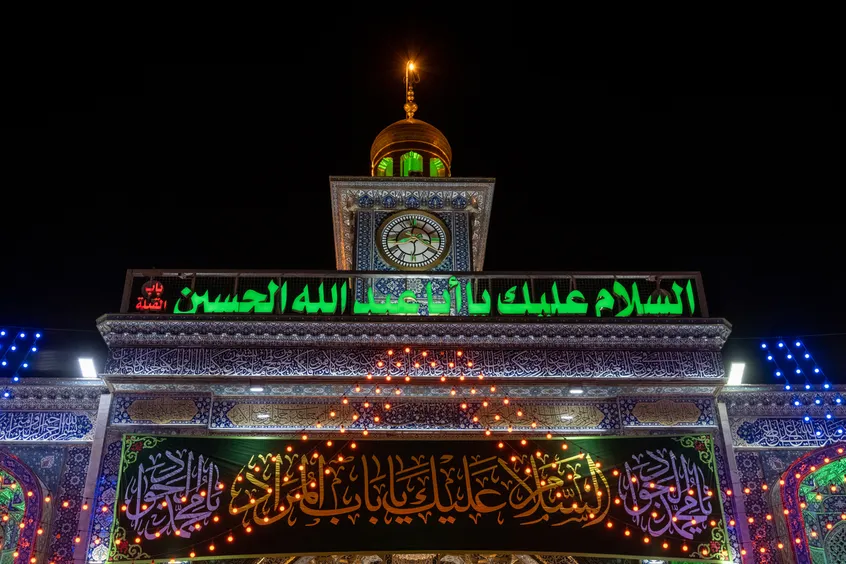
*Full photo caption: The shrine of Imam Hussein ibn Ali (626–680 AD), the third Shia Imam, grandson of Muhammad. Revered as the “Prince of Martyrs,” he is central to Shia identity for his 680 AD martyrdom at the Battle of Karbala.
Jewish believers react to Iranian strikes
Jewish believers have also been reacting to what has been unfolding across the Middle East. A Messianic Jewish man, who wished to be known as Michael, told en that this war was “inevitable” due to Iran’s long-standing desire to destroy Israel and their support of various terrorist proxies, but he expressed hope for Iran’s church if the regime is overthrown.
While Michael stressed that he could not speak for all Jewish followers of Jesus, he believes “many” support the strikes in Iran. He said: “Many, if not all, support the pre-emptive strikes and the war, even though they have reservations about Bibi’s response to 7 October and his handling of the war with Gaza.
“They would acknowledge that Iran and its proxies have been a problem for years. As a community we serve in the army, and many prayers are directed to the safety of those who are serving and for those in the reserves as well. They have had to spend months away from home and family during the war with Gaza and Hezbollah, and are now back in again during this war.”
While Michael expressed concern for the vulnerable impacted by warfare, he also expressed hope for a “huge spiritual tectonic shift in the region”, coming in the form of greater unity between Messianic Jews and the Iranian church.
He said: “The national church has witnessed untold suffering and, with their brothers and sisters in the diaspora, they have been praying for years that the day would finally come when this ‘evil regime’ would fall and they would finally be able to return home.
“At the same time, the Iranian church is known for its rather ‘supernatural’ love for Israel and the Jewish people. Having been involved in discipling over the last ten years, I can personally testify to this.”
LIV Golf uncertainty – good for the game?
Much sporting focus has gone into the end of the calendar’s traditional summer events and the start of the new …