In 2012 during a conference, Onesphore Manirakiza, a leader of a Christian organisation, felt compelled to start training other pastors in Burundi.
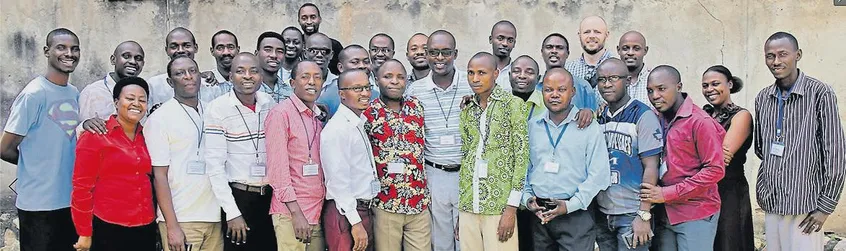
Two years later, a group of six pastors began to meet regularly to share ministerial challenges with Manirakiza. Two years after that, Transforming Burundi began, which aimed to train and coach church leaders with the aim of creating healthier churches. By 2018 Transforming Burundi became the Antioch School – a school which has already trained over 200 church leaders. After leaving the country, a few weeks ago, Russ Bennett (see photo – back row on right), missionary and trainer, reports on the work so far:
When the editor asked me to write this article, I was still living in Burundi completely unaware of the coming pandemic. As a team of seven adults and five children, we were doing ministry as usual. Burundi is a little landlocked country south of Rwanda that has been war-torn, had multiple genocides, and had a major political crisis in 2015 where over 450,000 people left the country to become refugees.
As a team we thought of these refugees many times during our unplanned exit due to Covid-19. Bordering countries began closing, and three out of four airlines that service Burundi closed. So we hurried to book our flights.
When we first booked we had a week to say our goodbyes, pack our stuff, and uproot our lives. However, the week turned into less than four days, because on 20 March we learned the Burundi airport was closing. We scrambled to rebook tickets and boarded the penultimate flight. We weren’t able to say many goodbyes, and because of the scramble, we left everything behind but our carry-ons.
As we boarded the plane, we knew that we, too, ran the risk of becoming Covid-19 refugees in either Kenya or Dubai, depending on other cancellations. We prayed and asked God to get us home. Seventy-four hours later we arrived in Charleston, SC, tired but thankful not to be stranded.
We had planned to leave Burundi in April to serve for a month in Beverley, Yorkshire with a church, and visit family before returning home. God had other plans.
Striving for healthier local churches
Ministry for us in Burundi is to establish local pastors in their context to equip their own leaders instead of sending them elsewhere to be trained. Bible colleges are wonderful, but I believe the local church is responsible for training its own leaders. Bible colleges should be a resource to those churches to empower local elders to train the next generation of leaders.
To help the local church accomplish this task we became members of a Burundian church. Our team translated 15 books in the past 18 months, because Burundians have so few resources in Kirundi. We trained a group of 56 pastors and helped our Burundian teammates (www.antiochafrica.com) build infrastructure to sustain a network of over 250 churches. This required many hours of teaching, preaching, assessing and mobilising local church leaders.
Part of our team has simultaneously partnered with J-Life to do health assessments and increase the capacity of local leaders to help widows and orphans in Bubanza climb out of poverty. The work there is also catalysing a movement of churches that evangelise, expand, establish, and entrust the gospel to others. This work is ongoing despite our exit, but it is not easy.
Burundi, as the second-poorest country in the world, feels an economic crisis faster than anywhere else. More people will die in Burundi from starvation this year than from Covid-19 if the world’s economy doesn’t start churning soon. Despite these challenges, our Burundian teammates remain steadfast in their work. With little testing and an upcoming election, people have to keep working. There is no government bailout coming and very few have money to spare. ‘If you don’t work today you don’t eat tonight,’ is the norm for 10million Burundians.
Yet there is one thing I would want everyone to know about Burundi. Although they have few material possessions, many possess a real relationship with Jesus. They are willing to do whatever it takes to make disciples, plant churches, and send missionaries to the hardest-to-reach places in North Africa. The world may have material possessions and structured bailouts, but these Burundians have the true meaning of life. That is to love the Lord with all your heart, soul, and mind and to love your neighbour as yourself.