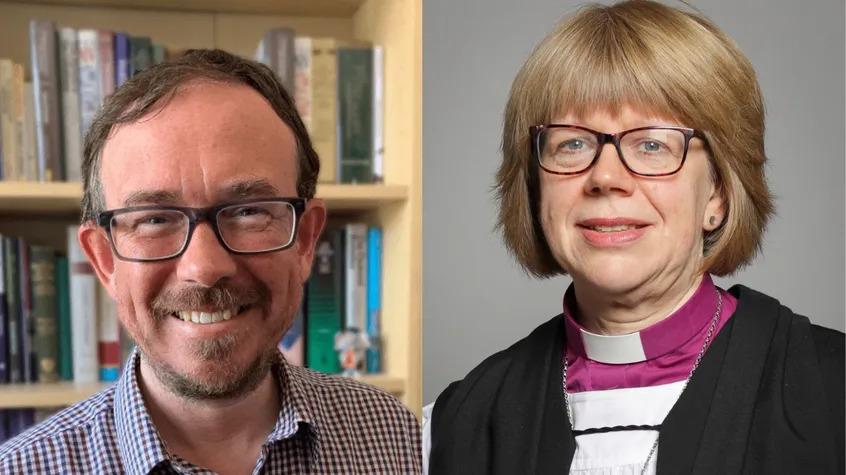
A leading conservative evangelical in the CofE says Sarah Mullally has led the way in an attempt to “institutionally gaslight the entire church.”
In an article published by the Gospel Coalition in the USA, Lee Gatiss, Director of Church Society, writes: “The biggest challenge for the new Archbishop is the crisis of trust and credibility she faces. She has led the way in an attempt to institutionally gaslight the entire church, claiming that she and other revisionist bishops are not changing the doctrine of the church on marriage and sexuality, even while they attempt the most radical change to Church of England teaching and practice for 500 years.
“This has led to the collapse of confidence in Canterbury around the world and a severe split not just in General Synod but in every parish and chapel in the land.”

On 3 October it was announced that Sarah Mullally would be the new Archbishop of Canterbury. Since then, evangelicals around the globe have been reacting to the announcement: there’s been opposition to the liberal views (see below) Mullally holds on a number of issues; complementarians have been objecting to a woman serving in the role; others have been questioning the necessity of bishops altogether.
“While she has opposed assisted suicide, the new Archbishop seems to be pro-choice as well as pro-gay blessings,” Gatiss continues. “She’s not a theologian or known as a gifted preacher. And she may well have certain safeguarding failures to account for on her watch in London according to many observers. All this does not bode well in a post-Welby world, and looks set to lead to further fracturing of the already fragile global communion.”
TGC also published an article by Mark Thompson – Principal of Moore Theological College in Australia and Chair of the Sydney Diocesan Doctrine Commission – in which he describes the Church of England as continuing its “tragic slide into irrelevance” by announcing Mullally’s appointment.
“Anglicans around the world had hoped for the appointment of an orthodox and faithful guardian of the faith who would address the serious decline in England’s established church and its dire standing in the global Anglican Communion,” Thompson writes. “Sadly, those making the appointment have chosen to continue on a decades-long course of theological revisionism, cultural capitulation, and unprecedented division.”
According to Thompson, the Church of England’s recent trajectory has “emptied churches and attracted the condemnation of Anglicans” not just in the UK, but worldwide.
Yet Thompson offers encouragement in his piece as he reminds readers that Christ’s gospel mission doesn’t depend on the Archbishop of Canterbury. “There are many faithful Christians, and many faithful Christian ministries, at work within the Church of England despite one fiasco after another at the top,” Thompson writes. “New churches are being planted. Men and women are being converted. Believers are being strengthened, deepened, and matured in their faith. God’s Word is being clearly preached in many Anglican pulpits across Britain.
“Alongside them, a host of [Biblically] faithful ministries have emerged outside the Church of England’s structures where the challenges of a new age of evangelism are being embraced enthusiastically. That’s why, in a very real sense, the appointment of Mullally as Archbishop of Canterbury is an entire irrelevance.”
Should the CofE pay slavery reparations?
During a recent trip to Ghana, Archbishop of Canterbury Sarah Mullally renewed her commitment to a £100 million reparation fund …