
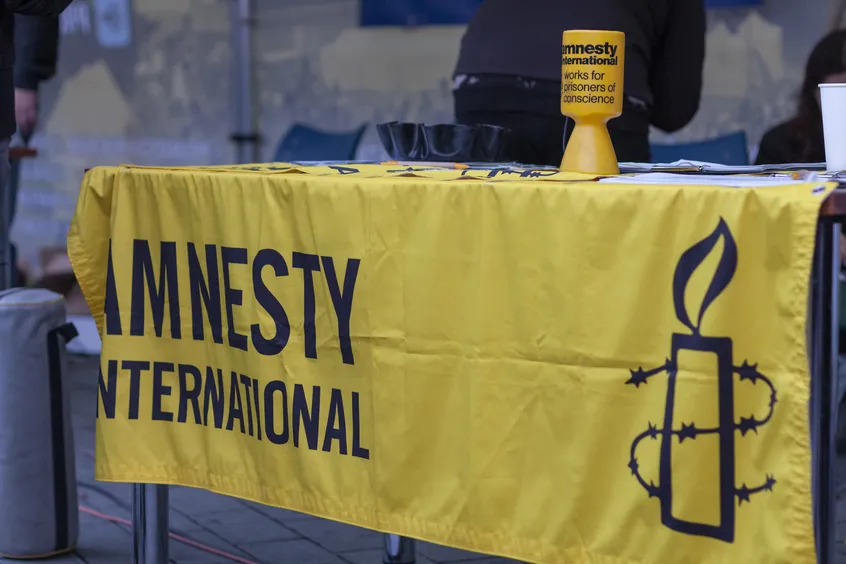
One of the so-called “anti-rights organisations” named in a now-withdrawn report by Amnesty International UK has coordinated a joint letter to the Charity Commission.
Eleven Christian charities signed the letter, put together by Christian legal advocacy group ADF International (UK); it was sent to the Chair of the Charity Commission and copied to the Equality and Human Rights Commission (EHRC). The letter was in response to the now-withdrawn report by Amnesty International UK entitled “A growing threat: the anti-rights movement in the UK” in which several evangelical organisations – including en – were branded “anti-rights organisations”.
Robert Clarke, Director of Advocacy at ADF International, told en: “Amnesty International UK’s ‘anti-rights’ report may have been withdrawn, but the bias behind it hasn’t gone away.
“The report was riddled with sweeping generalisations and glaring inaccuracies, targeting for censorship organisations that have in common only their disagreement with Amnesty. It’s right that it was withdrawn, but the fact remains that it – and similar pieces – was commissioned, written, and published in the first place.
“And that makes it bigger than just one report. It's about whether people of faith can speak freely in public life without being smeared as extremists for holding mainstream Christian convictions. A free society doesn't police belief, and human rights organisations shouldn’t call for censorship. We have asked the Charity Commission to affirm what should be clear: Christian organisations are not a threat to be managed, but partners in pursuing the public good.”
At the time of writing, ADF International (UK) hadn’t yet received a response from the Charity Commission or the EHRC, however they have reportedly acknowledged receiving the letter when asked by other outlets like The Times.
Background
In its now-withdrawn report, Amnesty International UK defined “anti-rights actors” as “formal and informal groups, individuals, private and state actors whose aim is to restrict human rights by undermining human rights protections in law and practice.” Challenging the report’s characterisation of the organisations’ work as “anti-rights” and seeking to “challenge core human rights principles”, the joint letter says: “Several of our organisations exist specifically to protect the fundamental freedoms that have formed the bedrock of democratic society for centuries, have deep roots in Christian thought, and are enshrined in international human rights frameworks.”
The Evangelical Alliance, Affinity, and Christian Action, Research and Education (CARE) are three of the letter’s signatories. CARE’s Director of Communications and Engagement, James Mildred, said at the time of the report’s release and subsequent withdrawal: “It is sad to see how far Amnesty International [has] fallen. This sort of report is such a waste of time, effort and money. Human rights exist because all humanity is made in the image of God. And this starts from the moment of conception. It has been CARE’s privilege to defend the rights of unborn babies, children, women and men. We reject Amnesty’s selective approach to human rights and instead, we advocate on behalf of the most vulnerable in our society”.
Danny Webster, Director of Advocacy at the Evangelical Alliance, told en: “Amnesty International [labels] groups as ‘anti-rights’ to try and shut down legitimate political engagement and cast aspersions on vital policy and campaigning activity. Amnesty International should spend more time supporting freedom of speech and religious expression than trying to shut down, cut off funding and delegitimise vital Christian engagement in public life.”
And Graham Nicholls, Director of Affinity, spoke of the organisation’s “disappointment” at being labelled an “anti-rights actor”. Nicholls told en: “This seems to be because, as part of the normal political discourse, we have expressed our objections to the proposed UK law on so-called ‘[conversion] practices’. We completely reject this unsubstantiated claim. Amnesty [is] known for championing human rights across the world, but in this report, they are wanting to limit the rights of Christians and many other groups from exercising their freedoms of speech, conscience and religion. Affinity and our members are committed to recognising and respecting every human being as a man or [woman] made in God's image with inherent dignity and rights. We do not encourage or condone any coercive, controlling or violent behaviour against anyone, whatever their beliefs or practice. However, we will continue to stand up for the rights of pastors, parents and Christians to have respectful conversations around sexuality and gender precisely because we love our neighbours and we want the best for them.”
For en’s response to being cited in the report, see the print story in our August issue, online as “en responds to Amnesty criticism”.
Lydia works full-time for en as a multimedia journalist; she is also en's audience engagement officer, meaning she creates content for social media, among other things. She has degrees in broadcast journalism and creative writing.






UK universities – a new Dark Age?
I have just read Nigel Biggar’s latest book: The New Dark Age: Why Liberals Must Win the Culture Wars (Polity …