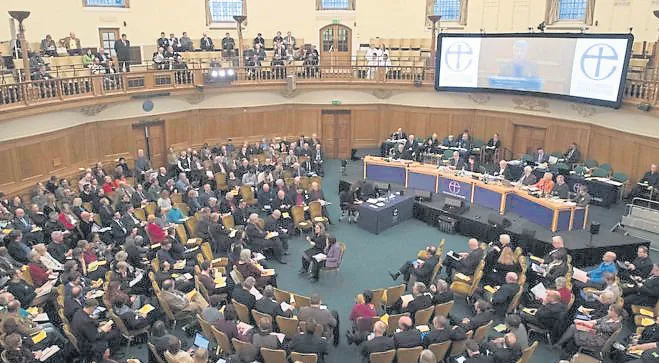
Superficially we did the usual things: passing obscure legal provisions.
For example, there was giving official permission not to have to wear robes at main services (which I realise you all have done faithfully up until now); the valiant effort to put something to do with mission on the agenda. We even had the obligatory ‘current affairs’ motion, this time from the Archbishops following the surprises at the General Election, generally calling for more prayer and appropriate lobbying.
But there were signs that something was amiss early on, when rather non-controversial amendments to the Archbishops’ proposal, which aimed to strengthen statements with regard to biblical and gospel priorities, were lost – but unless the Archbishop had backed them, which he didn’t for reasons of ‘simplicity’, it is hard to get them passed.
Watershed
However, the watershed became apparent from the other seemingly obligatory controversial agenda items. This time, on conversion therapy and transsexual liturgy. The motions themselves were both subtle – we are all against abusive therapies, and we are all for welcoming all people including transsexuals; but the innocuous additions to the proposals were clearly designed to do more. The subtlety is that ‘conversion therapy’ is an ill-defined term – it can mean just specific professional counselling therapies, and it is legitimately debateable how effective they are in actually changing a person’s sexual orientation, but it could include merely praying with someone at their request to diminish an unwanted same-sex attraction.
Trojan horse
There was an excellent amendment put in by Sean Doherty of ‘Living Out’ that achieved what the original motion seemed to ask for, but it was lost – the radical held sway over the Christian. Similarly, in the debate about welcoming transsexuals in church, the Trojan horse there was in a request for liturgy to mark a person’s transition, because, as was said repeatedly, framing the debate: ‘The Church does the work of God through liturgy’! Again, a reasonable amendment, giving clarity to the nuances, was rejected; and although the final motion only actually asks the House of Bishops to consider a new liturgy and the Archbishop of York implied they probably wouldn’t do it, he ended the debate asking for a strong support for the motion, which was received – including the significant milestone of a more than two-thirds majority in each house, which is the bar that has to be met to change doctrine in future.
So why a watershed?
1. Broken EGGS. In each of the controversial debates the Evangelical Group on General Synod (EGGS) gave a clear and strong support for the main amendments to each motion, and clearly lost. The illusion of a gradual evangelical ascendency in synod was shown to be far weaker than people realised. The evangelical concerns about biblical sexuality are no longer held by the ‘middle ground’ of synod any more.
2. Story theology. The new norm for syn-odical debate on controversial matters has become the telling of stories – especially the personal and painful ones. Who would not be moved when told in the transgender debate: ‘Synod, please vote for this now. Don’t delay it, or my friend may not be around for when you finally do it.’
There was little or no theological reflection on the issues. There was very little contribution from the bishops either, and on both occasions the Archbishop of York took the last word to push the original motions through, which is a powerful influence on the ‘non-aligned middle’. References to the Bible, or even to non-politically-correct research, were received awkwardly and mocked on the Twittersphere. The story we are telling now in synod is ‘Inclusion’, everyone is welcome!
3. Shifted middle. In previous synods, the non-aligned middle, the roughly one third of synod who don’t self-identify as either conservative or radical, could usually be relied on to be socially conservative, to be slow to bow to the pressures of political correctness. No longer! It was clear that an unqualified inclusion agenda is now seen as the mainstream. Ten years ago, the LGBTI lobbyists were clearly only a vocal minority; today, if you speak out for the previously received biblical understandings, you are made to feel like the minority. The radicals have the confidence that their stories now resonate with more people; conservatives speak with the fear that disagreement on the sexuality issues for theological reasons will be heard as whichever phobia it can be labelled as.
4. Episcopal paralysis. After the clergy refused to take note of the bishop’s report last February, this session left the bishops staying really quiet, with the exception of the more vocal liberal bishops and the interventions of the Archbishop of York. On key theological issues they listened and didn’t lead.
What are we to make of it all?
1. Hear the wake-up call. The gradual ascendency of our culture’s values in the church is not a surprise, it has long been expected. But the wake-up call is not for us to teach biblical truth and ethics to our evangelical churches, in theory we have been doing that. The wake-up call is that those basic biblical truths desperately need to be taught to the vast number of Christians who are largely in middle-of-the-road parishes and who are now more swayed by culture than their Christian traditions. It is a call to seek a new Reformation. When Protestant truth took root against prevailing Catholicism it took much sacrifice, wisdom and grace. It took a ministry ready to serve the flock of Christ outside of their comfort zone. It took leaders ready to suffer for truth so that the gospel could be heard across the nation and not just in the churches that already accepted it.
2. Help the faithful. Now, more than ever, we need to learn to support one another in gospel work in the Church of England. That means more than sharing in conferences. It will have to mean sharing our lives, praying personally and accountably together, standing with each other under the personal pressure that will only increase. I find the gruelling experience of General Synod is only survivable when you have people around you, praying with and for you, sharing the recovery time together. Those sorts of relationships are even more necessary in the more isolated experience of parochial ministry.
3. Hope in the Lord. My final reflection of being at synod is that the Lord has confronted us with the obvious truth that politics and strategy will not change the Church of England. That isn’t a call to get out of the Church of England and leave the flock to the wolves – that is not good shepherding; rather the good shepherd lays down his life for the sheep, which is the calling of his under-shepherds too. The battles of synod are not all lost, they must still be fought by the faithful, however painful and draining it will be. But the battle for our future is already won, because the Lord will judge his people and one day purge us from every rebellion, sin and unbelief and make us wholly holy to him.
So it may be that we are at a watershed; but the thing about watersheds is that it could go either way! And in the spiritual battle ahead, what are we called to do in all the spiritual armour of God? Not to win battles, they are won already, but we are just to stand!
Revd Dr Rob Munro is rector of St Mary’s Cheadle and a member of General Synod.