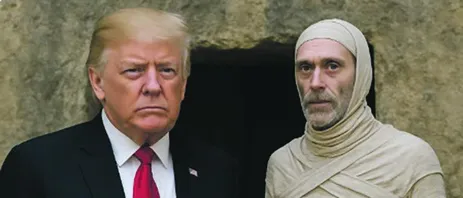
President Lazarus? Understanding US politics

Tony Bennett
Date posted: 22 May 2025
Having spent a lifetime teaching and writing about American politics, I’m often asked this question by bemused church friends: “Why did 82% of white evangelical men vote for Donald Trump in 2024?” And the first thing that I want them to understand is that both they and those American voters are using the word “evangelical” to mean two different things.
My friends use the word to refer to something spiritual centring on the gospel of our Lord Jesus Christ concerning man’s sinfulness, Christ’s atoning sacrifice on the cross, the empowering of the Holy Spirit to live God-honouring lives, and the need to preach that gospel to those as yet unsaved.
Politics USA
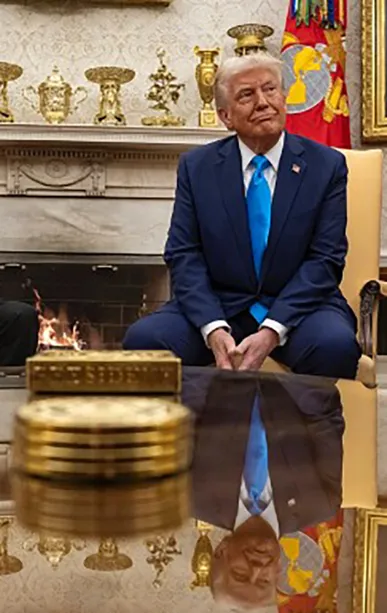
Donald Trump: An imperial president?
Tony Bennett
Date posted: 2 Dec 2025
The term “the imperial presidency” gained popularity in the USA in the early 1970s as a consequence of a book of that title by the historian Arthur Schlesinger.
Schlesinger charted what he saw as the abuse of power by successive presidents, most especially by Johnson (1963–69) and Nixon (1969–74). The presidency, claimed Schlesinger, had come to resemble more an imperial court than the office envisaged by the Founding Fathers back in the 1780s.
Comment USA
Prayer in schools?
Tony Bennett
Date posted: 26 Aug 2026
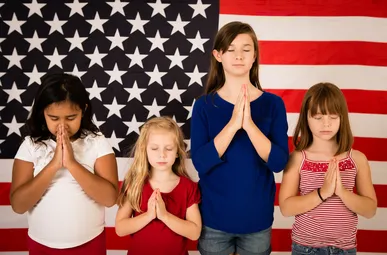
When I attended state schools in Derby from the mid-1950s to the late-1960s, every school day began with an act of Christian worship which included a hymn, a Bible reading, and prayers always concluding with the Lord’s Prayer. All this was a requirement of the 1944 Education Act. I gather things are somewhat different today. Most British schools don’t feel comfortable any more “doing God”, let alone Jesus.
That’s the reverse of what’s happened in the USA. It’s all very different over there where such things are decided not by legislation but by the Constitution as interpreted by the US Supreme Court. Let’s start with the Constitution. The First Amendment to the Constitution states that “Congress shall make no law respecting the establishment of religion.” From the 1960s through to 2000, the Supreme Court interpreted that prohibition on a nationally-prescribed religion to declare unconstitutional a host of Christian practices in public (i.e. state-run) schools.
Should UK Christians go to Franklin Graham’s rallies?
Tony Bennett
Date posted: 2 Jul 2026
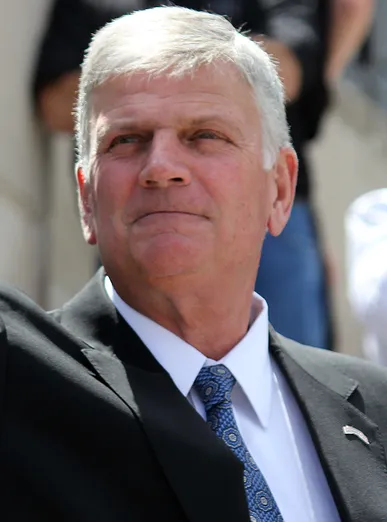
Charles Colson was a senior member of President Nixon’s White House Staff who was sentenced to prison for his role in the Watergate cover-up. But having come to saving faith in Christ, he tells in his autobiography of what he witnessed when he would bring visitors to meet Nixon.
Colson would gather guests in a room near the Oval Office, where they would talk about what they were going to tell the President when they were face to face with him. ‘But it was always the same,’ Colson writes. ‘In the reception room they would rehearse their angry lines.’ But once they were in the Oval Office, ‘it was as if they’d suddenly sniffed some intoxicating fragrance. For invariably, the lions of the waiting room became the meek lambs of the Oval Office. And none were more cowardly than the religious leaders.’

Politics USA
Trump and 'the most important issue': Immigration
Tony Bennett
Date posted: 23 Jun 2025
Rather like studying Scripture, context is so important.
In 2015, having glided down that gold escalator in Trump Tower in New York to announce his first presidential bid, Donald Trump was not a minute into the speech when he delivered this broadside against immigrants: “When Mexico sends its people, they’re not sending their best. They’re sending people that have lots of problems … They’re bringing drugs. They’re bringing crime. They’re rapists.”

Prayer in schools?
When I attended state schools in Derby from the mid-1950s to the late-1960s, every school day began with an act of Christian worship which included a hymn, a Bible reading, and prayers always concluding with the Lord’s Prayer. All this was a requirement of the 1944 Education Act. I gather things are somewhat different today. Most British schools don’t feel comfortable any more “doing God”, let alone Jesus.
That’s the reverse of what’s happened in the USA. It’s all very different over there where such things are decided not by legislation but by the Constitution as interpreted by the US Supreme Court. Let’s start with the Constitution. The First Amendment to the Constitution states that “Congress shall make no law respecting the establishment of religion.” From the 1960s through to 2000, the Supreme Court interpreted that prohibition on a nationally-prescribed religion to declare unconstitutional a host of Christian practices in public (i.e. state-run) schools.