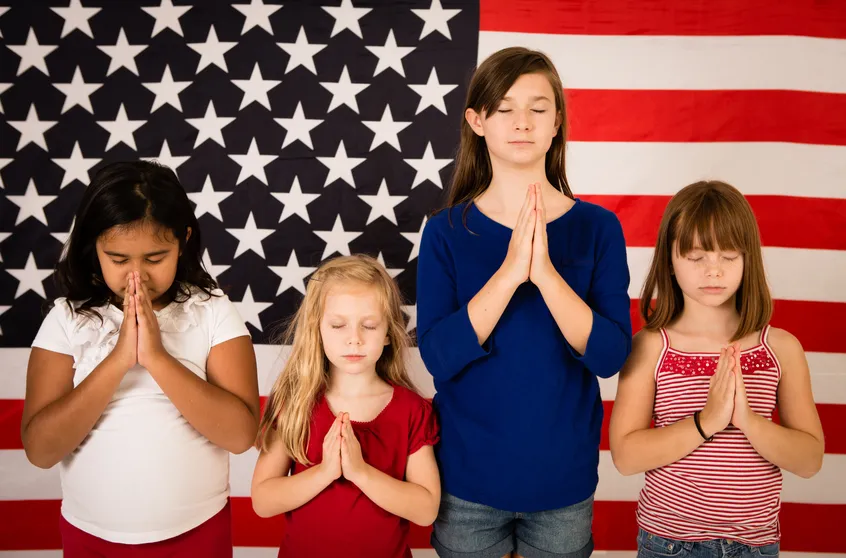
When I attended state schools in Derby from the mid-1950s to the late-1960s, every school day began with an act of Christian worship which included a hymn, a Bible reading, and prayers always concluding with the Lord’s Prayer. All this was a requirement of the 1944 Education Act. I gather things are somewhat different today. Most British schools don’t feel comfortable any more “doing God”, let alone Jesus.
That’s the reverse of what’s happened in the USA. It’s all very different over there where such things are decided not by legislation but by the Constitution as interpreted by the US Supreme Court. Let’s start with the Constitution. The First Amendment to the Constitution states that “Congress shall make no law respecting the establishment of religion.” From the 1960s through to 2000, the Supreme Court interpreted that prohibition on a nationally-prescribed religion to declare unconstitutional a host of Christian practices in public (i.e. state-run) schools.
It started in 1962 when the Supreme Court banned prayers in all public schools composed by the school authorities. The following year, the Court added the reciting of the Lord’s Prayer and Bible reading to the list of constitutionally forbidden things in public schools. (Private schools could – and still can – do what they like.) The 1960s was a period of political liberalism in the United States – under presidents Kennedy and Johnson – and the Supreme Court was likewise of a liberal hue. Indeed, the US Supreme Court at this time was probably at its most liberal, dominated by three very liberal justices – Earl Warren (the Chief Justice), Hugo Black and William Douglas.
To get round this constitutional ban on prayer, many schools introduced a “period of quiet reflection.” But in 1985, much to President Ronald Reagan’s annoyance, the Supreme Court declared that practice unconstitutional too. The previous decisions had stipulated that to be held as constitutional, such laws had to have “a clearly secular purpose.” But in this 1985 case, the Court’s majority argued that the Alabama law in question “was not motivated by any clearly secular purpose,” that “indeed, the statute had no secular purpose at all”. The Court therefore concluded that the law had been passed “for the sole purpose of expressing the State’s endorsement of prayer activities at the beginning of each school day.” Liberal justice John Paul Stevens writing for the majority stated: “Such an endorsement is not consistent with the established principle that the government must pursue a course of complete neutrality toward religion.”
However, as these and similar decisions were announced – 1992 saw prayers at school graduation ceremonies banned, and in 2000 came a similar ban on student-led prayer over the PA system before high school football games – there were those who pointed out that although the Supreme Court might be diligently upholding the words from the First Amendment quoted above, the sentence didn’t end there. For the full wording of that part of the Constitution reads: “Congress shall make no law respecting the establishment of religion, or prohibiting the free exercise thereof.”
The nine members of the US Supreme Court are appointed by the president and hold office for life. So it takes some time for the Court’s ideological balance to shift. And it wasn’t until the appointees of George W. Bush (2001–2009) and Donald Trump (2017–2021) joined the Court that the balance swung from there being a clear liberal majority to there being a clear conservative one. Republican presidents tend to appoint conservative justices whilst Democrats tend to appoint more liberal justices.
By 2021, the Court included six Republican appointees and only three Democratic appointees. That’s why in the last five years the Court has made different decisions in the matter of prayers in public schools. In a 2022 decision, the Court upheld the right of a public school football coach to lead students in on-field, post-match prayer. The Court ruled that a Washington state school board had violated the constitutional rights of Joseph Kennedy by not renewing his coaching contract when he refused to stop the post-match prayers. Trump appointee Justice Neil Gorsuch, writing for the six-member majority, stated: “We are aware of no historically sound understanding of the [First Amendment] that makes it necessary for government to be hostile to religion in this way.”
After the recent France v England men’s football World Cup third-place final, comment was made when four English and three French players linked arms to join in Christian prayer on the field. One wonders how would this be viewed in British state schools these days. Have the pendulums in the UK and the US been swinging in opposite directions?
Iran: The trivialisation of war
Speaking to reporters at the Pentagon recently, U.S. Defence Secretary Pete Hegseth promised to bring on Iran the biggest onslaught …