
Young survivor sings tribute to Texas flood victims

Emily Pollok
One of the young survivors of July’s catastrophic flash flooding in Texas has written a song in tribute to the 27 girls from Camp Mystic killed in the disaster.
Skyler Darrington, 12, shared her revised rendition of Leonard Cohen’s “Hallelujah” on US TV show Fox & Friends. “That event really helped my faith grow,” she said during the broadcast. “All my friends were there. We sung during the tragic event, and it just helped us grow.”
Politics USA
Not about US: The misuse of one verse in American evangelicalism

Tony Bennett
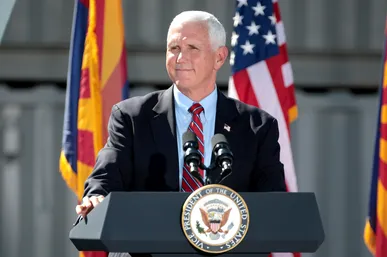
Former Vice President Mike Pence has for many years introduced himself to audiences by saying: “I’m a Christian, a conservative, and a Republican – in that order.”
I’ve heard many evangelical Christians in the UK speak warmly of Pence’s strong Biblical faith. Indeed, there is much to admire. But I’m concerned.
letter from America
Why is evangelism increasingly ‘optional’?

Josh Moody
It has become startlingly obvious to me over the years that evangelism, and its importance, has increasingly receded in the life of the church in America.
I know there are exceptions, and of course there are many individuals who are effective and zealous in personal evangelism. But my anecdotal and instinctive observation was recently confirmed by Lausanne’s survey on the importance of the Great Commission. The survey asked whether the average Christian, in various countries, believes that sharing the gospel is essential or optional. It is no great surprise that where the church is growing rapidly the average Christian believes that sharing the gospel is essential: Africa, Asia, Latin America. But where the church is not growing (North America and Europe) the average Christian thinks that evangelism is merely optional. You can look at the figures yourself here: lausanne.org/ report/great-commission-discipleship.


















Should UK Christians go to Franklin Graham’s rallies?
Charles Colson was a senior member of President Nixon’s White House Staff who was sentenced to prison for his role in the Watergate cover-up. But having come to saving faith in Christ, he tells in his autobiography of what he witnessed when he would bring visitors to meet Nixon.
Colson would gather guests in a room near the Oval Office, where they would talk about what they were going to tell the President when they were face to face with him. ‘But it was always the same,’ Colson writes. ‘In the reception room they would rehearse their angry lines.’ But once they were in the Oval Office, ‘it was as if they’d suddenly sniffed some intoxicating fragrance. For invariably, the lions of the waiting room became the meek lambs of the Oval Office. And none were more cowardly than the religious leaders.’