
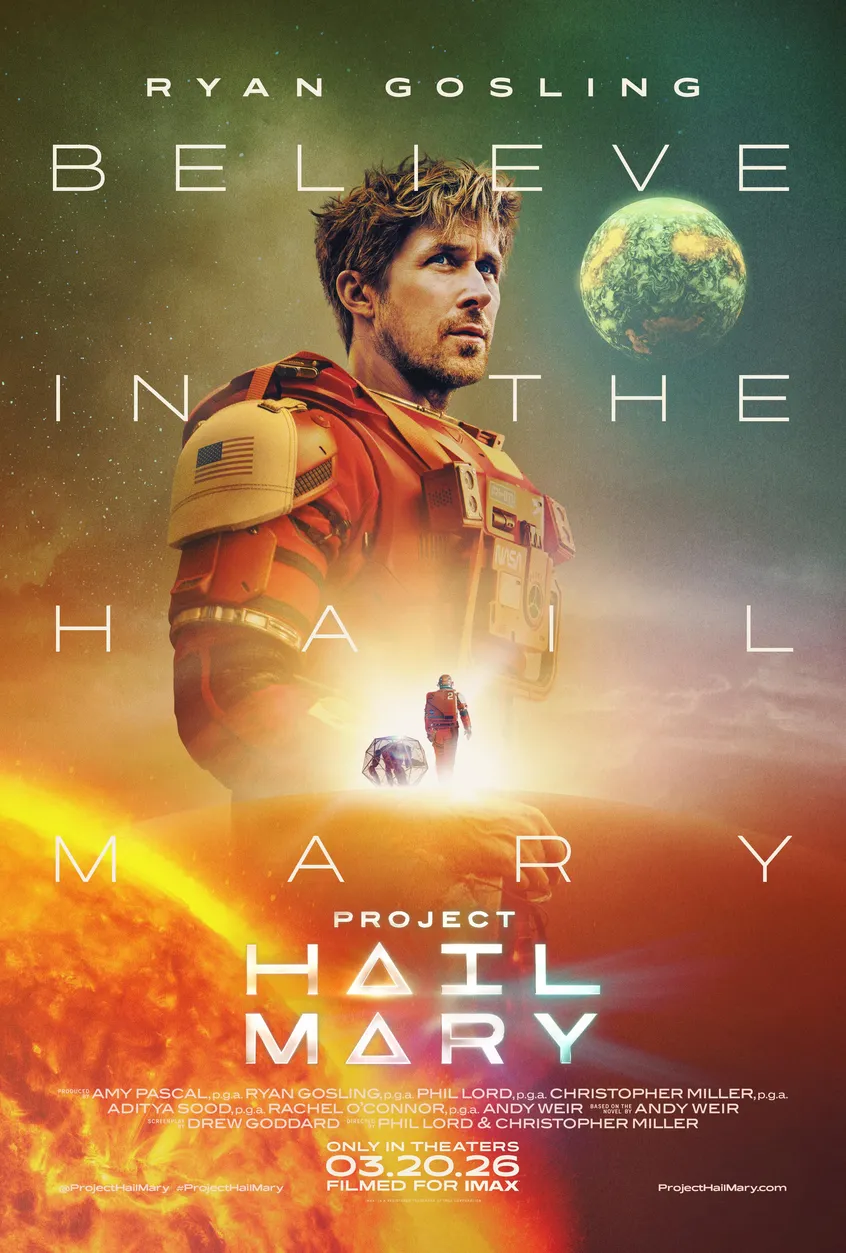
Warning: Contains spoilers!
When I gleefully pointed out a local Project Hail Mary poster for the 15th time, my husband said, “You know, I’ve never seen you this excited about a film. Never!”
It’s true. I’ve not been this excited about a film release since Return of the King came out in 2003. (Yes, I am that cool.) And having seen Project Hail Mary, I did quite literally go and buy the t-shirt. (More cool points.) So what’s so special about it?
Overview
Before I dive in, let me give you a quick overview: Project Hail Mary was released in cinemas earlier this year and it’s now available for streaming. It’s based on Andy Weir’s best-selling 2021 novel of the same name.
At the time of writing, the film has grossed over £500 million so far, and it’s got a very satisfactory 8.2/10 rating from the critics on Rotten Tomatoes.
The film begins with amnesiac scientist Dr Ryland Grace (played by Ryan Gosling) waking up from a coma as the sole survivor on a spaceship—the Hail Mary—which is about to arrive at "local" star Tau Ceti.
The film is told partly in the present (aboard the Hail Mary) and partly through flashbacks set on Earth. The latter reveal that a star-eating algae called Astrophage is destroying hundreds of stars, including the Sun. As the only nearby star which is unaffected, Tau Ceti becomes the destination for the mission on which humanity pins its hopes: Project Hail Mary.
At Tau Ceti, Dr Grace encounters an alien he names Rocky—the sole survivor aboard his planet’s equivalent of the Hail Mary. Together, Grace and Rocky investigate Tau Ceti’s defences and come up with a suitably dramatic solution to save both their planets.
What's so special about this film?
Now, back to my question—what’s so special about Project Hail Mary?
Well, it’s beautiful. Project Hail Mary’s special effects are stunning. The sets—especially the ship’s interior and exterior—are immersive and believable.
James Ortiz’s voice acting and his team of puppeteers succeed in breathing winsome life into Rocky.
And while Gosling’s comic charm carries us through much of the film, it’s his performance in the space funeral scene that has particularly stayed with me. Similarly, Sandra Hüller (who plays Project Hail Mary’s mission director Eva Stratt) gives a hauntingly conflicted performance.
Last, but not least, the music—I love the music. It captures both the story’s key ingredients: the sorrow and desperation and isolation as well as the whimsy and friendship and faith.
Faith. That, in a word, is the heart of Project Hail Mary. I don’t mean faith in the way we would usually mean it. It’s not about trust in the Lord Jesus or, for that matter, in the Virgin Mary. (A flashback scene clarifies that the title refers to American football’s Hail Mary pass, used as a last-ditch attempt to win the game.) As far as the audience knows, only Stratt believes in God—“Beats the alternative,” she tells Grace—and we don’t know precisely who that God is.
Instead, and as Gosling himself puts it, the film’s central message is “reminding us of what we're capable of as human beings.” [1] In other words, Project Hail Mary’s faith is in humanity.
That faith is also at the heart of what makes Project Hail Mary so appealing. As Gosling recognises in the same interview, it’s a stark contrast to the recent onslaught of dystopian films and TV series—think House of the Dragon, Silo and The Testaments. Our daily headlines often tell a similarly dystopian story: that humanity’s disunity and greed have caused impending catastrophes and rendered us unable to avert or escape from them.
Against these two backdrops, Project Hail Mary’s faith in humanity is a welcome relief. It’s a return to the hope of an era which proclaimed, “There’s some good in this world, Mr Frodo – and it’s worth fighting for.” [2]
Challenging cynicism
It’s easy to see the problems with having faith in humanity—and it’s true that Project Hail Mary has a darker side. But we shouldn’t allow either of those things to persuade us to dismiss the film’s central message completely. Problematic, yes. Entirely untrue? No.
It’s true that the human race is made up of deeply flawed people (as Stratt’s ruthlessness and Grace’s initial cowardice remind us). But it’s also true that each member of the human race is an image-bearer (Gen. 1v27) and that God loved us to the point of giving His only Son to die in our place (John 3v16).
It’s likewise true that human beings (both God-fearing and not—Gen. 4v17-22, Ex. 35v30-35) have the capacity to do hugely impressive things in a variety of spheres.
If we have learnt to see ourselves and other people as hopeless, incapable and irredeemable, then we need to hear again the gospel proclamation of hope and joy and grace.
Let’s allow Project Hail Mary’s gospel echoes to challenge a cynicism that the Lord neither shares nor condones.
An important note …
With all that said, I can’t ignore the profound ethical problems in Project Hail Mary. What do we do with the fact that the astronauts are offered—and eagerly embrace—their choice of methods to commit suicide so they can avoid eventual starvation once the mission is completed?
More problematic still, when the original volunteer scientists are killed in a pre-mission explosion, how do we handle Stratt’s choice to drug a terrified Grace so that he is forced aboard the Hail Mary?
There aren’t easy answers. And yet, the more I reflect on Project Hail Mary, the more convinced I am that both dilemmas arise from our desire to seize control of everything we can.
We don’t want to risk uncertainty.
As book Stratt says, “I don’t like complexity. I don’t like risk.” [3]
Uncertainty, and complexity, require us to relinquish our faith in ourselves and to trust, instead, in God. And many of us would much prefer to have a less-good outcome that we can control than to trust God to steer us through catastrophe and into the blessing beyond.
That choice makes us feel more comfortable. But it also deprives us of the opportunity to see God’s grace at its clearest (e.g. Est. 4v16; 2 Cor. 12v9-12).
What might God have done if Stratt had been willing to embrace holy risk? And what could God do with us and through us if only we allowed him to take full control?
Aside from all of Project Hail Mary’s other merits, those two challenges—to our cynicism and to our love of control—should motivate you to watch it. But there’s one more reason. And that is this: it reminds us how much powerful people need our prayers (1 Tim. 2v1-2).
How many times a day does our Prime Minister find himself facing ethical dilemmas? How frequently is he tempted by cynicism? How often is he tempted to choose the certainty of control rather than the risk associated with preserving freedoms?
Let Project Hail Mary remind us to pray that our leaders choose a better way. Those prayers can be—as Rocky might say—our “words of great encouragement.”
- "Ryan Gosling on Blending Humour and Sci-Fi in New Film Project Hail Mary", BBC News, 19 March 2026: bbc.co.uk
- The Lord of the Rings: The Two Towers, directed by Peter Jackson (New Line Cinema, 2002), 02:35:40.
- Andy Weir, Project Hail Mary (2021; Penguin Books, 2022), 140.
Fran works part-time for Affinity managing their publications and is a part-time MTh student at Edinburgh Theological Seminary. When she's not reading theological journals, she can be found exploring the Peak District with her husband and their border collie.





Why are we drawn to stories of self-sacrifice?
This article contains spoilers!Okay, I had to put the disclaimer because it's true – this article does contain spoilers. …