This article contains spoilers!
Okay, I had to put the disclaimer because it's true – this article does contain spoilers. However, this film is seven years old. But even though that's the case, you may be in the same boat that I was a mere few months ago, having never seen any of the Avengers films; so there's your warning. Stop reading if you don't want spoilers.
Right, now that that's out of the way, let's discuss Avengers: Endgame.
The film came out in 2019. As of the time of writing, it is the second highest-grossing film worldwide (second only to Avatar, you know, the one with the blue people?). Endgame is the "part two" to its predecessor, Infinity War, and tells the tale of the Avengers seeking to bring back the half of the Earth which their antagonist, Thanos, eliminated with a snap of his Infinity-Stone-adorned fingers ("the snap").
I'm not here to discuss the intricacies of the plot or every single happening during Endgame's three-hour playtime.
I'm here to discuss self-sacrifice.
Iron Man
Here's my confession: the death of Iron Man (Robert Downey-Jr) brought me to tears. Scratch that, I was full-on sobbing for a good 20 minutes. (Side note: Does anyone else love when a film makes you cry? No? Just me? Okay...)
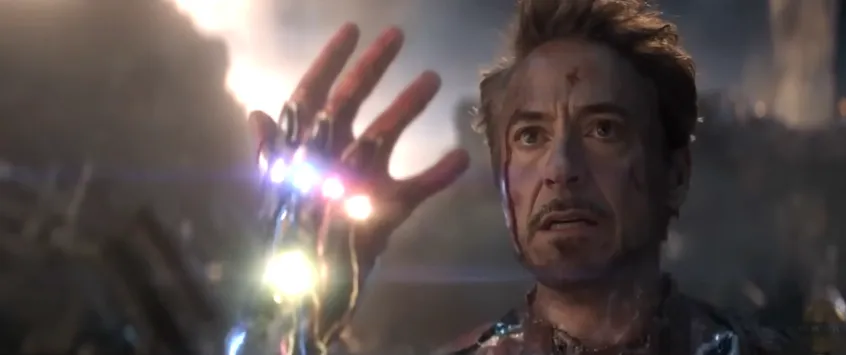
The "final battle" against Thanos has been raging for some time now, and Iron Man turns to Doctor Strange (Benedict Cumberbatch) who makes the number "one" with his hand; he's referring to the one-out-of-14-million possible futures he "saw" in which the Avengers defeat Thanos. A knowing look dawns on Iron Man's face. He then proceeds to get the Infinity Stones, transferring them to his own armour – leaving the empty Gauntlet on Thanos's hand – then, with a "snap", gets rid of Thanos and all his cronies.
But what of Iron Man/Tony Stark? What of the fact that – earlier in the film – we heard about the sheer power of the Infinity Gauntlet?
A few moments later, and we witness Iron Man succumbing to the impact of what he's done. He's saved the world, but he's about to lose his own life.
Cue the tears as Stark's love interest and mother of his child (Gwyneth Paltrow) says, "We're going to be okay. You can rest now."
Here I go again...
'It's like Jesus'
As I witnessed Tony Stark's death, I couldn't help but be reminded of another who gave His life for the good of mankind; my tears were actually less about Iron Man's death in itself, and more because – as I only-just-managed to say to my boyfriend as the tears came thick and fast – it reminded me of Jesus.
Now, I don't know about anyone else, but I often feel so aware of my inability to comprehend the cross; to comprehend the suffering, weight of our sin upon our Lord's shoulders, the separation from the Father, that Jesus experienced. But, as I sat watching Stark's death play out on screen, I was reminded of what Jesus did for me and of how wonderful, kind, loving, glorious – I could go on – it was.
And it's true.
I saw a portrayal of self-sacrifice, as I witnessed the death of a character who I'd grown to love; as he did what needed to be done – of his own accord – for the good of others. He knew it would destroy him, and yet he did it anyway. Why? Love, perhaps.
Self-sacrifice
I'm confident that even non-Christians find on-screen portrayals of self-sacrifice extremely compelling. And I believe that this speaks to the profound beauty of the gospel story. It is a story in which the Hero dies. It is a story in which the Saviour puts the good of others (and the glory of God) before Himself.
In a world where society frequently tells us (whether explicitly or implicitly) to put ourselves first, we remain drawn to stories where the exact opposite is true.
God "has put eternity into man’s heart" so reads Ecclesiastes 3v11. In Romans 1v20, Paul writes: "For since the creation of the world God’s invisible qualities—his eternal power and divine nature—have been clearly seen, being understood from what has been made, so that people are without excuse." Though these verses may not speak directly into man's draw towards stories of self-sacrifice, this "draw" towards something that is at the very heart of the gospel story can point us to the fact that we have a longing within us which can only be satisfied by God. This "eternity-shaped hole" can only be filled by One: "whoever drinks the water I give them will never thirst. Indeed, the water I give them will become in them a spring of water welling up to eternal life" (John 4v14).
So next time you find yourself captivated by an on-screen portrayal of self-sacrifice, perhaps pause and ask yourself why. Could it be because you're witnessing a glimpse (and I mean a mere glimpse) of what your Saviour went through, to save you from the power of sin and death? Could it be because God is using that particular film, or television show, to point you towards – and remind you of – the "Old, Old Story"?
And the amazing news is: He didn't stay dead. He is risen and, because of that truth, we can have confidence, that we, too will rise again. Hallelujah!