Rest refocussed through Christ

John Woods  |  Reviews
Date posted:  17 Aug 2026
Share Add       
Rest refocussed through Christ

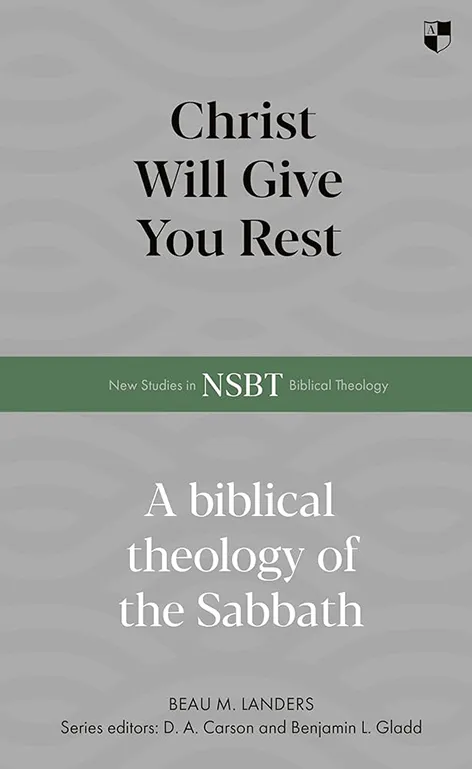
CHRIST WILL GIVE YOU REST
A Biblical Theology of the Sabbath
By Beau M. Landers
Apollos. 363 pages. £29.99
ISBN 978 1 789 784 186

It is always a treat to receive one of these silver-covered volumes in the “New Studies in Biblical Theology” series. The ingredients are simple: take a first-rate Biblical scholar, give them space to explore and explain an area of their expertise, and then publish something that will be worth reading on an important Biblical topic. All the ingredients are present in this fine study on the Sabbath.

Beau Landers begins this work in Part 1 with an examination of how the Sabbath has been understood in church history from the early church to the 20th century.
The author’s attention is then turned to scholarly work in the past quarter of a century, before helpfully presenting five views concerning the Sabbath:

  1. The permanent Sabbath view: keep Saturday holy
  2. The Christian Sabbath view: keep Sunday holy
  3. The mediating view: keep one day holy
  4. The transformed Sabbath view: all days are holy
  5. The discontinued Sabbath view: no day is more holy than another

He lays out these views with care to present the arguments in the words (sometimes extended) of their proponents.

The author asks five evaluation questions of the five views:

  1. What is the relationship between creation and the Sabbath?
  2. What is the purpose of the Sabbath command?
  3. How does Jesus change the Sabbath?
  4. How is Colossians 2v16-17 interpreted?
  5. What is Sabbath observance for the NT Christian?

Landers is clearly not afraid of plot spoilers, because he lays his cards on the table up front by telling the readers that his is an advocate of the fourth view: The transformed Sabbath. Giving his reason for this decision he writes: “The key failure of other views is that they often only ask: What is New Testament Sabbath observance? Instead, what should be asked is: How does the theme of Sabbath develop across the canon and culminate in Christ?”

Having made this substantial introduction to the subject the author moves on to Part 2, which is a careful and substantial trawl through the Biblical material about the Sabbath.

Landers guides the reader through the Torah, the Former and Latter Prophets and the Writings in the Old Testament. I was particularly interested in his sections on what the Biblical material dealing with the periods pre-fall and pre-Sinai has to say concerning the understanding of the Sabbath at that time.

Landers then spends a third of his book wrestling with the material on the Sabbath in the Gospels, Acts, letters and Revelation. This part also includes a brief section on the two New Testament mentions of the first day of the week and the one mention of the Lord’s Day.

Although these references are outside the author’s remit of looking at passages that specifically deal with the Sabbath, his comments are instructive. He seeks to make it clear that there is insufficient evidence that these three references can be used to build a concept of a “Christian Sabbath”. Dealing with the letter to the Hebrews, Landers devotes a full and helpful section to the extended passage on the rest found in Christ in Hebrews 3v7-4v11. For me this has been one of the most compelling arguments for my understanding of Sabbath rest, so I was grateful for such a full treatment here.

Landers draws things together in a succinct conclusion, entitled: The Sabbath and Christ with implications for the church.

Here Landers revisits the five main Sabbath views and the five questions he asks of them. Building on the evidence explored in his book, Landers lays out why he has adopted the view he has already proposed in his “plot-spoiler” at the beginning of the book.

In answer to the fifth question, Landers draws out four implications for the church:

  1. The Sabbath is greater than a day of the week.
  2. Sabbath is an everyday reality for the church.
  3. Sabbath is a certain, future hope for the church.
  4. Sabbath is the proclamation of the church.

It has been 44 years since From Sabbath to Lord’s Day (edited by D.A. Carson) was published. That book contained contributors from a variety of viewpoints, including arguments for the view of the Sabbath advocated here by Landers. I am grateful that Carson has commissioned this new book-length treatment of the subject. It is contemporary, comprehensive and compelling. It is a long book, but is written in a clear and readable style. Highly recommended (whatever your view of the Sabbath).

I contributed the article of the Sabbath in IVP’s New Dictionary of Theology: Historical and Systematic (pp795-796). I wish that I had this fine resource available to me at the time.

Share
< Previous article| Reviews| Next article >
Read more articles on:   theology
Read more articles by John Woods >>
Reviews
Ancient role models

Ancient role models

One of the things I do apart from being the Reviews Editor for Evangelicals Now is the Dead Preachers’ Society. …

Comment
Big Church Festival: 'The site became eerily quiet'

Big Church Festival: 'The site became eerily quiet'

We live in West Sussex, just down the road from the site of the Big Church Festival (BCF) – an …

About en

Our vision, values and history

Read more

Subscribe

Enjoy our monthly paper and full online access for just £40/year

Find out more