Deep wisdom

Vernon Wilkins  |  Reviews
Date posted:  19 Aug 2026
Share Add       
Deep wisdom

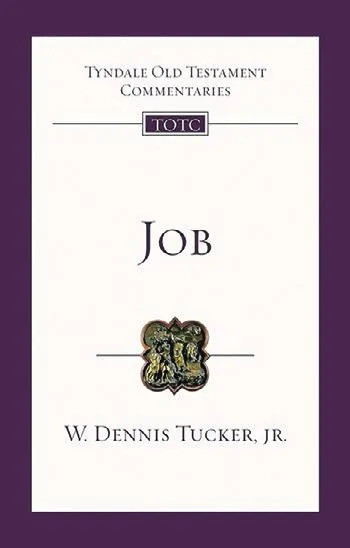
JOB
By
W. Dennis Tucker, Jr.
IVP. 332 pages, £19.99
ISBN 978 1 783 599 684

This is a new entry in the Tyndale Old Testament Commentaries series, replacing the much earlier one by Francis Andersen and much the same length.

Typically for the series, this volume has an Introduction, but much shorter than I would have expected, covering issues such as the place of Job in the canon, its structure, language and ancient near-eastern (ANE) context, its unity, genre and date. In respect of the latter, his conclusion is that Job is post-exilic, basing his conclusion on his dating of Jeremiah and ‘Deutero-Isaiah’ (his term) as exilic or early post-exilic, contra his predecessor, Andersen (his date is the reign of Solomon). Although the introductory pages are a relatively short section, they contain a prominent piece comparing Job with other ANE laments over undeserved suffering, which latter is, for our author, the “crucible which Job must endure” and thus test the nature of his God.

There is a very lengthy bibliography but, deficiently it seems to me, it doesn’t include notable Job scholars such as Christopher Ash, Out of the Storm (2004), and Robert Fyall, Now My Eyes Have Seen You (2002), and so he doesn’t engage with such worthies or their alternative views. For instance, whereas for Fyall the images of Behemoth and Leviathan evoke the themes of death and evil, and whereas Ash points to the cross as the ultimate resolution of the undeserved suffering question, Tucker sees these animals (for him, definitively the hippo and the crocodile) as being just created beings that represent a battle with chaos (chaoskampf). This surprised me, given that, as I understand it, chaoskampf as the underlying theme of the Biblical record of creation is much less in favour nowadays in academic scholarship. But in Tucker’s commentary, God’s final speech to Job is concerned with just this. Nonetheless, our author agrees with the vast majority of works on the book of Job that it concerns the man Job’s need to disassociate his suffering from any suggestion that righteousness deserves automatic prosperity and health. God’s just providence, His right to deal with humanity as He pleases, trumps all other concerns. And, helpfully, although suffering is Job’s unfortunate lot, the book is not about suffering per se, and so does not say ‘look at me’, the sufferer, but says ‘look at God’ and His nature, particularly His justice.

Share
< Previous article| Reviews| Next article >
Read more articles on:   theology
Read more articles by Vernon Wilkins >>
Reviews
Wisdom from history

Wisdom from history

Church Society, an evangelical “fellowship contending to reform and renew the Church of England in Biblical faith”, has published these …

Reviews
We believe: Exploring ancient faith

We believe: Exploring ancient faith

2025 is the 17th-centenary year of the original Nicene Creed. This volume is a timely contribution to the undoubtedly busy …

About en

Our vision, values and history

Read more

Give a subscription

Our monthly newspaper is the perfect gift for those who love to think deeply

Give here