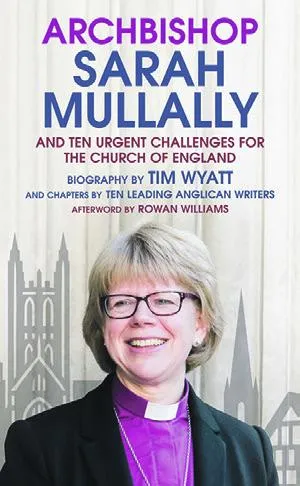
With the appointment of a new primate in Canterbury, two books are being published, both with the new Archbishop’s face on the cover.
The first is Archbishop Sarah Mullally: And Ten Urgent Challenges for the Church of England, which opens with a 40-page biography of Sarah Mullally by Tim Wyatt.
It then offers ten chapters of urgent challenges for the new Archbishop, before closing with a wise Afterword from former archbishop Rowan Williams.
Published in a hurry
Published briskly in February, it acknowledges that the ten chapters were put together “in a hurry”. They set out a range of challenges for our established Church, some of which offer perspectives far from those of most en readers. Each chapter is written in hope and ends with a prayer.
The Dean of Southwark’s chapter calls us to return to deep love of God and of neighbour, and for the Archbishop to consider heroes of the faith both past and present; another chapter on Nationalism and Racism calls for the dismantling of institutional racism. The chapter on disability inclusion barely mentions the Archbishop, despite her being the first neurodiverse Archbishop – open about her dyslexia. Several chapters highlight threats faced by Mullally’s archiepiscopacy – the Revd Dr Charlie Bączyk-Bell’s on LGBTQIA inclusion comes as the Living in Love and Faith process is formally ended, but renewed and rebranded.
He unpacks the Archbishop’s known work in this area, while personally calling for the church to “embrace same-sex marriage as a bare minimum”. Divisions in this area remain a huge risk as Mullally takes the reins. There is also a chapter on transgender inclusion, and one on safeguarding from Andrew Graystone.
Unity
There is a fascinating personal, thought-provoking perspective on the challenge of Global Anglican Unity from Amatu Christian-Iwuagwu. Later chapters show more of the opportunities that our national church has, providing hope to en readers – a powerful and inspiring chapter from Jon Kuhrt on poverty calling for an integrated Christian witness; from Ruth Valerio on the climate crisis and how creation-care is integral to leading for the common good. Archbishop Sarah may be on the cover, but the contents here showcase the deep divisions in the Church of England.
ARCHBISHOP SARAH MULLALLY: And Ten Urgent Challenges for the Church of England
By Tim Wyatt et al
DLT. 160 pages. £8.99
ISBN 978 1 917 362 207
For a better understanding of the Archbishop herself, put together with more speed and less haste, there is now also Andrew Atherstone’s biography Archbishop Sarah Mullally.
Described as “an authoritative study” of her character, priorities, and of the shaping of her Christian faith. I thought I was fairly familiar with much of Mullally’s history – her time as the youngest-ever Chief Nursing Officer, and later at Salisbury Cathedral, followed by becoming Suffragan Bishop of Crediton, then her rise to be Bishop of London. There is more on all those roles, with fascinating detail (and joyful colour photos).
Evangelical youth group
But more than that, there are substantive chapters on Sarah’s early life, on her coming to faith in an Anglican evangelical church youth group, her dyslexia diagnosis, and her time as president of her polytechnic’s Christian Union (which was affiliated to UCCF). Alongside her studies, she got stuck into a local evangelical church in South London – St Stephen’s, Stockwell. Joining at 18, it was here that she got to know her husband, raised her children, staying over two decades, and this was where she received her call to ordained ministry.
Aged 19 she joined the PCC. By 28 she was beginning to preach at services. During a 1991 interregnum, Sarah was regularly preaching while her husband Eamonn was churchwarden; the parish profile was clear – they were looking for their new vicar to be a “conservative evangelical”. For Sarah’s curacy, they moved from Stockwell to Battersea Fields, a more theologically mixed parish with an “open evangelical” incumbent. Then on to Sutton, where she was team rector of three “middle of the road” parishes, followed by a move to Salisbury Cathedral under Dean June Osborne.
Revisionists might call this journey progress. Evangelicals would doubtless use another word! Atherstone instead observes her focus on compassion and kindness, describing her “pastoral pragmatism”. That our new Archbishop understands evangelicals cannot be doubted when reading about her roots. Justin Welby was seen as the evangelical Archbishop, yet by the end evangelicals felt very let down. Sarah Mullally comes to us, not as evangelical, but as calm and compassionate, with a call to wash feet. Roots are important; Mullally’s are evangelical.
To be challenged about the state of our church and feel something of the weight our Archbishop picks up for us, read the first of these two books. To understand more of her – and many people’s – journey from an evangelical youth to something else, and how this may yet bring us hope at a difficult time for the church, read the Atherstone biography.
ARCHBISHOP SARAH MULLALLY
By Andrew Atherstone
Hodder & Stoughton. 208 pages. £22
ISBN 978 1 399 828 789
Should the CofE pay slavery reparations?
During a recent trip to Ghana, Archbishop of Canterbury Sarah Mullally renewed her commitment to a £100 million reparation fund …