Understanding fatherlessness

Dan Strange  |  Reviews
Date posted:  15 Jun 2025
Share Add       
Understanding fatherlessness

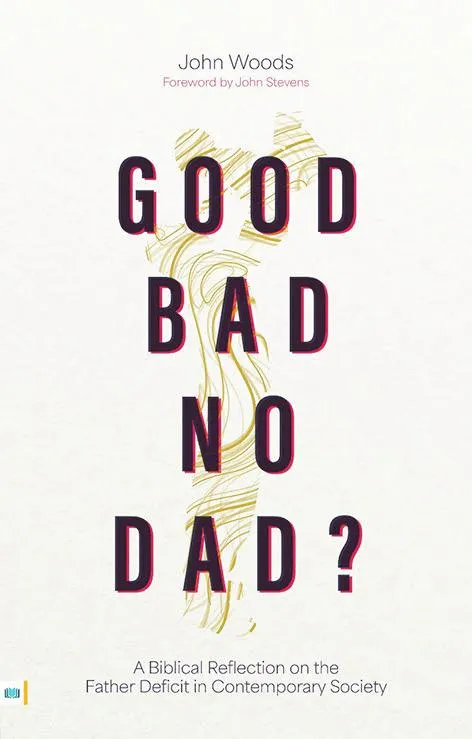
GOOD, BAD, NO DAD?
A Biblical Reflection on the Father
Deficit in Contemporary Society
By John Woods
Grace Publications. 244 pages. £14.99
ISBN 978 1 912 154 975

“What is the first thing you think about when you hear the word ‘father’?” It’s a question that might conjure up a parodic vision of eyes closed, speaking to a Freudian figure from the comfort of an expensive therapist’s couch.

In John Woods’ powerful study, it becomes a serious, revealing, and uncomfortable question from a pastor for whom this issue is far from professional or detached: “This is my story, this is my wound, this is my missing piece” (p.15).


However, Good, Bad, No Dad? (I’m still trying to work out the title!) is not merely a personal study, but the kind of book that should and indeed will search the majority of those reading it, because in Woods’ definition of fatherlessness he includes not only unknown and absent fathers, but also present but distant fathers, present but abusive fathers, and fathers who have died prematurely.

It’s a book personal and relevant to all of us. What Woods brings to the surface, but something that I think we know deep down, is that the father deficit is a pervasive and profound issue in our society – “approximately one in two boys aged 15 are not living with both parents, of which 90% aren’t living with their father” (p.230) – and so a massive pastoral issue in our churches. The irony in reading John’s book is that our Christian communities, who play a seminal role in addressing this deficit, are not giving it the time and attention it needs.

Woods’ main focus is “to give a flavour of what it feels like to be fatherless and provide some Biblical pointers of how the matter can be addressed by the church. Whatever our own experience may be, as Christians we know perfect spiritual fatherhood in God our Heavenly Father, who also teaches us to care for those who are humanly fatherless” (p.227). To achieve this end, the book is somewhat eclectic both in structure and style, but this keeps the reader moving and so not getting too bogged down in what is a heavy subject.

Woods is well-read, well-travelled and well-lived. He writes with both sensitivity and verve. He has some lovely turns of phrase and a wide range of illustrations from culture.

On one level the book is a Biblical theology of fatherhood including chapters on human fathers in the Biblical story (OT and NT), God the Father in the Biblical story (OT and NT), prayer, turning to our Heavenly Father and knowing our Heavenly Father. The author as pastor and preacher covers this material well, slowing down at various places to expound particularly pertinent passages.

‘Above and apart’

What sets the book apart and above from your usual Biblical study is that interspersed throughout are transcriptions of interviews that Woods has conducted with a variety of people affected by the themes in the book. These are very moving, in places heartbreaking, in places hopeful. This juxtaposition between Biblical material and interview provided a powerful dynamic once one had got used to the pattern.

Each chapter concludes with some helpful questions, thoughtful prayers, and possible actions to take forward. It will be ideal for churches to work through slowly and carefully. Woods writes that “one of the things I would like this book to accomplish is to create a safe environment where people can be honest and vulnerable about how they feel, and seek help in exploring how to deal with those feelings” (p.81). These are conversations we desperately need, and I hope Good, Bad, No Dad? will be an important step in moving us forward. Highly recommended.

Share
< Previous article| Reviews| Next article >
Read more articles on:   men  /  parenting
Read more articles by Dan Strange >>
Features
The Cross: Atonement, controversy & victory

The Cross: Atonement, controversy & victory

In the last few weeks there's been a flurry of on-line activity over John Mark Comer's comments on Instagram concerning …

Features
Diognetus’ diagnosis...

Diognetus’ diagnosis...

He was just there to buy his dinner.In a Constantinople fish shop in 1436, a young theology student notices …

New here?

Register and get three free articles each month!

Register

Give a subscription

Our monthly newspaper is the perfect gift for those who love to think deeply

Give here