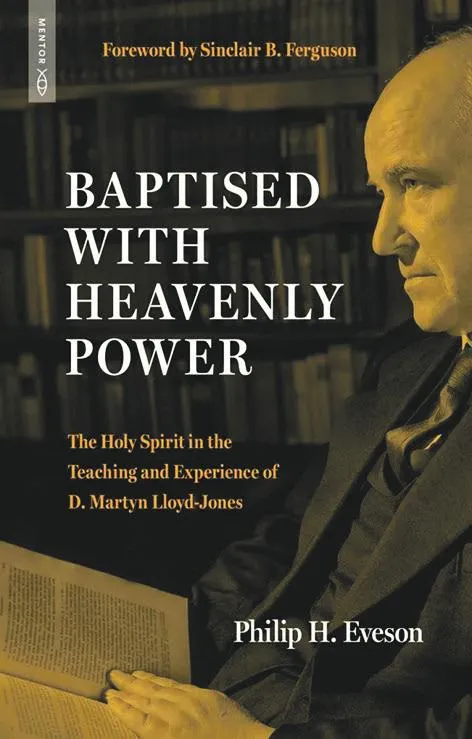
BAPTISED WITH HEAVENLY POWER:
The Holy Spirit in the Teaching and
Experience of D. Martyn Lloyd-Jones
By Philip H Eveson
Mentor. 424 pages. £17.99
ISBN 978 1 527 112 537
I very much enjoyed reading this book. At a certain level it was a walk down memory lane. I heard Martyn Lloyd-Jones (MLJ) preach a half-dozen times when I was a student and met him on two occasions.
Like many young preachers at the time, I eagerly devoured his books on The Sermon on the Mount, Romans and Ephesians; these along with his Preachers and Preaching changed the way that people thought about what to preach and how to preach.
There were some who had reservations about what MLJ did with the sealing of the Spirit in Ephesians 1 and the witness of the Spirit in Romans 8, and these reservations were heightened with the later publication of Joy Unspeakable and Prove All Things. (This was like the moment for Bob Dylan fans when he went “electric” at the Newport Folk Festival, or later when he released Self-Portrait.)
MLJ was viewed by some as abandoning a reformed theological position and becoming a closet charismatic; many charismatics with a reformed soteriology certainly took great encouragement from these books. Having gone through the process of reading all these books as they appeared I must confess to being excited by the vista of more of the Spirit that MLJ opened for me, not least in the abundant series of historical examples of people who experienced such experiences, but hesitant concerning the language he used to describe these experiences.
Therefore I welcome this fine book by Philip Eveson, who knew MLJ and seeks to revisit his teaching on the Holy Spirit, to make a robust defence of the Doctor.
The book is in four sections: Theological Background; Theology of the Holy Spirit; Revival and the Holy Spirit; Preaching and the Holy Spirit.
The first section establishes that MLJ stood squarely in the reformed tradition and was particularly nourished by the works of the Puritans. It was the emphasis of the Puritans on experiential faith that attracted MLJ, as it resonated with his own Calvinist Methodist background in Wales.
The second section deals thoroughly with MLJ’s teaching on the Holy Spirit. It traces the development of his thinking and argues that MLJ did not abandon reformed theology in his preaching on the sealing the Spirit and baptism of the Holy Spirit. The author defends Lloyd-Jones’ use of language and exegesis on these matters, and helpfully navigates the differences between the conclusions of MLJ and John Stott on the work of the Holy Spirit.
Part three explores the emphasis of MLJ on revival, and whether he displayed obsessional tendencies in his thinking about the topic. As a student in South Wales in the mid-seventies I was exposed to what could at times be an unhealthy fascination with the subject of revival, which smacked more of weary nostalgia than energetic longing.
Section Four deals with Preaching and the Holy Spirit. This is a fruitful examination of preaching being more than teaching the Bible, and the relationship between word and Spirit in preaching.
The book is greatly enhanced by the addition of two appendices. The first is a transcript of MLJ speaking at an event that commemorated the 70th anniversary of the 1904 Welsh Revival. The second is an extract from MLJ’s journal from 1930-31, which opens a fascinating window into the young MLJ’s thought world.
Philip Eveson is to be thanked for such a substantial and thorough account of MLJ’s thinking on the work of the Holy Spirit. I have been informed and instructed by this volume about the nuances of MLJ’s teaching on this subject yet have not necessarily changed my mind. I still think as I did 40 years ago that MLJ is right in seeing the need for deeper experiences of the Holy Spirit but wrong in the way he labels them.
Rather than seeing such experiences as a secondary work of the Holy Spirit I think that they are to be seen as a deeper or more intensive experience of the first blessing of receiving the Spirit. I think this is more in accord with the prayers of Paul in Ephesians Chapters 1 and 3. It also guards against any attempt to move toward a two-tier view of Christian experience.
Yet I wholeheartedly agree with Sinclair Ferguson, who writes the following in the Foreword: “Even if at the end of the day a reader still has reservations about Lloyd-Jones’ teaching, this volume should still have the effect of bringing us with Dr Lloyd-Jones to realise our insufficiency and inadequacy; and, surely, to acknowledge that God has much more to give us than we have either asked for or experienced.”