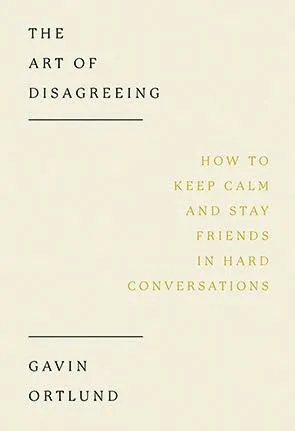
THE ART OF DISAGREEING:
How to Keep Calm and Stay Friends in
Hard Conversations
By Gavin Ortlund
Good Book Company. 96 pages. £7.99
ISBN 978 1 802 541 403
I was very glad to receive this timely title from the author of Finding the Right Hills to Die On (which does not refer to actual hills or actual dying, but does help to put our positions on some theological topics into perspective!). What is plain is that the same irenic spirit displayed in that book can also be found here in this brief book.
Ortlund begins by asking why disagreement is so difficult; he helpfully reminds us that disagreement is not necessarily a bad thing, the issue is how we disagree. He suggests that ‘in the modern world, we are losing the ability to disagree well,’ and that this leads to fractured relationships. By contrast, when disagreements are handled well, they can be productive and lead to mutual understanding. When we learn how to disagree well, instead of making enemies we make friends. To develop this posture in our relationships with those with whom we might not see eye to eye, the author suggests five things that ought to be displayed in our lives:

1. Kindness. Ortlund writes that ‘when we sincerely wish others well, it comes across’. Yet he also reminds us that kindness must not be confused with a sentimentality that refuses to see the difference between truth and falsehood.
‘Jesus, teach us how to disagree, with your courage and your compassion flowing through our hearts.’
2. Courage. The author helps readers to see when we should not back down, as well as when we also need courage to engage with those from whom we differ, so that we can clarify both their and our points of view.
3. Listening. Here he suggests that listening is not high on our culture’s list of values, but is a vital feature of true Biblical spirituality. This for me was one of the most valuable parts of the book. Ortlund offers six insightful strategies for learning how to listen (see a summary below), and a five-step guide for how to pray about being a person who genuinely listens.
4. Persuasion. This is one of the tricky bits of learning the art of disagreeing. Ortlund offers eight steps for seeking to graciously persuade another person to change their mind. Again, this is a posture that seeks to be humble and involves ‘keeping an open mind as we open our mouths’.
5. Love. In this section the author takes a deep dive into the passages in John’s Gospel that call for Christians to show love and value unity (John 13 and 17). He also makes good use of The Mark of the Christian, Francis Schaeffer’s brilliant booklet on love as the Christian’s badge. Ortlund suggests that this posture of love ‘means we must lay aside any agenda that has to do with our own reputation or ego or selfish desires and instead seek the broader good of the kingdom of Christ’.
The book is enhanced by some thoughtful concluding prayers and helpful questions after each chapter. In a world that tends to easily fracture, and where it has become easy to be disagreeable, time spent pondering this little book could be a game-changer.
Strategies for Listening
First, be content to take your time in arriving at a final judgement about the disagreement.
Second, if you are more talkative by temperament, be careful not to overcrowd the conversation with your words.
Third, ask clarifying questions. Asking questions of someone you disagree with is not compromise. It is a way to distil and clarify their ideas so that you can better understand them and the nature of the disagreement.
Fourth, pay attention to little details, including the speaker’s non-verbal communication. Good listening involves observing fine distinctions rather than clumping ideas together based on loose association.
Fifth, remember to give the benefit of the doubt. In any conversation, there will be some level of ambiguity in what the other party is saying. This presents us with a choice. We can fill in the blanks in a way that assumes the worst, or that assumes the best, or that lands somewhere in the middle. Make it your goal to assume the best, within reason. Err on the side of naïvety rather than cynicism.
Finally, when you are confronted with strong or dogmatic opinions, remember that there may be pain lying underneath these views that you cannot see.
See the extract from The Art of Disagreeing here.