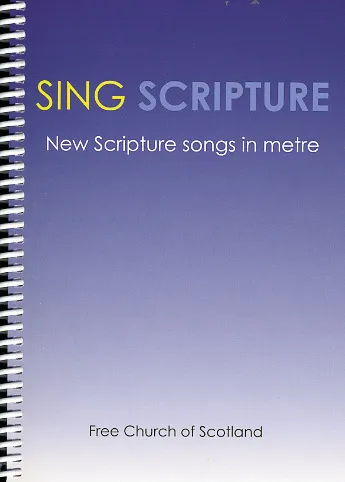
SING SCRIPTURE:
New Scripture Songs in Metre, third edition
2015 (mainly words only)
Edited by Donald M Macdonald
Free Church of Scotland. 142 pages £6.00
ISBN 978 0 954 459 148
More than ever these days, some humble sensitivity is needed in assessing Scottish developments from south of the border; we must respect one another’s histories and heritage. What may appear to the English as faithful but plodding paraphrases are probably a breath of invigorating Highland air, sharing the rugged style and extending the scope of the older Psalm versions.
These songs come in Bible order; 13 from the prophets, eight from the gospels, 48 from the epistles and six from Revelation, plus two robust baptismal hymns. One of two ‘extras’ with new music is straight, unrhymed Numbers 6, which makes us wish that Exodus or Deuteronomy had been included. Smooth rhymes and stresses take second place to accuracy of meaning.

Whole congregation can sing!
The most popular stanza-forms are Common Metre (CM, as in ‘Crimond’) and 8787D, but a dozen others are also used; just one in Short Metre. Accessible and singable tunes are named for each text; the beauty of this is that they can be sung unaccompanied or with one basic instrument; the ‘worship group’ is the whole congregation! With four exceptions the verses are anonymous; another great idea, if hardly a new one.
We may be struck by the length of many items, usually qualified by indications of ‘convenient sections for singing’ (verses 1-6, 6-10, etc.).Whether even so these texts will find their way on to our southern screens remains doubtful. We could do a lot worse, and often do; but after making every cultural allowance, it is hard to imagine singing some narratives (Luke 4, John 3) or arguments (Galatians 5) in metre. ‘While shepherds watched’, old style, was surely a one-off. It is good to have Matthew 11.28 in full context, but generally the soaring lyrical passages from Isaiah, Paul and John seem more effective and their treatment here more justifiable.
Enriching
They could certainly enrich those whose only permitted sung praise has been a rigidly traditional form of the Psalms. Such churches should welcome a useful Foreword and some exemplary copyright provisions, both generous and sensible.