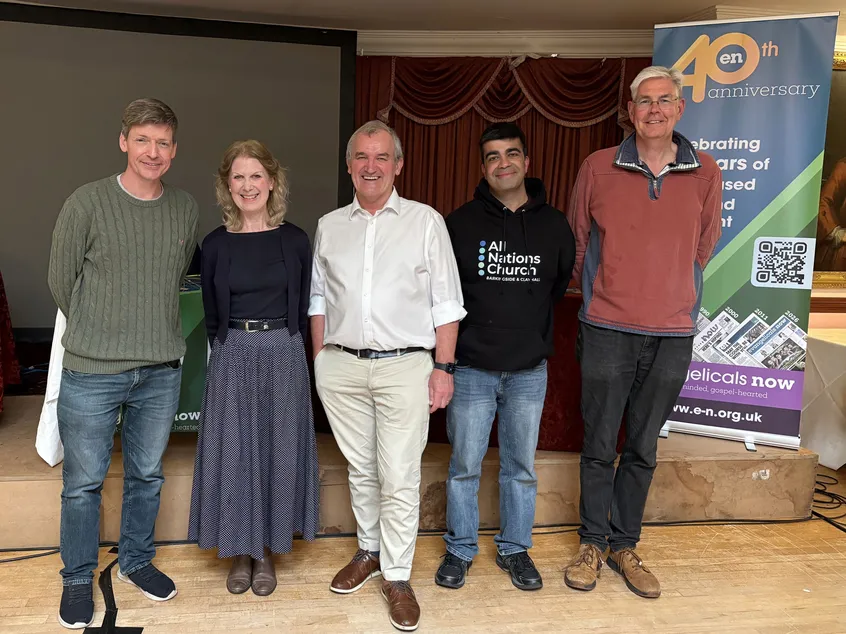
At the Livermead House Hotel in Torquay, Devon, a panel of well-known Bible-based Christians were posed a question: "Is the term 'evangelical' an 'outdated' title?..."
From 6-10 April 2026, around 2,000 Christians gathered in the South of England for the first "Rising Lights" event - an Eastertime gathering organised by the Fellowship of Independent Evangelical Churches (FIEC).
en was exhibiting at the conference, and on Thursday 9 April hosted its own version of the BBC's "Any Questions?" which saw an invitation for Rising Lights attendees to submit questions to the panel.
Evangelicalism
Founder of The Good Book Company and en's Vice-Chair of Trustees, Tim Thornborough, took on the responsibility of hosting the panel discussion. And he began by stating: "'Evangelicalism' has been the phrase that we've used - it's the title of Evangelicals Now - but it's a title that has come into some disrepute by groups around the world who behave in different ways and believe different things."
Thornborough added: "The word 'evangelical' has, sort of, defined us for generations. The key 'pillars' of it might be something to do with the Bible - Bible-centred, gospel-centred, cross-centred - and active in how we pursue and reach out with our faith."
Panel discussion at the Livermead House Hotel
Thornborough then turned to the panel: "Is the term 'evangelical' an 'outdated' title? Should we look for something else or should we seek to add another 'pillar' to what we're doing, so that people really understand who we are, and don't confuse us with some of the slightly 'balmy' people out there?"
The Christian Institute's Sharon James was the first to answer.
Four pillars - and a fifth?
"I am thrilled to be an evangelical," James began. "It's a great word deriving from 'gospel', 'good news'. It goes right back to Wycliffe, the evangelical doctor; we have a fine heritage going back." James cited David Bebbington, referencing the historian and professor's concepts used to define evangelicalism.
James continued: "We believe in the inspired Word of God - that's the first thing. We believe in the redemptive blood of Jesus Christ... redemption, the gospel... That's the second thing. We believe in personal regeneration, the work of the Holy Spirit, and we pray for revival - that's the third thing. We are activists. We believe that if we love God, we will love neighbour."
Outlining her work with the Christian Institute in defining the term, James said: "We've added a fifth pillar. We've been radical. We've said that we need to emphasise fellowship; fellowship that even if we differ on secondary issues such as church government or various other questions, if we believe those four things, we are brothers and sisters with the millions of people across the globe who also believe those things."
John Stevens
A few minutes later, FIEC National Director John Stevens was called upon, for his thoughts on the 'evangelical' title. "I completely agree with Sharon," Stevens began. "I think we've got to reinvest it with its real historical meaning."
Stevens went on to state that he doesn't believe the "answer" is to abandon the term. "The answer is to actually keep filling it with its real meaning and keep living out the kind of clarity and generosity that it's meant to be able to convey," he said.
Political differentiation
It was to evangelist, podcaster and apologist Glen Scrivener - of Speak Life - that Thornborough turned to next; the third member of the four-person panel. Thornborough quizzed Scrivener on how he would interact with someone who might misunderstand the title 'evangelical'.
Glen Scrivener
"Perhaps the best thing to do is to say, 'Yes, I'm an evangelical but my understanding and the global church's understanding of evangelical is not a voting bloc'," Scrivener said.
He continued: "Which is what I think in a US context 'evangelical' has come to mean. It's been a reliable voting bloc for one particular party in a two-party system for the last 40-plus years. And it has had an outsized influence on the most powerful country on earth, and is used for good and for ill for political purposes by the largest, well, the most significant country in terms of global power."
"And so you want to differentiate 'evangelical' from its political roots," Scrivener continued. "But I think it's for that reason that it's probably important to hold on to 'evangelical' because I think the global church can teach the US church what an evangelical really is."
'What on earth is an evangelical?'
"Do you use that term in your ministry?" Thornborough asked Rick Raja - Minister of All Nations, Barkingside, and the final panel member. "Or do you tend to use other kind of words to describe yourself, to self-identify?"
Raja replied with an anecdote: "I'd been a Christian for maybe six, seven years. I was applying to a theological college, and there was a question there which said, 'Please describe your theological convictions'. And I thought, 'Right, okay - I believe the Bible, the Lord Jesus Christ, who died and rose again for my sins...'
"But I said to my pastor, 'Hang on, they want it in a few words - in a word or two.' And he said, 'Just put evangelical.' I looked at him, and I was like, What on earth is that? And he said, 'Well it's all the things that you've said, that - in one sense - distinguishes you from, say, a [Roman] Catholic.'
"And I said, 'Okay I'll just put that down.' So I put 'evangelical' down.
"I think the point is you can be a Christian, particularly as a new Christian or young Christian, and be doing those things. And at what point does it matter? At what point do you have to understand the term or use the term?"
We'll conclude by revisiting James' contribution. After outlining her 'pillars' of evangelicalism, James added: "In initiatives like A Passion for Life, we can do gospel work together because we believe that the blood of Jesus Christ saves sinners from sins. We've known that for ourselves and we want others to know that because we want God to be glorified.
"And that fellowship is global, not just British. Evangelicals are across the globe; 75 per cent more of evangelicals are in the Global South now. And they're our brothers and [sisters]. And we can have that marvellous unity."
James concluded: "So yes, the term has been brought into disrepute, but rather than ditching it, let's be more radical about it and live it out, and make it a term that Evangelicals Now can go on calling itself, without the cost of rebranding!
"Let's own it."