As we look forward to Easter, some of us may reflect on how many people attended Christmas services, and be recalling the joy of overflowing churches.
There has been talk of a Christian revival in the UK for at least a year – and speculation about it everywhere from the press to podcasts. But where is the data showing us how the Spirit is moving? Instead, we are often presented with disappointing data from various denominations about decreasing numbers of people attending church.
The Bible Society’s latest report A Quiet Revival might well be the evidence we have been hoping for, showing a potentially significant shift – and particularly in young people’s approach to Christianity.

What do the statistics show?
Published on Tuesday, A Quiet Revival compares two YouGov polls on churchgoing and Christianity with over 13,000 people, conducted online in 2018 and 2024, and augmented with fieldwork at the end of 2024. It is robust research, albeit based on self-reporting. And the statistics is shows are somewhat staggering – and in a good way!
Attitudes to church
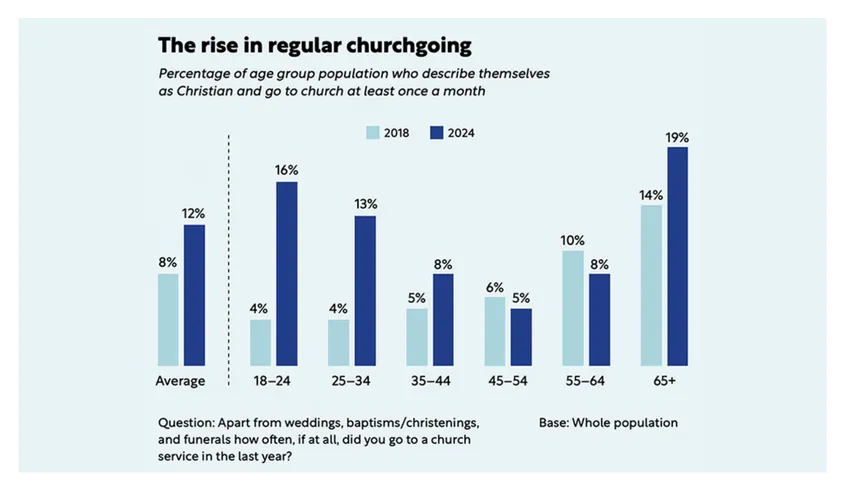
Twelve per cent of those surveyed said they attended church at least once a month last year, a rise from 8% in 2018. The report is clear that "in numerical terms, that’s growth from 3.7m in 2018 to 5.8m in 2024 – an increase of 56%".
Some of this can be attributed to a growth in diversity, and the reports notes that 32% of churchgoers aged 18–54 are now from an ethnic minority. However, that is far from the full picture. In 2018, just 4% of 18–24-year-olds said that they attended church monthly or more. In the more recent survey, this figure had risen to 16%. In a world where there is growing concern about young men, this survey showed their church attendance rising most – from 4% to 21%.
Attitudes to the Bible
So, more younger people are putting themselves in pews – but this report found that 67% of churchgoing Christians now also read the Bible at least weekly outside of church, and noted "both Bible reading and rates of confidence in the Bible have increased among churchgoers compared to 2018". The report’s co-author and Bible Society’s Director of Research and Impact, Dr Rhiannon McAleer describes this as "high Bible hunger" on a podcast conversation with Justin Brierley. And that faith is accompanied by a desire to do good – 79% of churchgoers said it is important to them to try to make a difference in the world.
Our country’s denominational make-up looks to be changing. Catholicism has significantly increased, while Pentecostalism is now the third biggest Christian tradition in England and Wales, with the percentage of churchgoers identifying as Anglicans dropping steadily. The report reveals nominal Christianity is falling away – the idea that people are "to some extent Christian ‘by default’ is rapidly diminishing."
Questions to be asked
There are questions to be asked about some of the data – this new report indicates that both Church of England and Catholic churchgoers went up significantly between 2018 and 2024. But data from the denominations themselves indicates a decline over the period between 2018/19 and 2023 in both Catholic and Church of England attendance. When will this data be reflected in the pattern seen in the pews? Is it that people might be prone to saying they attended church when what they meant was, they intended to attend? Or perhaps we have more people coming along to our churches for a smaller proportion of Sundays – if ‘committed’ used to mean once a week, is it now more realistically once a fortnight or even once a month?
The report highlights some more saddening statistics too. It reveals young people are struggling to read the Bible. Thirty-five per cent of 18–34-year-old churchgoers agree that their faith is undermined when they think or read about some parts of the Bible. The most common words used to describe the Bible are outdated and contradictory. More than half of the population (51%) apparently disagree that "the Bible is relevant to me personally", with just 25% agreeing that it is personally relevant.
How the Bible is being consumed is also changing. You might wonder if print Bibles might be going out of fashion with a younger demographic – but that just isn’t the case. Two-thirds of those attending churches who read the Bible use a paper Bible at least weekly. Those 18–34 are the ones you’d think most likely to use a Bible-reading app, but like 35–54-year-olds, they use hard-copy Bibles almost as often. Instead, younger Christians are the group most likely to engage with the Bible through audio recordings.
What can you do about it?
All this data is fascinating, but how can churches helpfully use it – what might we think about doing differently as a result?
We can be confident in encouraging personal evangelism. The report shows an amazing openness to Christianity - 34% of 18–24-year-old non-churchgoers would go to church if invited by a friend. It describes a normalisation of Christianity in the culture, and how people are searching for meaning and community – and finding it in church. They just need someone they know to point them in the right direction.
We can be confident that evangelism is best done as part of a relationship. Popular figures from Tom Holland through to Christian footballers might speak publicly about the benefits of faith, but "over a fifth (22%) of non-churchgoing 18–34s say they would read the Bible if recommended by a family member or friend they trust, compared to 13% who would if a trusted celebrity or public thinker recommended it." And the report shows we have more work to do in helping to grow "understanding of, experience with, and confidence in the Bible." The report suggests that "intentional intergenerational conversation" would help hugely with this – and that it needs to be a listening and learning experience for everyone.
This report reveals some staggering statistics about how churches are growing – and growing younger. We need not be staggered when young people walk into our churches. Many of their hearts and mind are open, looking for connection and meaning. They might have many questions, and some may be lacking in Bible confidence, but we can be ready to welcome them – and ready to help them share the gospel with those they themselves are in relationship with.
If there is a revival underway– quiet or noisy – we all need to be ready to do our part in sharing the good news.
Beyond the algorithm: Faithfulness in a 'viral' age
My son does social media for his part-time job. Part of the task is creating posts for the business's social …