Christian art? ‘Agenda-driven’? Try watching Netflix for five minutes...

Lydia Houghton  |  Features
Date posted:  26 Aug 2026
Share Add       
Christian art? ‘Agenda-driven’? Try  watching Netflix for five minutes...

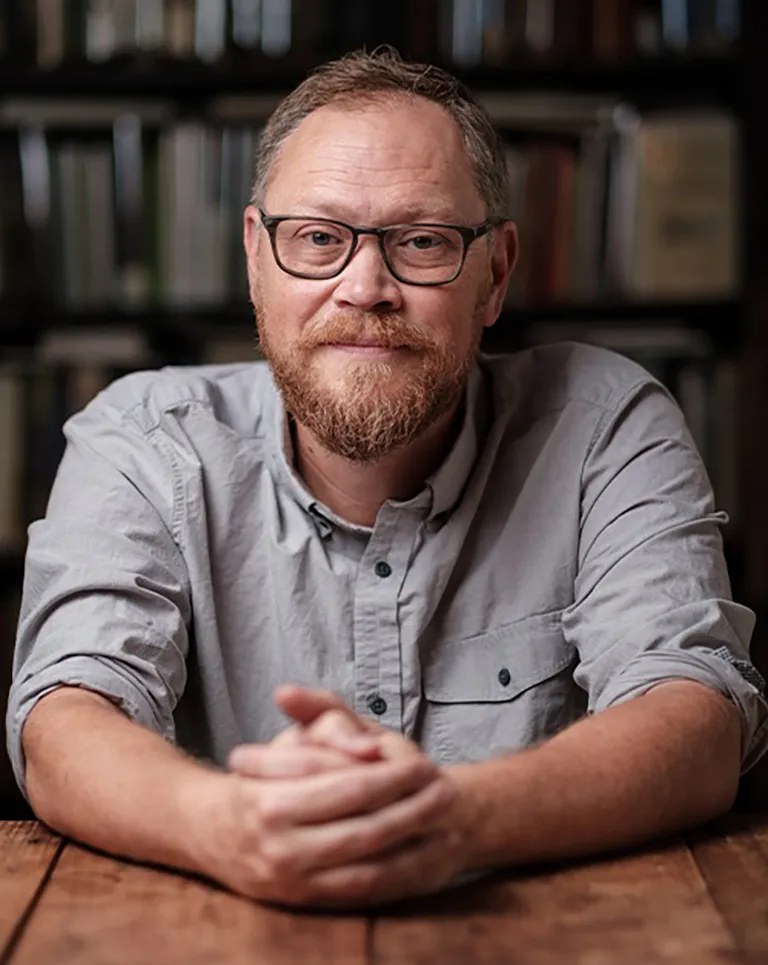
Andrew Peterson (photo: thrive.asburyseminary.edu)

en journalist Lydia Houghton interviews American musician and author Andrew Peterson. He is best known for the Wingfeather Saga, a fantasy adventure series for young readers, which has sold over a million copies and been adapted into an animated series. As a Christian folk-rock singer-songwriter he is known for “Dancing in the Minefields,” “The Silence of God,” “Be Kind to Yourself,” and the modern hymn “Is He Worthy?” (co-written with Ben Shive).

LH: Andrew, in your own words, how would you describe what you do?

Andrew: I think of myself mainly as a songwriter. I moved to Nashville 30 years ago or so to be a songwriter and along the way fell into some different things and am so happy about that. So, I am an author and I love to garden and to beekeep. And I founded the Rabbit Room, which is a ministry that gathers artists. And so, yeah, I do a lot of different things. It’s hard to know how to answer that question. But I’ve noticed about myself that I still think of myself mainly as a songwriter. So, I think of everything else in terms of how it compares to songwriting.


LH: Off the back of that, how does your faith impact your day-to-day, and your work too?

Andrew: Oh, it impacts it in every way. I grew up in the church, but really, I think of it as really giving my life to Jesus when I was about 18 or 19 years old, and I have only become more convinced the older I get that it’s the best story and the truest story. Yeah, I, for whatever reason, don’t know how to order my life outside of that context. And so, for example, when I sit down to write a song, I don’t usually sit down thinking, “I’m going to write a song about Jesus.” I’m often writing a song about whatever. And for whatever reason, my internal compass always aims in that direction. And so, I tend to pretty naturally be in conversation with God as I’m working.

And it’s funny, my wife just asked me yesterday how often I think about God throughout the day. Isn’t that a good question? We were talking about that, comparing each other’s answers. And, you know, I told her, well, I think about Him in the morning when I have my, kind of, quiet time. And I think about Him when I pray before each meal. And in between, when life is not a crisis, I’m usually thinking about Him in terms of giving thanks for little things, you know. And so, the first sip of coffee in the morning, I usually take that sip and think or say, thank you, Lord, you know. I travel a lot, so when I am home for a long stretch, I’m really grateful to sleep in my own bed and have my own pillow. And so, every night when I get in bed, I notice that I say, thank you, Lord, that I get to be in my bed tonight. So, I think that it’s just an ongoing conversation that happens throughout the course of the day.

And that changes when I’m in crisis mode. And I think that it’s interesting, isn’t it, that when you’re going through something really difficult, that conversation is amplified to the “nth degree”. I feel like I’m much more in communication with the Lord when I’m desperate and when I’m hurting. And so, yeah, that’s how it feels to me. It just feels like, oh man, what a relief that right now the seas are calm, and I can just enjoy the beauty of the world that He made. I don’t know if that answers your question?

LH: It does. And that’s a beautiful answer. Gratitude and thanking Him, like you said, for the first sip of coffee, it’s just a wonderful blessing to be able to do that. Now, On the Edge of the Dark Sea of Darkness – the first book of the Wingfeather Saga – was your first book. Where did the idea for that come from?

A poster for season three of the Wingfeather Saga animated TV series (photo: wingfeathersaga.fandom.com)

Andrew: A lot of it came from wanting to tell a good story to my children. We read a lot as a family aloud, so I would, you know, as often as I could when I was home, you know, we would gather around before bedtime and read our way through a story, whether it was Narnia or Watership Down or, you know, The Hobbit and different stories – there was always some story being told in our house. And I recognised that it was hard to find the kind of stories that I really loved and thought, I would love to try to just write one that would make 12-year-old Andrew happy. That was kind of my main goal.

I loved to read adventure stories when I was a kid. And so, I just wanted to write a story that would make my kids happy and make me happy. So, yeah, that’s where it came from. I read a lot of fantasy when I was a kid, and so really love world-building; certain things can happen in a fantasy story that can’t happen in other kinds of stories. And so that’s what I wanted to try.

LH: C.S. Lewis maintained that the Narnia books in his eyes weren’t allegorical. So, I wanted to ask you, are the Wingfeather books allegorical in any way?

Andrew: No! They’re not. I love that you know that about C.S. Lewis. I often have to clarify it when I get asked that question in a public context. Because I think what people want is for me to say, yes, it’s allegorical, and this is how it is an outflow of my faith. Just because you can, I think, probably sniff out the fact that I’m a Christian while you’re reading the books does not therefore mean that they’re allegorical. And so, I love C.S. Lewis’s answer – he said that the Narnia books were “supposal” stories. And so, in that strict sense, Aslan doesn’t represent Christ, he is Christ in that world. And I love that you know that! It makes me so happy.

And of course, Tolkien was very allergic to the idea of allegory in his stories. And I’m the same. And I think I blame it partly on the fact that I’m a pastor’s kid. Like, because I grew up in the church, I was always suspicious of a lesson. Or if I sensed that, you know, if there was a story that was going along and all of a sudden there was the application that presented itself, it popped the bubble and all of a sudden, I was not in the world with the story anymore.

And you know, it’s funny – Christians get a lot of grief, I think, for the fact that Christian art is often accused of being agenda-driven. But anyone who watches a Netflix show… it takes five minutes to see that it’s not just Christian art that is agenda driven. And, you know, people say Christian movies are bad, and I want to be like, how many of us has flipped through Netflix trying to find anything that’s not terrible, right? It’s not just Christian art that’s bad, humans just make bad art; but also, humans make really wonderful, transcendent, beautiful art, whether you’re Christians or not.

And so anyway, I’m kind of soapboxing here. But so, when I sat down to write the Wingfeather Saga, my goal was to try to tell the very best story that I could tell, to write a story that would make an eight-year-old child want to turn the page and find out what happens next. And, because I am a Christian – and because I’m used to doing this in songs – I don’t have to try to write Christian songs, I am a Christian, and so my songs end up having the fragrance, the aroma of my faith, right? And so, I think my story was the same way.

I wanted there to be a maker in this world because in my mind, it just makes sense that the people in the world of Aerwiar would assume that somebody had to have made the world, which is how most of humanity has thought over the years. But other than that, the things that show up that are moving to people and that resonate with their Christianity, I think are organically infused in the story.

And what I love about that is that when I go to the bookshop, I see the Wingfeather Saga next to Philip Pullman books, next to J.K. Rowling, next to Katherine Rundell, you know what I mean? I’m not saying that I’m nearly as good as any of those writers, but I am saying that my goal was for the story to be taken on its own merit as a story, not filed under “Christian books”.

And the cool thing about that is I’ve had so many stories from people who are, firstly, just relieved that there’s a great story their kids can get lost in; that they don’t have to worry about certain content. But also, I have been so delighted to see the way the Holy Spirit has moved in the story, and I’ve gotten emails from people who have the most astonishing stories about how God spoke to them through this book in ways that I, the author, could never have crafted. And so I think that’s the real joy of entrusting the ends to the Lord – like all we can be in charge of is telling a good story and I mean that metaphorically, we can’t control other people, we can’t control the outcome, we have to kind of release that illusion of control over the reader and just allow the story to be the story and then the author gets the delight of seeing how God is using it.

The Wingfeather Saga Box Set is now available to buy.

Share
< Previous article| Features| Next article >
Read more articles on:   TV & film  /  interview  /  music
Read more articles by Lydia Houghton >>
World
Ukraine: Good  news amid war

Ukraine: Good news amid war

European Christian Mission International (ECMI) says that, among Baptists alone, around 160 Ukrainian churches have been planted across Europe during …

People
Chris Cummings

Chris Cummings

National charity Church Urban Fund (CUF) – which works with local partners to help them reach out to their communities …

New here?

Register and get three free articles each month!

Register

Need to advertise?

We can help you reach Christians across the country

Find out more