
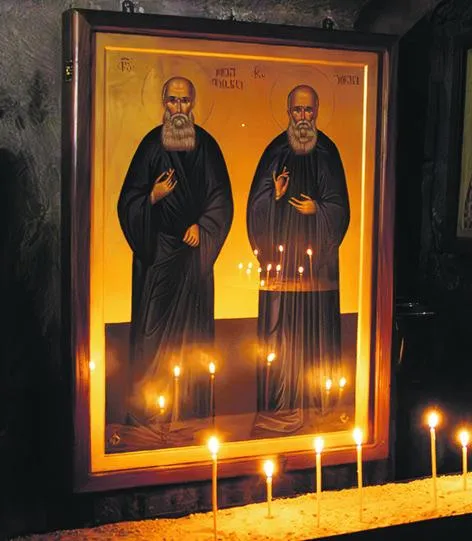
I begin this occasional series on Eastern Orthodoxy by taking a look at icons. Icons are perhaps the thing that most non-Orthodox people associate with Orthodoxy.
Flat and two-dimensional images of saints, the Virgin Mary (often referred to as the Theotokos or Mother of God in Orthodoxy) and Jesus Christ, icons can be seen in Orthodox homes but most prominently in Orthodox churches. There they are placed on the walls, but are most concentrated on what is called the iconostasis, which is the screen in the church before and behind which the liturgy is conducted.
The iconostasis indicates the central place that icons have in Orthodoxy in general and in its worship in particular. As in its worship, so with an icon “nature and supernature, here and the beyond, world and God, are linked together” in the words of Metropolitan Seraphim. Icons are a bond to Christ, Mary and the heavenly church of the glorified saints in the eternal world. As such icons are not merely images that remind the faithful of what they portray, but rather they connect them to their reality. In his classic defence of icons, the great seventh-century Syrian theologian, John of Damascus, says that they are “materials laden with Divine energy and gracious power”. Or as the Orthodox liturgy puts it: “Not before powerless idols do we believers prostrate ourselves … No … from [them] we draw the grace of salvation”.

Eastern Orthodoxy and 'Trojan Horse' church planting
I have been interested in Eastern Orthodoxy ever since spending my linguist's year abroad in Novosibirsk in 1995/6.On my …