Sharing the gospel in a multicultural world

Jonnie Green  |  Features  |  engaging with culture today
Date posted:  13 Oct 2025
Share Add       
Sharing the gospel in a multicultural world

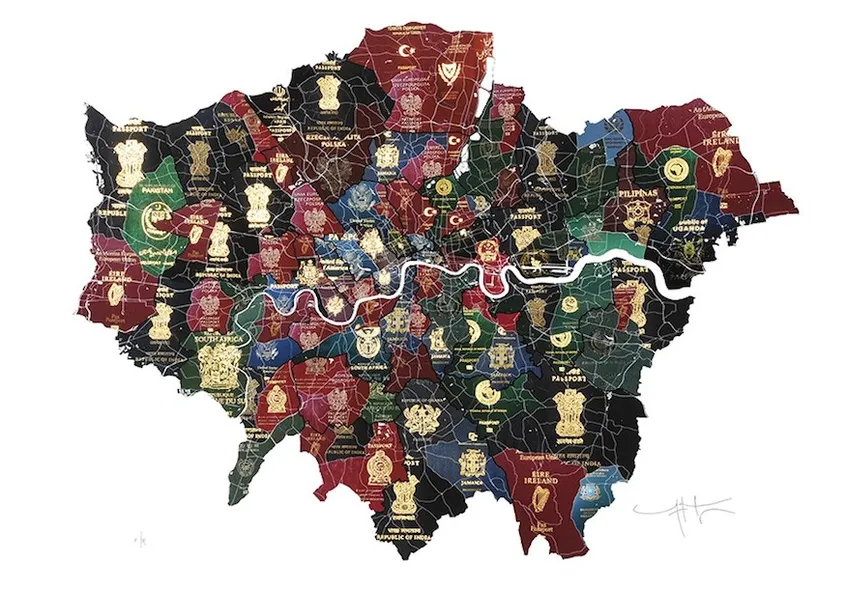
London Passport map, 2015, by Yanko Tihov. See full photo caption below

Who is your neighbour? I’ve enjoyed living in some very mixed neighbourhoods: Cantonese families next to Pakistani families, Ukrainian young professionals sharing housing with Indian graduates. In a culture which is growing increasingly fearful of the foreigner, the church has an amazing opportunity to share the gospel globally by sharing it locally.

But how? If, like me, you have existed within Western culture your entire life, we have been submerged into the waters of modernity. The very way that we see the world sits within the frame carved out by Plato, Kant and Nietzsche. We cannot help it. As Christians the way we think, feel, and see the gospel also sits within this frame. So how can I possibly share the gospel in a way which connects with someone who sees the world in a different frame? Someone who thinks, feels, and sees the world in a different way to me?

I think the answer lies not in what is different, but in what is the same. This is where the Dutch Reformed theologian Johan Herman Bavinck can really help us. In his careful reading of Romans 1v18-25 he begins to unpack that God is always revealing something of Himself through general revelation. In short: God is already speaking to everyone; this is culturally universal.

Bavinck then pushes it further: this general revelation expresses itself in a kind of “knowing not knowing” that bubbles under the surface of every human heart. The revelation is clear from God, yet suppressed by our sin. This creates a consciousness which seems to gravitate towards certain magnetic points: five hidden themes our world cannot stop talking about, that form the foundational questions we all seem to be asking. These magnetic points are summarised as: the norm; deliverance; totality; destiny; higher power. Can these points be the area where we can engage the multicultural world, precisely because it’s the place everyone is already in conversation with God?

Take for example deliverance: the universal acknowledgement that there is something wrong with the world, and it needs to be fixed. Working with international students I often find myself with friends from different cultural backgrounds, and will ask two questions: “What is wrong with the world? And how do we fix it?” Unsurprisingly there are a variety of answers: humanity is the problem, extinction is the answer; selfishness, corporations, lack of love, greed, lack of resources… people are not short of answers to “What is the problem?” And many have got great ideas on how to fix it.

To move the conversation from the hypothetical to the personal, try a follow-up question: “What do we do when we think we have done something wrong?” Again multiple answers may be proffered: it could be ceremonial washing to cleanse shame; or donating money to a good cause to “cleanse” the conscience; or a shower after a night of guilt… This is something we all do: we all have patterns of deliverance built into our lives. But do they work?

This is a conversation which has started to move from the theoretical into the personal; a point where it feels natural to introduce the transformative “world” of the gospel. You see, unlike our worlds that sit in specific frames, the world of the gospel can subvert the multicultural. In the Biblical world we are introduced to a brokenness that spreads further and deeper and more personally than we first thought. The whole cosmos is cursed. Yet it also introduces us to a God who engages with this brokenness in a way which spreads further, and deeper, and more personally than we first thought. You could just ask: “May I share how the Christian story shows us the problem, and how it’s fixed?”

Whoever your neighbour, we don’t need to be specialists; we can simply join in the conversation God is already having with them.

Photo caption: In 2015, artist Yanko Tihov made a map of London consisting of passports. It shows the most common non-British nationalities in each borough, using data from the 2011 census.

Share
< Previous article| Features| Next article >
Read more articles on:   culture
Read more articles by Jonnie Green >>
Features
What is good, anyway?

What is good, anyway?

Recently I was going through the new Uncover resource with a Hindu friend. During the conversation he stated that ultimately …

Need to advertise?

We can help you reach Christians across the country

Find out more

About en

Our vision, values and history

Read more