It is 50 years since the brutal Khmer Rouge seized power in Cambodia. Their genocide resulted in the deaths of 1.5-2 million people in the four years that followed. Here, the testimony of Christians from that time echoes down the years.
You are about to read some remarkable stories, writes Julia Cameron in the foreword to the book from which these accounts are drawn. They will stay with you. I’m sure of that.
Don Cormack’s Killing Fields, Living Fields, from which these excerpts are taken, traces the journey of the Cambodian church, from its early beginnings among a few Battambang rice farmers in the 1920s through to the present day. We hope these vignettes may make you want to read more.
Don Cormack is uniquely qualified to tell Cambodia’s story. He was one of the last missionaries to leave Phnom Penh when it fell to the Khmer Rouge in 1975, and one of the first to return afterwards. In between, he spent time in the sprawling refugee camps which sprang up along the Thai/Cambodian border. Don learned the Cambodian language, and his pastoral approach won the trust of those he met. Some were deeply traumatised and could only tell him their stories over weeks or months, a little at a time.
These cameos convey something of Cambodia’s tragic history between 1975 and 1979, when little news was coming out of the country. In that small southeast Asian nation, through darkness, and bloodshed, and fear, and sheer evil, we trace the hand of God. There has been unimaginable cruelty in many other parts of the world, and one wonders how similar the experiences of Christians have been in these places.
It took 1,900 years for the gospel to reach the Khmer people. When David Ellison, an American missionary, first gave a copy of Luke’s Gospel to some simple Cambodian rice farmers in 1923, they were riveted. The truth took hold of their hearts. In such a deeply Buddhist culture, Christian believers were shunned, despised and vulnerable. They were sometimes imprisoned, and always blamed when there was sickness or crop failure in a village. Being a Christian made you a pariah.
Fifty years later, shortly before Pol Pot came to power, the Holy Spirit began to move in new ways. While threatening clouds were gathering over Cambodia in 1973, Major Taing Chhirc was following news closely from Edinburgh. After service in Lon Nol’s army, he was now in Scotland studying engineering. Meanwhile, back in Cambodia, a spiritual awakening had begun, and many were turning to Christ. Chhirc, perceptive and courageous, saw the need for these new Christians to be nurtured in their faith. He sensed God’s clear call to him from Luke 9v23-24 to return to Cambodia despite the huge dangers. There might, he knew, be little time.
In July 1973, he alerted the UK’s Keswick Convention to pray. “You have had the gospel for centuries,” he said from the platform. “Why did you never come and tell us?” His words were unforgettable. Then, leaving his wife and young daughter in safety in Scotland, he flew back to Cambodia alone. He travelled via Singapore to visit the OMF International Headquarters. There he urged Michael Griffiths, OMF General Director, and his senior team, to send help.
The mission was at full stretch. Was it right to commit more resources to a new endeavour? Who would go? Just a few months earlier, two women leprosy nurses in South Thailand had been kidnapped and murdered. Was it irresponsible to place missionaries in mortal danger? These were not easy decisions. It was eventually agreed that only unmarried missionaries should be sent, so no children would be orphaned. It was further agreed that no-one should be required to go; there would be a call for volunteers.
Don Cormack was in Taiwan at the time, studying Chinese. He was one of five OMF volunteers to enter Cambodia. Joining the others in Phnom Penh in October 1974, he had only a few months before the whole team had to leave again. The country fell to the Khmer Rouge in April 1975. Major Chhirc was martyred soon afterwards.
What follows are three of the ten stories contained in the book Ten Stories From The Killing Fields published by Dictum Press in partnership with OMF International.
Story 5. Haim and his family face their execution
Whole families were often executed together in these fearful years. The way that Haim and his wife and children faced their deaths was whispered about for a long time. The author learned of it from a refugee.
Haim knew that the youthful black-clad Khmer Rouge soldiers now heading across the field were coming this time for him.
Leaning weakly against his hoe for support – itself ironically the primary instrument of execution – he watched their easy, menacing, unhurried pace. He was determined that when his turn came, he would die with dignity and without complaint. Since “Liberation” on 17 April 1975, what Cambodian had not considered this day?
Haim’s entire family was rounded up that afternoon. They were “the old dandruff”, “bad blood”, “enemies of the revolution”, “CIA agents”. They were Christians.
The family spent a sleepless night comforting one another and praying for each other as they lay bound together in the dewy grass beneath a stand of friendly trees. Next morning the teenage soldiers returned and led them to the nearby viel somlap, the “killing field”.
Curious villagers foraging in the bush nearby lingered, half hidden, watching the familiar routine as the family were ordered to dig a large grave for themselves. Then, consenting to Haim’s request for a moment to prepare themselves for death, father, mother and children, hands linked, knelt together around the gaping pit. With loud cries to God, Haim began exhorting both the Khmer Rouge and all those around to repent and believe the gospel.
In panic, one of Haim’s young sons suddenly bolted into the scrub. With amazing coolness, Haim prevailed upon the Khmer Rouge to allow him to go and call the boy back.
“What comparison, my son,” he called out, “stealing a few more days of life as a fugitive in that forest, wretched and alone, to joining your family here momentarily around this grave, but soon around the throne of God, free forever in Paradise?” After a few tense moments, the lad, weeping, walked slowly back to his place with the kneeling family.
By this time not a soldier standing there had the heart to raise his hoe on the backs of these noble heads. Ultimately this had to be done by the Khmer Rouge Chief, who had not witnessed these things. But few of those watching doubted that as each of these Christians’ bodies toppled silently into the earthen pit which the victims themselves had prepared, their souls soared heavenward to a place prepared by the Lord.
Reports like these were spread widely and not always by Christians, but by typical Cambodians who, until then, had despised the Puok Yesu.
Story 7. Pastor Hom, his flock, and his personal grief
It is now mid-January 1979, four years after Cambodia’s fall to the Khmer Rouge. Ninety percent of the nation’s Christians have already been massacred, or have died of disease, overwork, or malnutrition. The Vietnamese army has overrun Cambodia, driving the Khmer Rouge westwards, into the malaria- infested jungle along the Thai border, with many thousands of their Cambodian captives.
Pastor Hom, one of only three pastors to escape the genocide, hears news that the Vietnamese have just captured Phnom Penh. Violence is rife and nowhere is safe. Famine and malaria are both huge threats to survival. His young assistant, Seng, had collapsed and drowned while bathing in the river, racked with disease and overcome by sheer exhaustion. Now, his darling infant son has a high fever.
All Cambodia, it seemed, was on the move. Days were occupied with foraging for rice in the fields. But as the multitudes were all doing the same, they were forced to go deeper into the countryside where a number were killed by lurking Khmer Rouge, gangs of thieves, or from stepping on landmines.
Nights were even more fearful. At the height of the fighting around Tmar Koul, the Christians, unable to sleep, prayed in groups through the darkest hours, out in the fields where they camped.
Although they were free, all the basic means of life now had to be fought for. Water was a major problem. The fleeing Khmer Rouge had purposely polluted wells and pools by throwing dead bodies into them. But there was little choice other than boiling it if you could, and drinking it anyway. Seeing that the food situation was deteriorating rapidly and the fighting around Tmar Koul was still going on, Pastor Hom decided to move them all to Battambang City. It was every man for himself. By the time his family reached the city, so had tens of thousands of others.
Battambang had already been derelict for nearly four years. But now the masses crowded in, chopping down the trees, pillaging, turning everything upside down. All were reduced to foraging around like pigs in a great filthy pigsty. Every day, like all the others, he grimly searched for food, “like an old buffalo”, he mused, hauling his cart behind him. The Khmer Rouge had killed most of the livestock, pigs, chickens, ducks, cattle, etc., and meat was almost impossible to find. But he had good reason to be thankful for his deft skill, learned in boyhood, of catching field rats. And for rice, he was forced to search for kernels under people’s houses or compete with the rats for it in former granaries.
Hom’s wife walked for miles every day to find clean water and haul it back. One by one they all became ill. The children had chronic diarrhoea and scabies and then they caught measles. An epidemic was sweeping the slum city of squatters. Running sores infected their eyes and worms crawled from their festering noses and mouths. His youngest child was at the point of death. The little thing was wasting away. His mouth was a mass of sores, gums receding, unable to take any sustenance.
One night at about nine o’clock, Pastor Hom watched him raise a tiny shrivelled fist and with one finger extended, pointed to his tongue. He hadn’t been able to speak for days. Hom took an orange which he had earlier traded for some of his precious rice. He squeezed one or two drops into the child’s mouth.
His wife, weeping silently, coaxed a few drops of milk from her breast onto a curled leaf and eased them into the child’s open mouth. Then, having given all they had, they bowed their heads and Hom committed the little boy into the Lord’s keeping, concluding “though you have granted me this great suffering, my heart has not grown small towards you. I still love you with all my heart. But it is a heart filled with tears.’
At one in the morning, Hom reached out his hand and felt the child’s little body. It was stone cold. In the morning they wrapped him up and laid his remains to rest in a little grave they had dug among the trees. But the father could not forget his baby son. He felt sapped of all energy. He cried out to God to please relieve his grief and give him peace, for his heart was deeply shaken.
It was the ceaseless search for a water supply which brought them wandering one day into a vast encampment along the jungled Thai-Cambodian border where I [Don Cormack] happened to be working. He [Hom] chanced to hear some people gossiping about a foreign Christian teacher nearby. Surrounded by other Christians who were walking with him, he hurried over. I was just leaving one of the hot and crowded little huts where I had been teaching, and was walking away surrounded by families seeing me off, and the usual throng of curious onlookers and excited children all eager to help carry any bags or books. As we rounded a clump of bamboo atop a dusty knoll at the head of a muddy water hole, we heard them calling out behind us and excitedly waving their arms. I shall never forget turning round in my tracks and seeing the little procession hurrying towards us in single file along the narrow path on the steep bank surrounding the pool. One face, definitely older, haggard and sunburned, shone out above the others. Full of character, it glowed with an unmistakable light and warmth. I said to myself: “This can only be the beloved Pastor Hom of Battambang.”
All the Christians, with their families and friends around them, seated themselves on the ground beside the tall bamboo. They wasted no time in discarding their tattered black Khmer Rouge rags for the new clothes we provided, and they soon looked once more like typical Cambodian country folk, only much thinner. Facing them, sitting cross-legged behind a cardboard box full of new Cambodian Bibles and hymnbooks, was Pastor Hom. These precious books he began to distribute among his people, most of whom had lost all their Christian literature. It was now time to worship and thank God for all these blessings. Using the cardboard box as his lectern upon which he had placed his own tattered old Bible, he began exhorting his listeners, taking the opportunity clearly and simply to explain the facts of the gospel to all the curious onlookers. I was walking back to the truck for more literature when the singing began. It was so unusual to hear a chorus of voices singing together in unison in such a grim place as this, that I stopped to watch.
The golden colours of evening washed the sky, and the camp was relatively still. As the growing awareness dawned upon them that, yes, they could sing here without fear of death, their voices grew in volume and ardour. Before long I was unable to see the Christians for the vast crowd which was gathering around them to behold the amazing spectacle.
Hearing only the sound of their voices from within the midst of the crowd, I began to concentrate on the words they were now singing with a quality of rapture and conviction I had never heard before, or indeed since. It was an old much-loved hymn translated from the English. The last time I heard it sung was in 1975 at Noah’s Church (a ship marooned and abandoned on the banks of the Bassac River in Phnom Penh, used as a church) on the waterfront of besieged Phnom Penh. That was just before they entered the fiery crucible.
And now here among the exiles it sounded again:
The love of God,
How rich and pure
How measureless and strong;
It shall for evermore endure
The saints’ and angels’ song.
And the Lord whispered to me in that moment: “They came forth from the furnace with no smell of the burning upon them”… no trace of bitterness, no anger, no “why this?” or “why that?” But there they were, kneeling in the dust, exhausted and hungry, all having lost at least one family member to the Khmer Rouge, yet extolling the love of God. They were rich with the fragrance of the knowledge of him: a fragrance acquired, no doubt, from walking close to the Son of God through the flames. And I was convinced that they would have extolled the strong love of God, as indeed others had, even to the grave, for with suffering Job, they could repeat: “Though he slay me, yet will I hope in him.” Little wonder the crowds were drawn irresistibly to them that day. They were being attracted not to religion, not to a band of defiant survivors, but to the aroma of Christ, lingering naturally about these very plain earthen vessels there in the shade of the bamboo along that war-ravaged border.
Pastor Hom’s name in Cambodian means “fragrant aroma”.
Story 9. A Khmer Rouge soldier finds forgiveness
By late 1979 many Khmer Rouge footsoldiers, scattered, alone and disheartened, were struggling to stay alive. Could God forgive them for the evil and untold suffering they had inflicted on their countrymen?
Thousands of demoralised Khmer Rouge, and the multitudes of dying wretches they had driven into the forests with them under Vietnamese shelling, were spilling over into Thailand. I was helping as an interpreter for two Christian paramedics among those tens of thousands of diseased and malnourished refugees, collapsed all over the forest floor along the Thai-Cambodian border, south of Aranyaprathet. Most were dying of malnutrition, dysentery and cerebral malaria. Midst all the crises and pressures, and with scores of nameless victims being carried away each day to mass graves and an uncertain eternity, it was difficult to feel any sense of the sovereignty of God in their lives, or indeed mine in this terrible place. It was then as I scurried from one emergency to another that my attention was strangely drawn to a young Khmer Rouge soldier lying in the leaves, close to death. Not that there was anything unusual in that, but from his wide questioning eyes which seemed to follow me everywhere as I moved to and fro in front of him, I knew I had to stop and talk with him.
There was nothing else I could do for him in the circumstances except to hold his head, and soothe his burning temples with a damp cloth. Bending close to his ear, I began to talk to him saying that I had some very important “good news” to tell him.
As I uttered the Cambodian words for “good news”, it struck a chord of recognition within him and he struggled to tell me in a voice full of urgency of a time during the revolutionary war against the Lon Nol regime when he lay wounded under a tree. A stranger from the nearby village had appeared and told him of the Living Creator God and Saviour, Jesus Christ. Though he secretly tried to discover more of this “good news” he never met anyone who could help him. Then in April 1975, following the fall of Phnom Penh and the forced exodus of all the people into the countryside, he found himself a member of the Khmer Rouge garrison guarding the empty capital. On one of his regular patrols he passed a house which had an unusual signboard fading in the sun on its front fence which again spoke of “Good News”. Day by day as he passed the empty house, it fascinated him, and he wondered who had lived there, and what was this “Good News” they had. He felt so close to finding the answer to his quest, but the house, like all the buildings in Phnom Penh, lay empty and silent.
Hardly able to restrain my excitement, I asked exactly where in the city the house with the signboard was situated. It was undoubtedly our Good News Centre, at 10 Pologne Avenue! The place where I had lived prior to my flight from the falling city in 1975. Then I told him that it was I who had lived in that house, and now I would gladly tell him the same “Good News” we had once proclaimed there, and so I did, as he listened intently. That the sovereign hand of God had been upon us both, bringing us together in this far away, seemingly “godforsaken” no man’s land, a place of war and death, and at such a moment, was awesome beyond comprehension.
I know he found peace with God that hot afternoon because the last audible word which passed his lips was “Jesus”, and then he slipped into a deep coma. The next morning when we arrived early at the camp, it was just in time to see the orderlies carrying his stiff and lifeless body away towards the mass burial pits. I went and sat down quietly for a few moments under the trees, beside the place still marked by the crushed leaves where a brother, whose name I never discovered, had lived briefly and then, without moving, died in Christ.
Though it was a grim and terrible place, surely, I thought, this is holy ground, for here the sovereign God had appeared to a seeker of the kingdom and taken him quickly home. And to me, God had given the reassurance that despite everything, he was still in control. Furthermore, it dawned on me at that moment that the Lord’s everlasting arms would reach and enfold even the Khmer Rouge. And so they did over the months and years which followed.
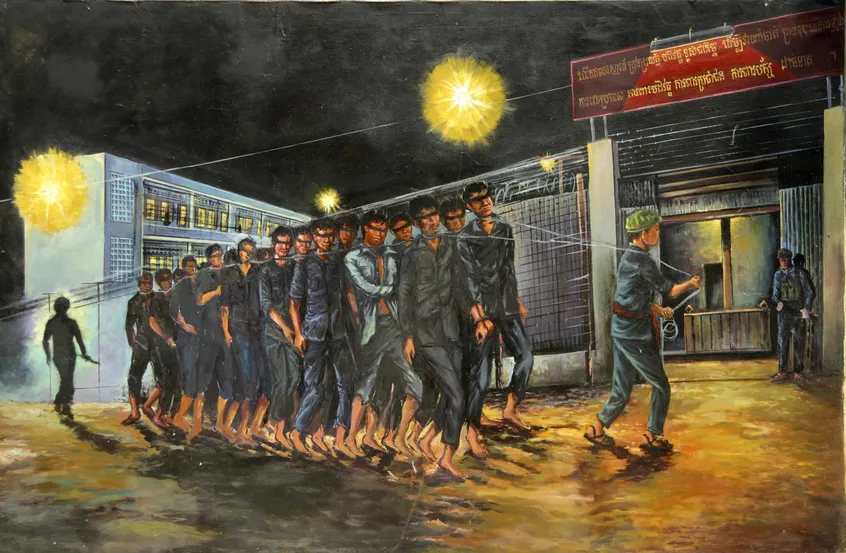
Full Picture Caption: A painting from the 2003 French documentary La machine de mort Khmère Rouge (The Khmer Rouge death machine). In Cambodia under the Khmer Rouge, the building pictured, S21 (Tuol Sleng) was the main “security office”. In this detention centre, a former high school located in the heart of Phnom Penh, between 18,000 and 20,000 prisoners were tortured, interrogated and then executed between 1975 and 1979. Only seven survived. At the time of filming, only three of them were still alive, two of whom returned 25 years later to testify (including the artist Vann Nath, whose painting is shown here), during a confrontation with their torturers. Nath was spared execution to paint dictator Pol Pot.