

The July 2023 edition of en ran my article "How can we think deeply about Islam?", a precis of a book that I am working on called Thinking Theologically About Islam.
It is my response of amazement that a religion with as little theological substance as Islam has can enthral the minds and hearts of so many millions of people. But to understand why I am convinced that a much more deliberately theological approach to Islam is needed, you will need to know something of my religious background.
I was brought up in a Catholic family, attending Catholic schools and going to church every week. Every evening, my dad would clap his hands and call us all (eventually we were 11 children!) to kneel around him and pray. Much of our religion was consistent with Bible teaching; we would pray: “Jesus, Jesus, God and man, I will love you all I can”. Our generally very happy home life reflected a nice, free-floating sense of spiritual significance. But this was the sum total of our religious heritage. For all practical purposes, religion’s role was the God-sanctioned method of making the best job of life in a difficult world. The catch-all answer to any (like me!) with lurking concerns about the meaning of life was to “have faith”.
Interestingly, the closest parallel that I have found to my early religious experience is in Islam, the religion of the Qur’an. Like my Catholicism, Islam does not try diagnosing a human predicament. It has no radical, God-given remedy to the cosmic catastrophe of sin. Prophets warn that God is God, and man is man. Wise people heed moral warnings and make the best of difficult circumstances in the present world in the vague hope of a better next. Muslims who may seek answers about the meaning of life and question the relevance of the Qur’an, often suffer a deep sense of betrayal of family relationships. To question is to blaspheme. The stock answer of family heads and mullahs is to seek to reinforce faith in the uniqueness of their book and the authority of their prophet. But, as with my experience within Catholicism, there are no answers for those with questions.
Another feature common to the Catholicism of my early experience and to Islam is the diminished role of God in religion. This may seem anomalous, especially in Islam where the untouchable majesty of Allah is emphasised. The existential reality, however, is that God is the unseen, undefined reason for taking morality seriously. In my Catholicism, “Jesus”, Mary and sometimes Joseph were viewed almost as proxy deities on whom one could focus your spiritual aspirations. Similarly in Islam, it is Mohammed and, to some extent, “Jesus the son of Mary”, rather than Allah, who are the focus of most religious fervour.
The result, in both cases, is that religion’s function is subjective and only very loosely connected with any clear concept of God Himself having a purpose. In 40 years of reflection on this, I have learned that what distinguishes Biblical religion most clearly from the religion of the Qur’an is the notion of God’s purpose. But how to know God’s purpose? Well, I thought, if God is God – whether Yahweh or Allah – and has arranged to have his thoughts written down, then we should allow him to “speak for himself”.
My “rules of engagement”
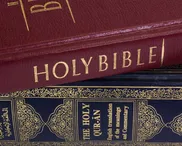
The rest of this article looks at what the Bible and the Qur’an say about God’s purpose. My “rules of engagement” are to allow these official, orthodox, primary sources of written revelation of both Christianity and Islam to stand as what they each claim to be: the sole, sufficient, verbally infallible communication from God to mankind.
It follows that what the respective books say about God’s purpose, is what God wants all people everywhere to understand is His purpose and, by extension, what He is really like. I consider this under three headings: the nature and scope of revelation; the presence, or absence, of genealogies and, the role of covenants in expressing God’s purposes.
Revelation – global, or parochial?
The origins and structure of the Bible and the Qur’an reveal much about the scope of God’s purposes. Take first the Bible’s divine inspiration: “All Scripture is breathed out by God and is profitable for teaching, for reproof, for correction, and for training in righteousness, that the man of God may be competent, equipped for every good work” (2 Tim. 3:16-17), and: “… no prophecy of Scripture comes from someone’s own interpretation. For no prophecy was ever produced by the will of man, but men spoke from God as they were carried along by the Holy Spirit” (2 Peter 1:20-21).
These verses teach that the words of the Bible have their origin in God Himself. Inspiration is supernatural but with the human agent’s personality naturally, and actively, engaged.
In the Bible, God spoke to His prophets over a very long period. Moses’ ministry started around 1,450BC. The apostle John completed the Revelation in about 95AD; some 1,500 years. God also spoke in many ways. Moses had almost “face to face” encounters with God. But God also used visual imagery, as at the “burning bush”. With Daniel, God used dreams, although Daniel still had to “capture” what he had “seen” and write it down.
Luke explains this human element as follows: “Inasmuch as many have undertaken to compile a narrative of the things that have been accomplished among us, just as those who from the beginning were eyewitnesses and ministers of the word have delivered them to us, it seemed good to me also, having followed all things closely for some time past, to write an orderly account for you, …” (Luke 1:1- 4).
There is also great variety in the types of human agents God used: Moses, the “prince of Egypt”, and David, the young shepherd; Nehemiah, the administrator, and Ezra, the priest; the apostle Paul, a trained theologian, and the apostle Peter, an “unschooled fisherman”; Luke, the medical doctor, and Amos, the farmer.
Finally, there is the variety in the Bible’s written forms, with at least ten different genres: straightforward historical narratives; human-interest narratives; guidance for ritual practices; poetic songs and hymns for the worship of God; wisdom for godly living; prophetic exhortation including predicting future events; “apocalyptic” writings using dramatic imagery about how the spiritual and material realms interact; the life, death and resurrection of Jesus Christ; an account of the expansion of the early church, and circular letters to help Christians understand God’s purposes and live accordingly.
The Bible was written in two widely circulated languages. Its Hebrew Scriptures, later translated into Greek, went with the Jews wherever they went among the nations. The contemporary Greek of the New Testament could be readily understood across the whole of the Roman empire.
All this variety means that the God of the Bible wants to be heard and understood, not only by the people originally closest to His purposes, but by all the nations of the world. The scope of God’s purpose is global, not parochial.
What about the God of the Qur’an? Islam also teaches that the words of the Qur’an have their origin in the mind of God. Allah makes his word to mankind known using the process of wahy in which a divine message is put into a human’s mind, in the language the recipient can understand: “We have sent it down as an Arabic Qur’an, in order that ye may learn wisdom” (Q 12:2), and: “Thus have We sent by inspiration to thee an Arabic Qur’an” (Q 42:7).
However, God alone is the active party; the recipient is passive. From a perfect divine original, words were communicated piecemeal to Mohammed in dreams, or trances.
“We reveal to thee this (portion of the) Qur’an: before this, thou too was among those who knew it not” (Q 12:3).
The prophet would then recall and recite the messages to companions who would memorise and transcribe the words. God thus communicates information not otherwise knowable. The messages were revealed to Mohammed between the year 609 and his death in 632. They became the Qur’an’s chapters, or surahs. After his death, written texts were collected and checked against memorised versions. A final version was approved and distributed during the reign of caliph Uthman ibn Affan (644 – 656); the whole revelatory process taking just over one human generation.
Although containing beautiful metaphorical language, with skilful variations of tone to highlight God’s majesty and authority, the Qur’an’s primary genres purport to be historic and contemporary narratives and prophetic exhortation. Previous books of revelation are mentioned, but are not relied on for authority. With its single human agency, single language, single historical period and culture, the Qur’an therefore stands entirely on its own authority. All peoples of the world need to accommodate themselves to the life and times of Mohammed if they are to appreciate God’s purpose. The scope of God’s purpose is parochial, not global.
The presence, or absence, of genealogies
In Islamic culture it is inconceivable to practise religion in any other way than within the extended family and the wider community. Loyalty within families is everything, and the Qur’an extols marriage as a blessing from Allah: “And among His Signs is this, that He created for you mates from among yourselves, that ye may dwell in tranquillity with them” (Q 30:21); and: “It is He Who created you from a single person, and made his mate of like nature, in order that he might dwell with her (in love)” (Q 7:189).
It seems quite anomalous therefore, that God himself should not link the process of divine revelation to human history through intergenerational connections among people to whom he has revealed himself. Instead, his final revelation to mankind consists in a book given to a single generation.
This highlights another difference between the religion of the Bible and that of the Qur’an. In the Bible, religion is about God acting within the intergenerational flow of human history. In the Qur’an, Allah speaks from outside of history.
Nowhere is this made clearer than in the Bible’s use of genealogies. Genealogies feature extensively in the Bible, but are completely absent from the Qur’an. Genealogies allow us to view the purposes of God progressively unfolding throughout history. Both the Old and New Testaments trace God’s activity through the lives of named individuals. In Matthew’s Gospel the focus is on the role of Abraham as the original custodian of God’s purpose. In Luke, the links go all the way back to Adam at creation. The long process of revelation is grounded in God’s dealings with real people in different periods of history. The genealogies are like God’s footprints in history. As a result, revelations from one period act as precursors to, and validators of, present and future revelation.
In contrast to this, the Qur’an’s only attempt to engage with previous revelation is to assert that whatever was revealed to earlier generations presented only the same message that Mohammed was bringing to his generation. It assumes also that all previous prophets worshipped Allah in the same way that Mohammed did: “Say ye: ‘We believe in Allah, and the revelation given to us, and to Abraham, Isma’il, Isaac, Jacob, and the Tribes, and that given to Moses and Jesus, and that given to (all) prophets from their Lord: We make no difference between one and another of them: And we bow to Allah (in Islam)’ ” (Q2:136).
But more than just linking divine revelation through the ages, the Bible’s genealogies provide a framework for revealing truths that seem irrational or, at best, unnecessary to Muslims. I’m thinking of the deity of Jesus Christ. This is an understandable stumbling block in a religion in which God stands outside of history and speaks to His created human beings who are within history. For deity itself to occupy the same created realm as his creatures makes no sense and appears to Muslims as an idolatrous affront to Allah’s dignity and majesty.
But if deity has from the very beginning been engaged intimately with His created realm, as is evidenced in the genealogies, then His direct entry into the creation in human form would at least have some provenance! The worlds of God and of man would, in some respects at least, be properly and intentionally coincident. Genealogies are certainly suggestive of this understanding. Matthew’s says: “The book of the genealogy of Jesus Christ, the son of David, the son of Abraham” (Matt. 1:1). And Luke’s: “Jesus, when he began his ministry, was about thirty years of age, being the son (as was supposed) of Joseph, the son of Heli, … the son of Adam, the son of God” (Luke 3:23, 38).
The Bible’s assertions about Jesus Christ are presented as the culmination of 1,500 years of God’s historic engaging with the world He created: “Long ago, at many times and in many ways, God spoke to our fathers by the prophets, but in these last days he has spoken to us by his Son” (Heb. 1:1). This is no bald, “left field” assertion that “Jesus Christ is God”. Rather, it is an assertion based on progressive revelation in which God commits Himself to His people.
In the absence of genealogies linking God’s purposes to any active involvement in his world, the Qur’an’s claim to be the sole, sufficient and final word to mankind relies on grand assertion, not historical demonstration.
The role of covenants
If the Bible’s genealogies highlight God’s involvement within history, its understanding of covenants goes further. In its Biblical use, covenant involves God pledging Himself irrevocably to certain people and requiring of them conduct consistent with the character of their God. In the Qur’an, covenants do not involve God committing himself. Allah does not make covenants; he takes covenants from his prophets: “And remember We took from the prophets their covenant: As (We did) from thee: from Noah, Abraham, Moses, and Jesus the son of Mary: We took from them a solemn covenant” (Q 33:7).
Covenants refer to the undertaking of individuals to obey what Allah requires of them. They imply no relational commitment between God and man as in Biblical covenants.
The existence of covenants in either book provides insight into what God is like, or what his demeanour towards mankind is. In the earliest forms of Biblical covenant Abraham knew God simply as el, or elohim in the plural. Its Arabic form would be ilah, or allah. The word conveys the reality that God is intrinsically separate from and above all in the natural, phenomenal realm. In the absence of the covenant context, fear and trembling, to the exclusion of any sense of kinship, is the proper human response. Yet, because of the frequency of his meetings with Abraham, and the benevolent demeanour adopted by God in them, Abraham and his descendants grasped that this God wanted to be on familiar terms with His people.
While peoples of other semitic religions could only interact with el / ilah / allah with impersonal deference, the Abrahamic family was uniquely able to combine a sense of God’s awful transcendence with a growing trust that His purposes for His people were beneficent and reliable. Trust, not terror, would become the hallmark of their religion.
In the Qur’an, covenant is less of a theme than it is in the Bible, but its use is not dissimilar. Covenants set the rules of engagement between God and man. God is majestic, sovereign in his might and power and no provision is made for safe approach. In the Bible, Yahweh is also the absolute sovereign; but, at His own initiative (and cost), He makes a way for His people to approach Him with awe, but confidence.
This stark difference in the demeanour of God towards mankind is made very clear in the Bible’s and the Qur’an’s respective accounts of Moses’ request to “see” God’s glory. In the Bible, God’s definitive answer to Moses is: “Then the LORD came down in the cloud and stood there with him and proclaimed his name, the LORD. And he passed in front of Moses, proclaiming, ‘The LORD, the LORD, the compassionate and gracious God, slow to anger, abounding in love and faithfulness, maintaining love to thousands, and forgiving wickedness, rebellion and sin. Yet he does not leave the guilty unpunished; he punishes the children and their children for the sin of the parents to the third and fourth generation.’” (Exod. 34:5-7).
God’s essential demeanour towards His people is shown here to be one of compassion and grace, yet not excluding the visiting of divine justice upon wickedness and rebellion.
In the Qur’an the incident is reported as follows: “When Moses came to the place appointed by Us, and his Lord addressed him, He said: ‘O my Lord! show (Thyself) to me, that I may look upon thee.’ Allah said: ‘By no means canst thou see Me (direct); But look upon the mount; if it abide in its place, then shalt thou see Me.’ When his Lord manifested His glory on the Mount, He made it as dust. And Moses fell down in a swoon. When he recovered his senses he said: ‘Glory be to Thee! to Thee I turn in repentance, and I am the first to believe.’” (Q 7:143).
The mount of glory is reduced to dust and Moses rendered unconscious. He learns a hard lesson that Allah’s purposes do not include any provision for a man to see God and live. Instead of the “Yahweh, Yahweh, full of loving kindness and faithfulness”, Moses acknowledges that the proper attitude before Allah’s glory, even for a prophet, is abject submission.
Further development of the covenant theme in the Old Testament would amplify the truth that God’s nature is both relational and personal. This would be seen in the emerging identification of the seemingly distinct, yet evidently equally divine, covenant redeemer and covenant enabler. Their presence hinted that the monotheistic divine nature was personally plural, and even trinitarian. Although this article is not the place to show it, it is salutary to note that the Biblical doctrine of the Trinity could only be confidently discerned in the New Testament because of the way that Yahweh had progressively revealed His character through covenants in the Old.
Concluding thoughts
In my introduction I commented on the similarities between my background in Catholicism, and typical religious experience in Islam: in both it is hard not to direct one’s religious sentiments towards substitutes for God. Of course, neither Catholicism nor Islam would accept that their veneration of saints, or the prophet Mohammed, in any way detracts from their worship of God. But the de facto reality is different. Mohammed and Islamic tradition are the key to Islam as a religion. And I have experienced firsthand in my Catholicism that church traditions are more important than Biblical theological tenets in shaping one’s religion.
The result is that religious practice in both faiths is largely subjective, and it is improper to question one another’s beliefs too critically. But this mutual respect can too easily divert attention away from the truly life and death determining differences between the Biblical and Qur’anic theologies.
My rules of engagement in this article have been to treat both the Bible and the Qur’an as God’s “sole, sufficient and verbally infallible communication to mankind”. One book is global in its scope; the other parochial. In one, God operates within the warp and woof of human history; in the other he is absent from history. Lastly, we saw that the God of the Bible wants committed intimacy with His people; for the God of the Qur’an both commitment and intimacy are anathema.
Unless we all learn to think more theologically about Islam these realities will remain obscured, and evangelism will be greatly impoverished.
Finally, observant readers will notice that I have hardly mentioned sin or salvation. How can I talk about Islam, let alone evangelism of Muslims, without these basic gospel truths? Two reasons. Firstly, evangelism requires great clarity about what one is dealing with. Understanding how God’s purposes in the Bible and the Qur’an are so radically different should make the task of talking about sin and salvation easier, not harder.
And, secondly, I am not finished! In subsequent articles I will be looking at “God’s Diagnosis” and “God’s Remedy” in the Bible and the Qur’an.





Why do I feel vulnerable when I evangelise?
What do you think the greatest fear in the Western World is? Death? Poverty? Climate Change? For decades, the number …