
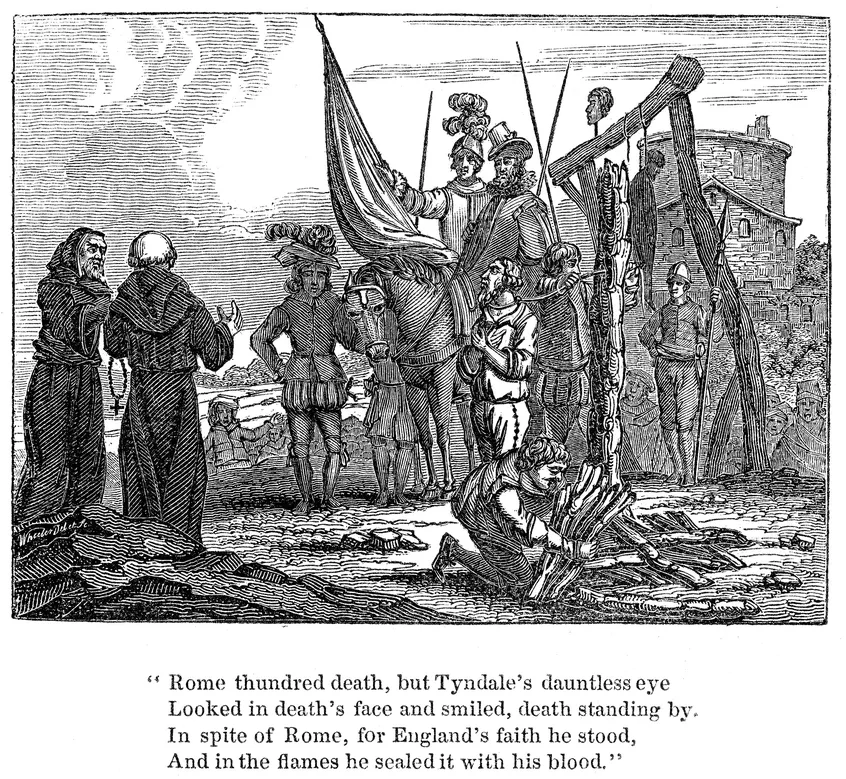
We can be quite sure there won’t be any fuss made in wider society, but July 2025 marks a special anniversary. According to Encyclopædia Brittanica, 500 years before, in July 1525, the New Testament was first published in modern English having been translated by William Tyndale.
I’m not one for celebrating historical anniversaries just for the sake of it, but it made me wonder if this could be an opportunity. Could the anniversary be a means of sharing the Bible with our community? Could we make the most of this by connecting with people and making the gospel known via this historical marker? It’s worth making the most of every opportunity, right?
What happened?
Tyndale wasn’t the first person to realise the need and undertake the task of producing an English Bible. There is actually a long history of translating the Bible into English, including efforts by Aldhelm, Bede and Ælfric, the Lindisfarne Gospels and the Wessex Gospels. We may particularly be aware of John Wycliffe, who translated the Bible a couple of centuries before Tyndale.
All these other translation attempts, however, were working from the Latin version called the Vulgate, whereas Tyndale was able to use Erasmus’s recently published edition of the New Testament in its original language, Greek. Furthermore, previous translations had been into Old English, Wycliffe’s was into Middle English, but Tyndale was the first to translate into Modern English.
The driving force for Tyndale is summed up by the answer he gave a learned opponent of his when he said that if God spares him, he will ensure that the boy who drives the plough shall know more of the Scripture than that learned opponent. He was driven by a passion that the Bible should be available to all, in the common language of the people. It should be understood by the young and uneducated rather than just being available to those educated in Latin. Yet Tyndale’s task was not merely to make the Scriptures available in the common language, but to make Christ Himself available. He was clear that through the Scriptures we meet Christ.
To say that undertaking such a work was not without challenge is an understatement. The King of England was opposed to the work, his translation was condemned by the church and soon enough he was declared a heretic. Facing such opposition, Tyndale could not continue this vital work based in England and so he moved to mainland Europe and was there able to continue his work, first in Hamburg and then Cologne.
After publishing his New Testament, he then set about translating the Old Testament. He didn’t finish, but the baton was passed to Myles Coverdale, who completed the task. Tyndale instead was betrayed by an associate, captured, and eventually executed in 1536. His final words were a prayer for the King of England’s eyes to be opened.
What impact did it have?
Whether or not King Henry VIII’s eyes were opened to the truth of the gospel, we can only guess (until glory), but the king was soon keen to give official recognition to Tyndale’s work. The Matthew Bible and the Great Bible were both published in England not long after Tyndale’s death, and both include a large proportion of Tyndale’s translation work.
The King James Bible was published almost a century later in 1611 and was produced with the same spirit as Tyndale’s own translation efforts, for just as Tyndale was concerned for the Scriptures to be translated into the common language of the people, so we find the same concerns expressed in the preface to the King James Bible. This version, which was for many centuries the mainstay of churches worshipping in the English language, owes much to Tyndale, with a significant amount of its wording and phraseology derived directly from the Tyndale Bible.
It’s not just the language of the Bible and of the church upon which Tyndale has had an impact. Over the centuries, the phrases and wording of the Bible have pervaded society more broadly, with over 250 phrases becoming common parlance and the vast majority of these coming to us from Tyndale through the King James Bible. Whether people are Christians or not, they speak the language of the Bible without even realising it, in large part thanks to Tyndale.
Throughout the centuries, following in Tyndale’s footsteps, many more Bible translations have been produced with the same desire for both modern and common language, thus making God’s word accessible to people whether well educated or not. Today, so many versions exist that my Bible app offers me 73 options in English (though admittedly some of these are only partial). Without God enabling someone to take those brave steps to pioneer a Modern English edition, that someone being Tyndale, we might never have had the Bible so accessible to us.
What could we do to mark the anniversary?
If we are to mark the anniversary of a man whose desire was to get the Scriptures to the people, what better way to do that than by getting the Bible out there to other people? The lack of Bible reading today is not down to the lack of availability, as it was in Tyndale’s day. Though you can buy a copy for a couple of pounds, few own a Bible, few have ever read the Bible, few see that it is even of any importance. Yet, if we can get Bibles to people and encourage them to see its importance, might God not use that to bring some to faith as they read of Christ?
That’s why we as a church have decided to try and make the most of this anniversary by getting the New Testament into people’s homes and hands, then as they read it, into their heads and hopefully their hearts. Our plan is to use next July as a means of engaging with our community in whatever way we can.
We recently gathered our church members in groups around tables with a blank piece of paper and one challenge – to come up with whatever imaginative ideas we could of distributing the New Testament to our community. They could be as simple or as ‘out there’ as anyone wanted to suggest. Here are some of the ideas we came up with:
Flyer with a Free Offer: We could have an attractive flyer printed and distributed (we have used Royal Mail in the past, though other flyer delivery companies are available) explaining the anniversary and offering to deliver a New Testament to their house. Depending on numbers, these would then be delivered by hand, providing further opportunity for conversation and follow up.
Book Box: Outside our building a Perspex book box could be mounted and loaded up with New Testaments with a sign highlighting their free availability. People could simply help themselves and it would be topped up as needed.
Social Media Content: There were a couple of suggestions for how we could use social media. One was similar to the flyer idea and would make the offer of a free New Testament. The other suggestion was that we make various videos that explain the history and the message of the Bible in an accessible and engaging way.
Family Bible Trail: Whether a trail around the community or around the church grounds, having a hunt for clues that also tell the story of the Bible. This could also end with food, prizes and a talk.
Schools Visits: Offering to take assemblies or RE lessons that explain the history of the Bible and its significance in relation to the English language. New Testaments could then be given out at the end of the visit.
Bible Bus: Imagine an ice cream van, but used for distributing Bibles free of charge. It would need a lot to make this one happen, but could have a massive impact.
Pop-up Shop: In most towns today there will be a number of shops that aren’t in use. Perhaps, for one month, a shop could be set up, not only with New Testaments and Bibles being made available, but it could also include an experience – a history walkthrough and a small exhibition explaining the Bible message.
Celebration Service: Hold an evangelistic service, with a meal, that includes a message explaining the importance of the Bible and proclaiming the person all of Scripture speaks of – Jesus!
We could never manage to pull off all those ideas and do them all well, given our limited budget and the number of people we have. Our intention is to focus in on two or three and make them work well. We already pray that God will use something of whatever we end up doing to bring some to faith in Jesus.
What about you? Is there anything you could do in your church to mark this anniversary? Or could you do something individually, or as a small group. Is there something that might connect with your neighbours and friends or in your own community? There are around eight months before the anniversary, which is enough time to make at least one idea work and work well.
Failing that, you could always celebrate a year later, when the New Testaments were first smuggled into England! If you need ten years to plan, there’s the anniversary of the first complete Bible in 1535. Church history is replete with many more historical anniversaries that we could spotlight and make the most of as an opportunity to share our knowledge of Jesus.





Should the CofE pay slavery reparations?
During a recent trip to Ghana, Archbishop of Canterbury Sarah Mullally renewed her commitment to a £100 million reparation fund …