
Historically, Trowbridge in Wiltshire was a seedbed of Protestant Dissent. And one of the key vehicles of that dissent in this market town was the Tabernacle Church, a Congregationalist product of the First Great Awakening.
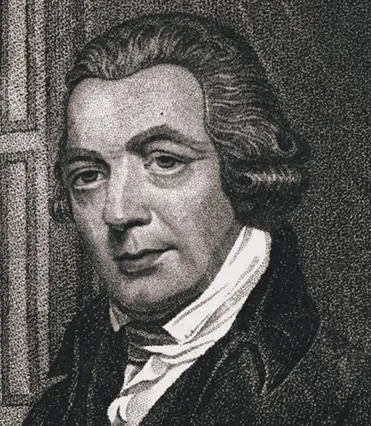
Central in the founding of this work was Joanna Turner (1732–1784), an ardent Methodist who was irrepressible in sharing the gospel and indefatigable in her efforts to extend the rule of Christ. After using her home as a house-church, she paid £500 for a small chapel to be built. This was later replaced by a meeting-house that was built in 1771 and measured 40 feet by 30 feet, which Joanna and her husband mostly funded. It was named the Tabernacle, after George Whitefield’s famous meeting-house in London. The church’s first minister (pictured) was John Clark (1746–1808).
Clark’s father, also John Clark (1702–1780), was a brewer, clothier, and shipping merchant. The son was principally a clothier, based in Trowbridge. Focused almost exclusively on the manufacture of cloth from soft Spanish merino wool, the younger Clark employed weavers and dyers from Wiltshire to Berkshire. Many of the villagers in the Avon Valley near Trowbridge worked for Clark, whose business activities led to his amassing a small fortune.
Clark began preaching extemporaneously in 1765. Within three years, though, due to a growing sense of his inability to preach effectively and of the greatness of Christian ministry, along with ‘the little success that seemed to follow… my labours’, Clark decided to leave off preaching for good. Some friends were with him, ‘drinking tea’, when he declared his determination in this regard on the afternoon of 21 February 1768, which was a Sunday.
His friends were seeking to persuade him otherwise, when a woman, an elderly member of the church, came to the door of Clark’s house with a request that he preach that evening from this text: ‘Then I said, I will not make mention of him, nor speak any more in his name. But his word was in mine heart as a burning fire shut up in my bones’ (Jer. 20:9). She confessed that she did not know where this text was to be found in the Bible, but she had been deeply impressed to specifically ask Clark to speak on these words that evening. Clark asked if she knew what he and his friends had been discussing before she arrived at his house. She did not! ‘This extraordinary circumstance’, Clark later wrote, ‘struck me very much. I could not but conclude it to be an interposition of providence’ to convince him to continue as a gospel preacher.
Alongside his preaching ministry, Clark continued to work in the clothing business, which, he believed, gave him some distinct advantages over a pastor whose salary was paid for by the church. As Clark noted: ‘My engaging in trade, for my temporal support, is certainly attended with many advantages.
‘It enables me to preach the gospel without charge; and rendering me independent of the people, it emboldens me to deliver the truth with greater freedom. It also tends to stop the mouth of the scoffing infidel, who would gladly represent all the ministers of Christ as preaching from mercenary views. Besides which, being in business enables a man to judge of the real characters and dispositions of people, better than he can learn them by theory or information; and he is thereby helped to address them in a more pointed and experimental way.’
Clark was thus able to pastor the Tabernacle Church without a salary. In fact, he set aside a significant sum of money for the ministry of the church after his death, along with substantial legacies to various Christian missionary societies.
In addition to his preaching and business activities, Clark was also a gifted musician. He played a number of instruments, including the spinet, violincello, and organ. He had two organs installed in his residence, Polebarn House, which became a hotel in the 20th century. He also composed both hymns and tunes, and among his literary remains was a hymnal. Various scientific subjects also fascinated him, especially chemistry, electricity, and astronomy. He went so far as to build an observatory in his house. Finally, in the words of the Trowbridge historian, P. J. Goodrich, he was ‘a fair poet, judged by the standards of the 18th century’. Apart from his Memoirs, which were edited for publication by the famous Bath Congregationalist William Jay (1769‒1853), Clark’s main literary legacy were a variety of poems and his hymnal that was published in 1799.
Commenting on Clark’s life, Jay reckoned that his ministry was especially distinguished by its ‘usefulness’ – one of the highest compliments that an 18th-century Christian could receive.







Should the CofE pay slavery reparations?
During a recent trip to Ghana, Archbishop of Canterbury Sarah Mullally renewed her commitment to a £100 million reparation fund …