
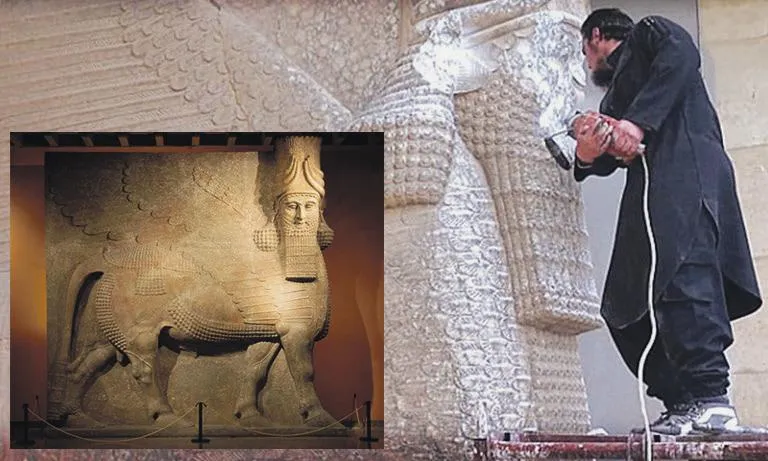
One of the most imposing exhibits you view at the British Museum are the enormous human-headed, winged bull sculptures that stand guard as you enter the Assyrian galleries.
Excavated by Henry Austen Layard in the Victorian period they were shipped, along with many carvings and reliefs from Nimrud, near Mosul, to London where they have been on display ever since. A number of these sculptures are on display at the British Museum, but they can also be seen in museums in Berlin, Paris, New York and Iraq.
This year in Iraq another huge statue was excavated near Mosul, weighing 18 tons. The head had been broken off by looters many years ago (though since recovered). In 2014 locals had buried what remained to hide it from the terrorist group ISIS (Islamic State in Iraq and Syria) who would have otherwise destroyed it. We can be grateful that the British Museum has freely displayed objects like this, safe from looters and vandals, for nearly two centuries.
Excavating monsters
The removal and shipping of those found by Layard is an engineering marvel in itself. When first excavated they retained traces of their original paintwork though this has long since disappeared. These imposing sculptures are called lamassu. This name comes from an ancient Sumerian word for a winged deity. Originally a goddess, the lamassu are portrayed as composite creatures – bird, human, lion and bull. When Layard discovered one during excavations at Nimrud, he recorded how the local workmen were frightened of what they saw emerging, ‘One of the workmen, on catching the first glimpse of the monster, had thrown down his basket and had run off towards Mosul as fast as his legs could carry him’ (Layard, Nineveh and Its Remains, p.139).
Layard was more an art collector than an archaeologist and chose only the finest quality Assyrian works to ship back home. His eye for art did not let him down. Part of his motivation was to demonstrate that the earlier art of Assyria could rival the later works of Greece and Rome. In this he was successful, not only with the first exhibitions: a number of illustrated volumes produced by Layard became bestsellers.
The statues certainly proved Layard’s point that the artist could match the skill of the later sculptors of Greece and Rome. They were also part of an inspiring age of grand discovery, as antiquarians developed techniques for excavation and transportation that would bring a lost ancient world back into public light. The translation of cuneiform texts would provide a chronology of ancient kings and international relations with numerous tie-ins to the history of ancient Israel.
The art of the supernatural
The lamassu themselves are reminiscent of a number of supernatural creatures that appear in the Bible. The visions of Ezekiel (Ezek.1:5-12) describe beings not unlike these composite creatures. A similar vision later in the prophecy (Ezek.10:3-14) describes them as cherubim. These angelic beings also appear in Revelation (Rev. 4:7). In the Bible the role of a cherub is protective – they protect the entrance to the Garden of Eden (Gen.3:24), and are represented in hammered gold over the Ark of the Covenant (Ex.25:18-21). In Psalm 99:1 we read that God is enthroned between the cherubim.
Are the Assyrian lamassu themselves an echo of a supernatural reality known from creation? Or are the Biblical cherubim portrayed in ways that people of the ancient near east would have already known from these statues? Certainly, the Bible describes the cherubim as real, angelic beings. The likeness to various animals draws upon attributes associated with each one. An ox is associated with strength (Prov.14:4), the lion with royalty (Hos. 11:10), and wings with protection (Ps. 91:4). The human head of the creatures reflect the wisdom associated with humankind. If God’s angels combine these attributes, then how much more powerful, wise and protective is God Himself?




The Jewishness of the Gospels proves they're true
When speaking to Jewish and Gentile friends you might have heard the accusation that the Gospel accounts were written centuries …