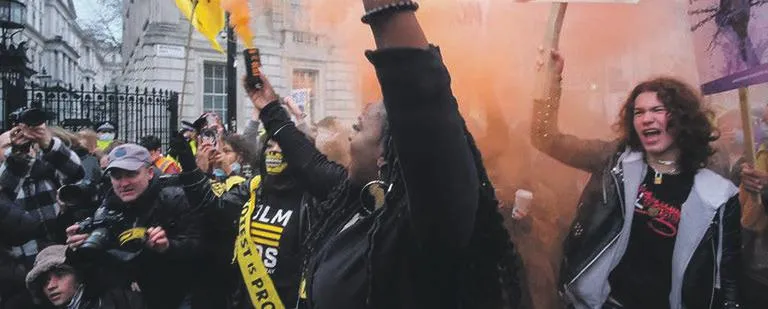
The Public Order Act is primarily about restricting the right to protest, or, depending on your political views, it’s about preventing campaign groups from interrupting your daily life. Naturally, Ministers have told us repeatedly that the Bill is necessary. But there’s one part of it that I want to draw your attention to.
Clause Ten means that significant restrictions are now in place on what people can and cannot do within a radius of an abortion facility. It introduces across England and Wales a national ‘buffer zone’ policy. It’s the exact same policy idea that was roundly rejected in 2018 by the then Home Secretary, Sajid Javid. At that time, the government did a data collection exercise and concluded that instances of genuine harassment outside abortion facilities were in the minority. Most pro-life vigils, it concluded, were peaceful and prayerful.
Although the Home Secretary has changed (along with most government posts!), it’s still, nominally at least, the same party in power. So, what’s changed since 2018? How come we’ve got buffer zones across the country when only five years ago it was being rejected? Has new evidence come forward to persuade the government to change its mind?
Sadly, the answer is an emphatic no. Despite wild claims from some MPs about stories of apparent harassment, no fresh evidence to prove their case has been presented. So why has the government caved? Let me lift the lid a bit on the murky world of politics. Put simply: the government has only so much political capital in these days where backbench rebellions, even if you have a big majority, can derail your legislative plans. It was facing a big enough battle on the general aims of the Bill. It also has ongoing political battles around its Illegal Migration Bill, and demands for NHS waiting times to be reduced. Basically, it simply didn’t want the fight over buffer zones and because Clause Ten was, on paper at least, about abortion, they gave MPs a free vote.
To be clear: the clause will mean silent prayer is criminalised. To think that police forces across England and Wales will be responsible for arresting people for silent prayer is befuddling, baffling and brain-numbingly foolish. This Orwellian clause will have significant ramifications for genuine free speech.
If you think I’m exaggerating, then the story of Isabel Vaughan-Spruce will be the reality check you need. She is a pro-life charity worker. She was arrested in December 2022 for silent prayer near an abortion facility in Birmingham (the council was doing a pilot buffer-zone policy). She was cleared by the courts. In March 2023, she was arrested again for the same crime. By six police officers. She said she was praying about free speech in her head. The officer correctly asked: ‘How do I know you’re not praying about abortion?’. How indeed! So, she was arrested again.
What a criminal waste of police time. And let’s be clear: this is all about the triumph of an insidious ideology. It’s an ideology and worldview where autonomy trumps all – even the right to life for preborn babies. It’s also a worldview that brooks no disagreement and allows no debate.
As ever, faithful Christian MPs mounted a brave but futile rearguard action to protect fundamental liberties. That they didn’t succeed is tragic, if unsurprising.
I suspect this new law will be challenged in the courts. I certainly hope so. In the meantime, we are reminded again how unwilling the political establishment is to even countenance that, on abortion, there might be a better way. We need courage to speak into these debates.
This Clause Ten, if implemented fully, will stop prayer within a radius of abortion clinics. But God’s ability to answer prayer has not. So, let’s pray for a turning of the tide, an opening of eyes and a change in society’s attitude towards the most vulnerable of all.
Our next PM? Burnham, Streeting & faith
Editor's note, added 19 June 2026: Andy Burnham has won the by-election in Makerfield. Earlier this week, we published …