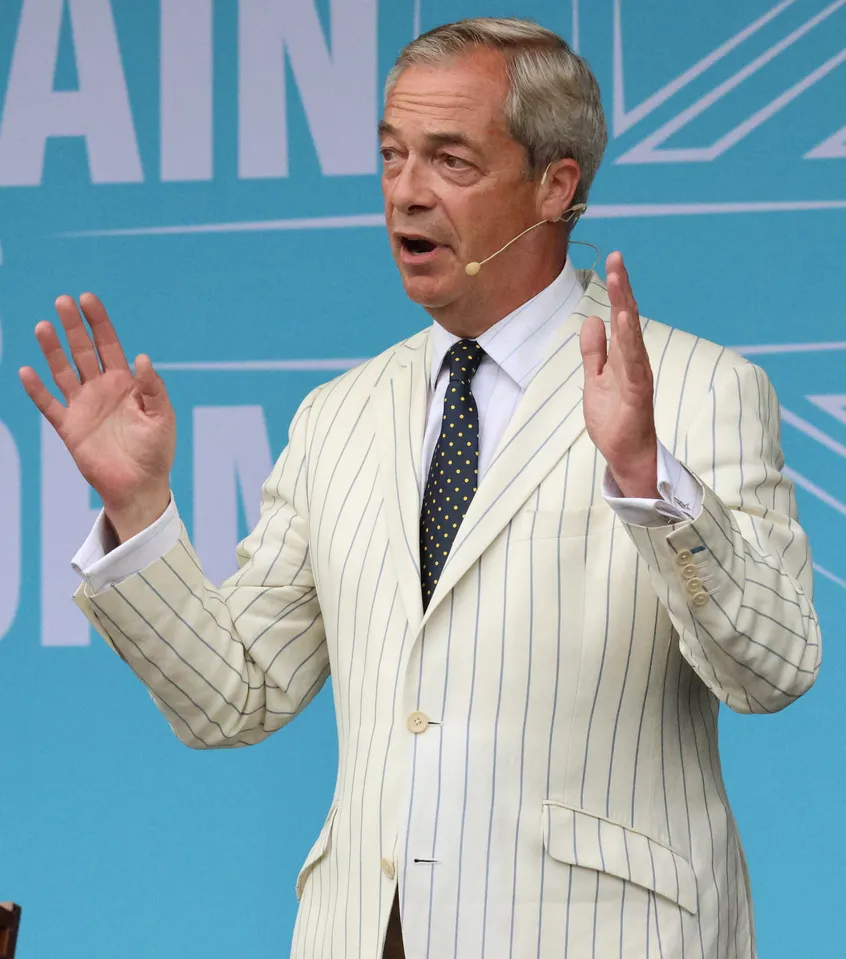
The Clacton by-election takes place on 13th August with 33 candidates – none from the main political parties – challenging Reform’s Nigel Farage to become the MP.
Mr Farage said that he triggered the election to set up a contest between "the people" and "the establishment", appealing to the voters to vindicate his conduct over the heads of the Parliamentary authorities.
Increasingly we see this populist approach in our politics, where validation is sought from the public against a supposedly corrupt and sinister political elite. It unashamedly aims to engage people’s guts and hearts over their minds and morality. But beneath the theatre I believe there is real jeopardy.

Risking a collapse of trust?
Encouraging a belief that everyone in authority is part of a conspiracy against decent ordinary people risks brewing revulsion with our whole system of government. If Reform are ultimately elected to power and then also fail to live up to public expectations, there is a danger of total collapse of trust in the political system. This could leave a vacuum for malign forces to exploit for their own gain.
I am not arguing that our institutions and forms of governance are perfect. Far from it. But our complex rules-based society has established processes to limit the power of individuals and hold them to account.
Ethical standards for public office holders
Everyone in public life is expected to follow the seven Nolan Principles, which set out a series of ethical standards for public office holders: selflessness, integrity, objectivity, accountability, openness, honesty and leadership.
We know that public figures regularly fail to live up to these standards. But in Romans 13, Paul wants Christians to understand that government – however flawed – is part of God’s order: "Let everyone be subject to the governing authorities, for there is no authority except that which God has established." (v. 1.
Let’s remember that Paul’s context was far more unethical than 21st-century Britain: he was a citizen of the often brutal and unjust Roman empire.
The Nolan Principles are based on Christian values and employ Biblical language to affirm that "all public office-holders are both servants of the public and stewards of public resources" – echoing Romans 13v4, that "the one in authority is God’s servant for your good".
However, we also find a tension in the Bible because the ultimate allegiance of Christians is to Jesus. "Jesus is Lord" means Caesar is not. "We must obey God rather than human beings!" cried the apostles when they were ordered to stop telling people the gospel in Acts 5v29.
So there is a line beyond which we should not submit to the authorities, and around this question is a long Christian tradition of debate. We are not to worship human authorities in God’s place. Governments cannot compel us to act against our consciences and force us to disobey God.
Obedience or disobedience?
Tom Wright and Mike Bird, in their book, Jesus and the Powers, conclude that it is possible for government to forfeit its authority if it acts with cruelty, greed or injustice. However, they emphasise that "obedience and respect for government is the norm even if the government is imperfect or unjust in some matters. Civil disobedience is reserved for unjust laws, and uncivil disobedience should be reserved only for violent authoritarians."
Is the UK in the situation where the government is so unjust that we should disobey or circumvent it? For all the imperfections of our current government and of our political system, I don’t believe it is reasonable to suggest that this threshold has even remotely been reached.
There is however a growing mismatch between the high standards we desire of our leaders and the low expectations we have of them. Politics is full of compromise and trust in authority has been declining for decades. In 1946, George Orwell called politics "a mass of lies, evasions, folly, hatred and schizophrenia".
Concluding thoughts
Politicians, like every human being, are flawed and fallen, and the exercise of power creates the temptation to act selfishly and for personal gain. This is precisely why checks and balances are put in place, to disperse power among individuals and institutions.
The framing of an establishment conspiracy against "the people" wilfully ignores these processes, poisons our debate and casts suspicion on all those who enter public life with a genuine desire to serve.
Indeed, the stirring of divisions creates a climate where public figures are frequently verbally and occasionally physically attacked, even killed. The question of Nigel Farage’s security is important; his position does put his safety at risk. We remember the murders of Jo Cox and David Amess, and – although at the time of writing we do not yet know the motivation – we were horrified at the recent murder of Ann Widdecombe in her own home.
In the midst of these tensions, we still need people to come forward to serve in public office with selflessness and integrity, and we should support them to do so. This also means that our leaders should humbly submit to the systems that hold them accountable. We believe as Christians that those in authority are ultimately answerable to God for their actions and therefore carry great responsibility. So let’s be praying for them today.
en invited Reform representatives to respond. Read responses from Jeff Featherstone and Trevor Bell here: "Populism: Reform members reply to Tim Farron"
Christian, get involved!
Every week new media headlines expose the muckiness of politics and the failings of politicians. It’s no wonder that trust …