Richard Cunningham explores C.S. Lewis’ sermon, ‘Learning in Wartime’ and what we may learn from it in the midst of a pandemic
I understood just how strange and surreal life had become under the shadow of Covid-19 when, waking from a vivid dream, I found conscious reality stranger than my night visions.
Police deployed to beauty spots to stop citizens from socialising; wild boars roaming in the towns of northern Italy; the civil war in Yemen pausing for the first time in four years due to coronavirus, while in Britain leading churchmen are demanding that the Prime Minister sack his chief advisor (for a claimed breach of lockdown restrictions) or risk losing the churches’ future cooperation.
At this strange time, when our instinct is to draw together in support and fellowship, to comfort one another and to reach out, we must remain physically distanced – which for those who live alone or cannot easily fend for themselves is even more distressing.
John Gray1 believes this is a turning point in history which signals ‘peak globalisation’ has been reached. He believes (having cited the EU’s response to Italy) that the much-reviled concept of the Nation State will materialise as the only realistic arrangement for citizens to be adequately protected and provided for. But who knows?
The supposed quip by a Chinese statesman in 1972 that it was ‘too early to tell’ about the impact of the French Revolution, should give us pause before pronouncing too prescriptively on this unfolding and unprecedented global revolution.
The dangers of over-thinking how to live during a crisis are wonderfully explored in C.S. Lewis’ ‘Learning in Wartime’2; a sermon preached to Oxford undergraduates during the early stages of the Second World War. If we substitute ‘coronavirus’ for ‘war’, it could hardly be more relevant, as Lewis encourages us to pursue normal, everyday life, but to do so in the more important context of heaven and hell.
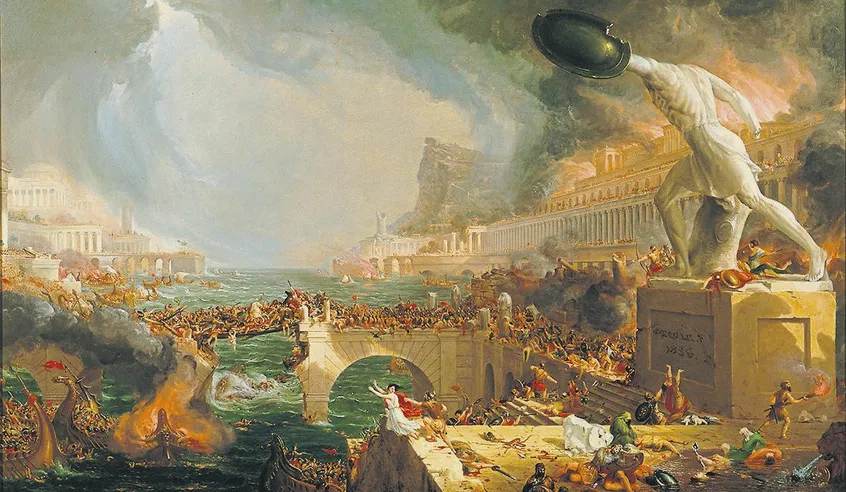
Fiddling while Rome burns
Lewis asks his audience if academic learning in the context of a World War isn’t like fiddling while Rome burns? Similarly, should we really be digging our garden, studying our Bible, reading Hilary Mantel or playing family board games during this global crisis?
We find ourselves torn between evangelistic urgency and the importance of maintaining as normal a life as possible. Tom Wright in his provocative article, ‘Christianity Offers No Answers About The Coronavirus. It’s Not Supposed To’, concludes: ‘… it is part of the Christian vocation not to be able to explain – and to lament instead’3 Is he right?
C.S. Lewis masterfully embraces an urgent eternal perspective that does not contradict the biblical injunctions to do everyday life to the glory of God. On the question of whether this constitutes fiddling while Rome burns, he says: ‘But to a Christian the true tragedy of Nero must be not that he fiddles while the city was on fire but that he fiddles on the brink of hell.’
Moreover, if we do not believe Jesus’ teaching on heaven and hell, then, Lewis argues, ‘our presence in this church is great tomfoolery. If we do [believe them], we must sometime overcome our spiritual prudery and mention them’.
‘The moment we do so, we can see that every Christian must … face a question compared with which the questions raised by the war are relatively unimportant. He must ask himself how it is right, or even psychologically possible, for creatures who are every moment advancing either to heaven or to hell, to spend any fraction of the little time allowed them in this world on such comparative trivialities as literature or art, mathematics or biology?
‘… we have always to answer the question: “How can you be so frivolous and selfish as to think about anything but the salvation of human souls?” and we have, at the moment, to answer the additional question, “How can you be so frivolous and selfish as to think of anything but the war?” ’.
Greater numbers are ‘attending’ online church services and some of our friends are for the first time willing to do Zoom seeker Bible studies with us. But will it last?
It is salutary to remember that fuller churches in Britain during the Second World War (the ‘no atheists in a fox-hole’ phenomenon) did not herald the much-promised revival.
Luke Coppen’s Easter article, ‘Will coronavirus hasten the demise of religion – or herald its revival?’4, makes a balanced assessment. Coppen hedges his bets, but (on balance) fears people might get out of the habit of church attendance and get used to being self-contained. But it is surely far ‘too early to tell’ and so we pray on for a lasting change.
Back to Lewis’ central questions as to whether we are being frivolous and selfish by thinking about anything other than the salvation of human souls or by thinking about anything other than our international crisis?
Holding the tension
On the first matter, we must always hold the tension of living in the light of eternity and taking our normal place in human society. The Thessalonian Christians became so super-spiritual that Paul commanded them to commend the gospel by going to work and leading a quiet life as good citizens. Holding the tension between gospel urgency (not fiddling while Rome burns) and taking our place in family, local community and work-life is precisely that. It is a tension which we must work hard to avoid collapsing at either end.
Collapsing the tension
The student who becomes so disinterested in their studies and the wider university experience of friendship, socialising and sport, because they have laudably prioritised CU and church activity, will struggle to avoid being stuck in a Christian bubble. This will eventually diminish their capacity to engage their friends and course-mates in any meaningful way. At the other extreme, the student who has no sense of spiritual urgency or evangelistic priority might be wonderfully involved in the lives of many unbelieving friends, but have no action plan to get beyond being a ‘silent witness’.
Do we focus all our time and energies on a crisis?
On the second matter, Lewis says: ‘[I] … believe it to be a duty to participate in this war … we may have a duty to rescue a drowning man, and perhaps, if we live on a dangerous coast, to learn life-saving so as to be ready for any drowning man when he turns up. It may be our duty to lose our own lives in saving him. But if anyone devoted himself to life-saving in the sense of giving it his total attention – so that he thought and spoke of nothing else and demanded the cessation of all other human activities until everyone had learned to swim – he would be a monomaniac. The rescue of drowning men is, then a duty worth dying for, but not worth living for. … A man may have to die for our country: but no man must, in any exclusive sense, live for his country.’
In our national emergency, Christians should cooperate fully with the authorities’ request for social distancing and temporarily suspend our foundational rights to assembly. To do otherwise would be to ignore the ‘drowning man’. But let’s never see ‘safety’ as the ultimate good and sacrifice our inviolable freedoms to it permanently.
Guard against excitement, frus-tration and fear
In his sermon, Lewis urges the avoidance of three enemies: excitement, frustration and fear. If we become too excited by the latest stats and projections of this pandemic, we might experience the frustration of not being able to pursue normal, enjoyable activities. The Lord gives us this moment – right now – to live and speak for Him and put our hand to do whatever is most useful and pleasing to Him.
‘Happy work is best done by the man who takes his long-term plans somewhat lightly and works from moment to moment “as to the Lord”. It is only our daily bread that we are encouraged to ask for. The present is the only time in which any duty can be done or any grace received.’
On the third enemy of fear, we must remember the sufferings of Gethsemane to guard against a stoic indifference. We also recall our Saviour weeping at the tomb of Lazarus. Tom Wright is correct to remind us of the need for lament and compassion. But there is an important additional insight that Lewis boldly provides. ‘War makes death real to us: and that would have been regarded as one of its blessings by most of the great Christians of the past. They thought it good for us to be always aware of our mortality. I am inclined to think they were right.’
The Christian is not to fear this pandemic (imposter and enemy though it is), nor to see it as a form of judgement (which some of the extreme environmentalists seem to suggest). Our Lord Jesus said, in the face of a terrible tragedy in which a tower collapsed killing 18 people, ‘… do you think they were more guilty than all the others living in Jerusalem? I tell you, no! But unless you repent, you too will all perish’ (Luke 13:4).
During this unusual time, Jesus continues to call us to serve and enjoy Him in our everyday activities and to reach out to those in need. But we must surely cultivate a greater evangelistic urgency and allow this pandemic to remind us that every person we interact with in our daily lives stands on the brink of either heaven or hell.
Richard M. Cunningham is Director of UCCF: The Christian Unions.
FOOTNOTES
1. John Gray, ‘Why this crisis is a turning point in hist-ory’, New Statesman 1 April 2020 2. https://bradleyggreen.com/attachments/Lewis. Learning%20in%20War-Time.pdf 3. Tom Wright, ‘Christianity Offers No Answers About The Coronavirus. It’s Not Supposed To’ Time maga-zine March 29 2020 4. Luke Coppen ‘Will coronavirus hasten the demise of religion-or herald its revival? Spectator 11 April 2020.