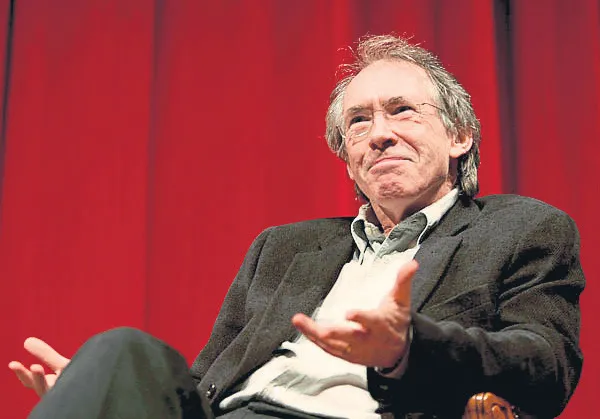
Ian McEwan’s latest novel, The Children’s Act, pits religious belief against the law.
The title is a reference to the 1989 Children’s Act, which claims that when a court comes to deal with any issue concerning children, the child’s welfare shall be the court’s paramount consideration. The Act discusses parental responsibility and states what should be done in cases where parents do not co-operate with the law or with statutory bodies. This is just what happens in McEwan’s novel.
Refusal of medical treatment
The plot is inspired by the experiences of McEwan’s friend and former Lord Justice of Appeal, Sir Alan Ward. It tells the story of a legal case involving a set of parents who refuse to allow their sick son to receive medical treatment because of their religious beliefs. Adam, an intelligent 17-year-old, is suffering from leukaemia. He will die if he is not given a lifesaving blood transfusion, but his family are Jehovah’s Witnesses and believe that the Bible prohibits the ingesting of blood.
Cases such as these often reach the high court, due to the complexity of the moral issues involved. As McEwan himself puts it: ‘Inevitably, there are differences in moral perspectives’. The novel asks: in a diverse multicultural and multifaith society, how should our legislation deal with difficult topics such as death, homosexuality, abortion, or – in this case – healthcare for children?
McEwan himself believes that, in such situations, religious beliefs are ‘distinctly unhelpful’ and prevent people from making rational decisions, claiming: ‘On the whole, the secular mind seems far superior in making reasonable judgments’. Secularism and science sit side by side in McEwan’s thinking and the theme of scientific rationalism trumping religious belief comes up again and again in his writings. In one interview, he has even described science as the only thing in our perilously changing world that we should look to for salvation.
Outspoken atheist
McEwan is an outspoken atheist and a supporter of the humanist cause. He claims: ‘My own view of religion is that people must be free to worship all the gods they want. But it’s only the secular spirit that will guarantee that freedom’. He also claims that his book is not a direct attack on religion. Rather, it is a reflection on the nature of decision making in courts of law and an encouragement that we should prioritise human wellbeing over any form of dogma.
If the secular spirit guarantees people freedom to worship the gods they want, McEwan looks to the secular courts to determine the manners in which people can choose to perform this worship. But the courts exist to determine what is lawful or unlawful, not what is good or bad, wise or unwise. As Sir Alan put it in the real-life case on which the novel is based: ‘This court is a court of law, not of morals’.
So where, if anywhere, might morals come into play? According to McEwan, it is crucial that people of no religion assert their belief in moral values. Furthermore, he claims that religion in itself ‘actually is a morally neutral force’. However, he claims, religion often plays to a side of human nature that desires simple solutions and certainties. When these are imposed upon others, religion has the potential to become ‘a very, very destructive force’ – a theme that McEwan explores in his novel Enduring Love. It is this belief that has repeatedly caused him to speak out against extremism; in 2008 he caused a media furore with some of his comments about Islam.
Unfair
Despite claiming that he wants people to have the freedom to follow whatever religion they choose, McEwan offers no counter examples of times when religion might cause people to be more loving, to make better choices or to do what is wise. Instead, he presents it simply as a barrier in important decision-making processes.
Questions for us
This is something that Christians would wish to challenge. But first we have some difficult questions to confront. How can we obey the government and the law (Romans 13.1-2) while holding firm to what the Bible teaches, even when the two things are contradictory? How can we demonstrate to our culture that in Jesus we find both certainty and freedom, logic and love? How can we express the high value that Jesus places on human life while also sharing his call to us to give up our lives for him (Matthew 16.25)? In this regard, clearly the challenges presented to the church by The Children’s Act are far from child’s play.