

Do you ever feel guilty and powerless as you walk past a homeless person?
Maybe you stop to chat. Maybe you take them into a fast-food outlet and marvel at how many spoonfuls of sugar go into their tea. Maybe you do nothing, and feel bad. Whatever you do or don't do, the feeling of powerlessness often kicks in.
Not every jobless person is homeless, but almost all homeless people are jobless; nor is every street dweller a man, either. Still, the chap in the shop doorway is the tip of an iceberg we walk past regularly.
What next? You have been told it is not a good idea to hand over money; even our broken system tends to meet the immediate need at some level. What you almost certainly cannot offer is a pathway from the street to independence.
That is where the Good Samaritan urges us on. We usually look at the parable by putting on our charity donation glasses: we see the inn, the payment, the promise to cover further expenses, and turn the parable into a steer to build hostels. That is not wrong as far as it goes. But what if the end game was not dependency? What if the Samaritan supported the broken man until he got back on his feet? What if the Samaritan's aim was to help the man become independent so he could continue living his own life?
We do not want to twist a thumbnail sketch into a policy paper. But the question is fair. What should the end game look like for the homeless person in the shop doorway, or for anyone else on the edge of disaster?
Jobs and the church
This is why we have been asking whether churches should help society by creating jobs. Not because job creation is the gospel. It is not. But neither should churches imagine the gospel has nothing to say about work, unemployment, bad jobs, or the value of useful and dignifying work, not to mention jobs as the major source of daily bread.
Christians do create employment for the poor and needy. We can point to Grace Enterprises in Nottingham, launched from a gardening business that moved into cleaning and a family of businesses, or to Transcend in the Middle East, a self-sustaining source of local employment. These and other stories appear in our short book, How to Merge Kingdom and Business: the most excellent way (2024), available from Grove Books and on Kindle.
The hard thing is finding churches with an integrated entrepreneurial and missional vision.
Our claim is modest and awkward: job creation is part of the church’s mission. Certainly not all of it. But part of it. It is desirable for churches and society, and in some places, with the right people, doable. Jesus came to create freedom: life to the full. We don't believe this means people should subside into dependency based on benefits or charity.
Charity matters. Generosity is key to Christian spiritual health, and Christian charities have done immense good helping people manage money, relationships and food. And that’s the start! It takes people back from the precipice. But surely the good news is more than a flat paid for by benefits, or a low-paid job that confirms every Sunday how much better off everyone else is?
Why churches might hesitate
There are strong reasons for churches to stay clear of all this. God and money are competing masters. Power gradients at work and church are hard enough separately; combine them and a vulnerable worker can end up on a very sticky wicket. Pastors favour order and harmony. Entrepreneurs are often wild. They do not always sit comfortably together.
Then there is governance. Any church that started a food bank knows how life became easier once an independent board took responsibility. Keep the project inside and it may overwhelm the church. But independent organisations drift. Spin it out and it may lose the connection. Managing it all is awkward.
And it is hard. Creating good-quality jobs for everyone is difficult. Capitalism knows how to make money; jobs arrive as a by-product. However, pay, security and satisfaction vary enormously. If governments, businesses and corporations struggle to solve employment problems, churches won’t find it easy, either. Still, difficult is not impossible. Nor is caution obedience. Churches cannot split life into church and secular compartments.
Jesus reached out to the poor. James warns churches not to ignore physical need. Churches should care about poverty not only by giving short-term help, but by helping people achieve work, stability, and independence. Creating jobs and solving poverty is extremely difficult, but difficulty should not stop Christians from trying. True Christian support should help people flourish, not keep them permanently dependent.
Delving deeper into Scripture
There is a Scriptural upside. Let’s start, not with Eden as a bounded garden, but with creation itself where everything materialises at a word. Without that explosive creativity, our theology of work struggles to meet a world trading in raw ideas, knowledge and AI. Jobs that create wealth from human effort and ingenuity belong in that frame.
Have you noticed how much Biblical teaching has a business edge? The minas, the rich fool, or the vineyard owner who pays what sustains the worker rather than the pro-rata market rate? How about the shrewd manager hedging his future through his master’s debtors? This economic connection is rarely made in preaching. Perhaps too few preachers are active in business.
When the disciples advise Jesus to disperse the 5,000 to find food, Jesus says, "You give them something to eat." Does that apply to jobs that feed the poor? We think it might.
Nehemiah behaves like a project manager; Solomon shows what happens when a business empire loses its way. Critically, the gospel first entered Europe at Lydia’s house, and she traded in expensive cloth. Business lies deep in the Biblical weave.
So yes, there are strong reasons for churches to stick clear and good theology suggesting that a job-creation initiative could be Kingdom business.
What would this look like in practice?
What if it worked? (All named organisations below are fictional.)
Imagine Olivia. She is a warehouse administrator when her relationship breaks down. She sofa-surfs, discovers she is pregnant and pours out her soul to Carol from the gym. Carol’s church has just started a partnership with a group of entrepreneurs, so Olivia moves into a hostel, keeps working until maternity leave, and when Lucas is born, women from the hostel and church help. Later, a babysitting rota lets her return to work part-time.
Meanwhile Ash, an entrepreneur from church, builds Schedskills: a concierge service helping healthcare providers reduce missed appointments, emergency visits and poor outcomes. Ash has created a way for people such as Olivia to set up appointments for others and ensure they keep them. Olivia manages her portfolio from her smartphone and in spare moments.
The Integrated Care Board pays per episode from the savings it makes. It would never make commercial sense if the entrepreneurs were simply after profit. But Olivia’s flexible work supplements her warehouse income, then grows as Lucas goes to nursery.
Or imagine Gary. He leaves the Army, retrains and teaches in Further Education, before family breakdown and illness tip him into homelessness and worklessness. Without an address he cannot land a job; without a job he cannot secure an address. Selling the Big Issue outside the Co-op, he meets Simon, who mixes faith and HR skills and introduces him to WayFare, a hostel offering board and work through SmartFloor.
It takes Gary a year to rehabilitate. First he does whatever is needed. Then he runs part of SmartFloor, secures a lectureship, pays for accommodation, does Simon’s social media as a side hustle, saves money and moves into his own flat.
The stories are fictional because we know how to construct parts of these journeys, but cannot yet join them up consistently and routinely. The pieces always come before integrated solutions.
Historic examples
Nor is the dream as strange as it sounds. Christians have been institution-building for a long time. In the so-called Dark Ages, monks and nuns delivered care, education and sometimes trade. Schools, universities and hospitals grew around scholars and healing skills. Wealth often accumulated inside the walls, and the structure eventually became a political target. But it was a start.
In the industrial age, mainly nonconformist entrepreneurs brought faith, vision and creative energy together. They created businesses, housing, pensions, towns and villages such as Bournville and Port Sunlight. Boots, Cadbury, Colman, Rowntree, Unilever and many more sprang from this soil. They were not perfect, and the Christian ethos often faded with the founder. But it was a start.
Even football tells part of the story. Enthusiastic Christians helped create clubs to stop working chaps blowing the family food money on payday in the pub. Aston Villa, Everton, Liverpool, Manchester City, Southampton, Tottenham Hotspur and others have Christian origins.
We have already cited examples that show this is possible here and now. The question is whether anything can be done systematically and at church.
Start with the place, not the pet project
That brings us to the upside-down problem. Entrepreneurs usually begin with a speciality – cars, food, cleaning, technology – or simply a love of starting companies. But if you want to start a company that pays great salaries to local people, where would you begin?
That is deceptively difficult. Some cookery programmes let chefs bring their ingredients. Others provide the ingredients and ask contestants to plan around them. Nobody opens three fridges at random on a housing estate and expects gourmet grub for a dozen people. Yet that is close to the inverse problem: how do you build on an employment brownfield site?
Most entrepreneurs are playing something like RollerCoaster Tycoon. Build the ride, set the price, watch the punters turn up, hire staff as the park grows. But job creation for a locality asks stranger questions. Would locals do a theme park better than a bakery? Can growth continue here? Are the customers local people or local businesses? What local skills could be monetised best?
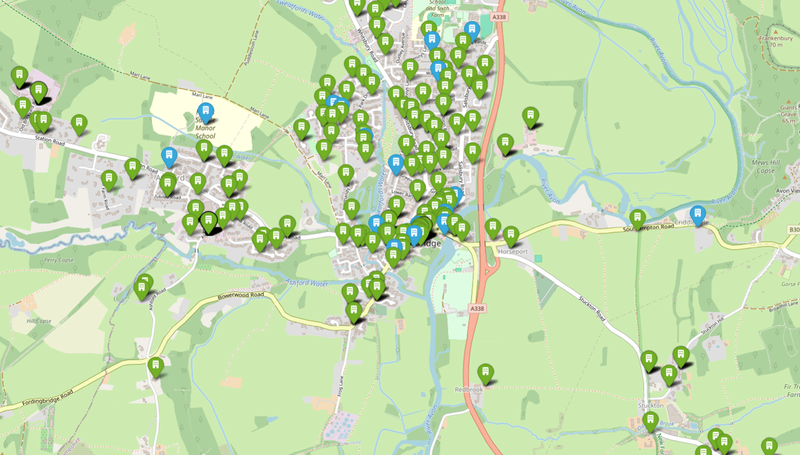
Figure one: The employment heat map (created by Joel) which maps the business terrain of a locale.
Step up the Employment Heat Map: a picture of the local area showing what is going on workwise – what skills are around, what local businesses do, where their workforce comes from, who works alone, who employs others and how many. With the right people, what once took a specialist team weeks can now be done from a home computer in hours.
That changes the question. You are not testing demand for your pet project. You are estimating what projects could be in demand locally, which could use local skills, and what the best overlap might cost. Then, build the business plans and pick the best.
Three ways to begin
So how might a church begin? Three ways.
First, partnering. Local churches can collaborate, possibly with charities but more usefully with entrepreneurial outfits, to create end-to-end solutions for needy locals. They need clarity about who they can partner with, how commercial and church needs fit, what the interface looks like, what success means, and the governance and exit strategy.
Churches can be attractive partners. They have local roots, cross-sectional skills, mixed engagement with local groups and sometimes buildings. A lot is going on, but nobody owns the end-to-end pathway, so people fall through the cracks. End-to-end is something churches can do.
Second, microbusinesses. In South Africa and Malawi, Phil saw pastors running car cleaning, mobile phone shops, cycle repair, brick making, yoghurt production and jewellery outlets. Trades, IT and food services can work too. But the local employment ecosystem matters. Low cost-of-entry businesses are easier to start but may depress salaries; higher cost-of-entry ones need more cash but can leverage higher returns.
So ask: what services or products would sell best in the area or from the area? What skills are there to build them? What is the best overlap, and what will it cost to get going?
Third, mentoring. Most churches have employment skills that dovetail with needs around them. That may mean helping church members plan careers and raise family living standards – not prosperity gospel, just independence so they can be generous. It may mean job shops or one-to-one sessions: CVs, planning, advocacy, references, encouragement, networking and research.
How do you choose? Dip a toe in the water and go from there. An influx of unemployed people might point towards mentoring. An approach by an outside agency might point towards partnership. Once you step out, you will soon work out whether to keep going or change direction.
This brings us back to the roadside. The Good Samaritan was a smart fellow on nobody’s religious leadership team. Maybe the right people are sometimes entrepreneurs, HR people, project managers, business owners, mentors and church members who can cheer someone on. The religious leaders walked past. The outsider got the chap over the line.
So here is a cheeky place to end. The only numbers in the parable are two denarii and three possible helpers. How realistic would it be for your church to create two or three jobs that enable workers to support their families without handouts? Not every church. Not every place. Not without problems. But perhaps somewhere near you there is a Carol, an Ash, a Simon, an Olivia or a Gary. Perhaps pieces of a pathway are already lying around. Perhaps the church does not have to own the answer. Perhaps it can help join the pieces.
Job creation is not the gospel. But a good job can be part of the freedom the gospel gives us and makes us care about. And if churches can help people get back on their feet, into work, independence and generosity, then maybe mercy sometimes does come with a job description.
Acknowledgements: Phil and Terry would like to thank Joel Young for his work in creating the Employment Heat Map and providing the graphic used.
Source: This piece is based on eight Substack posts under the banner, "Phil and Tez reflect on working life". To access these, start with Good Sam and the Roadside Man (datchet.substack.com – the others are linked to that).



How a campfire helped bridge cultural divides
His ice cream was using the cone to do a very good impression of a waterfall. The sweat on his …