The Good Samaritan & today's migrant myths

David Shepherd  |  Comment
Date posted:  17 Sep 2025
Share Add       
The Good Samaritan & today's migrant myths

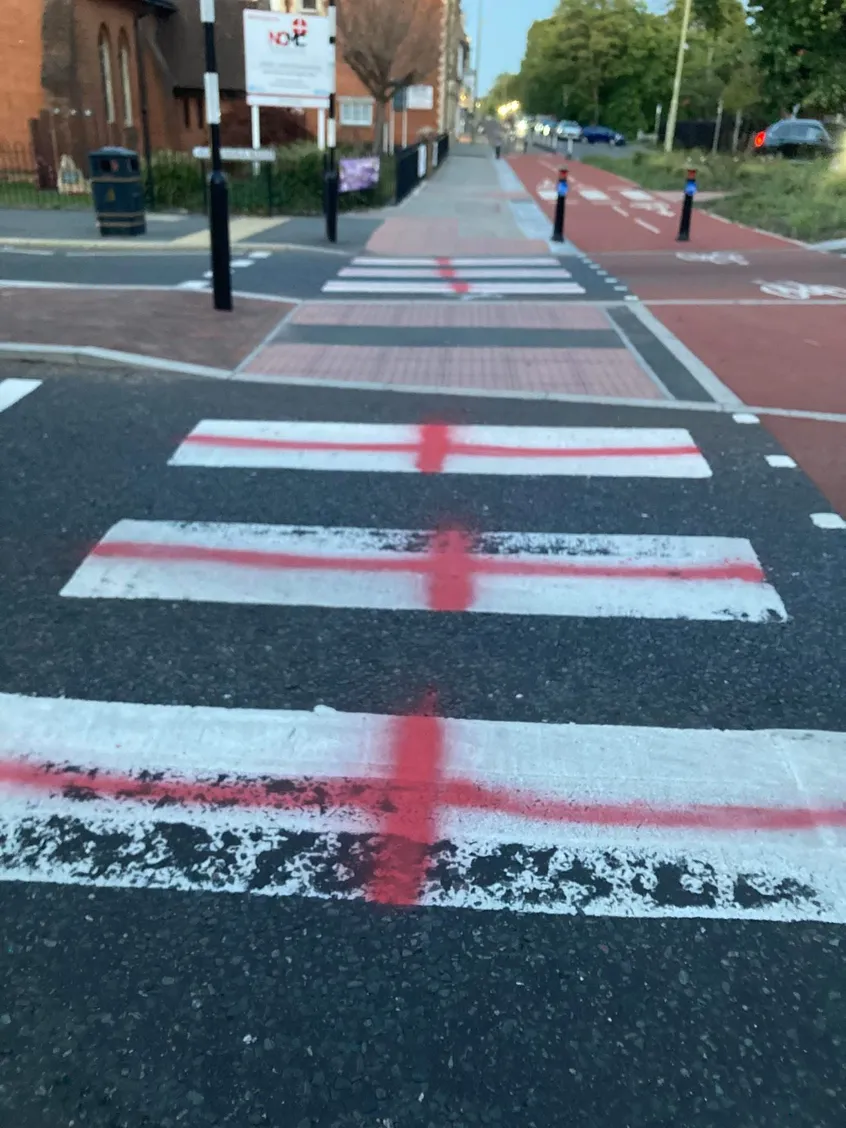
A zebra crossing in Farnborough, Hampshire.

Back in 2018, I read a post on the Psephizo blog (written by evangelical scholar Ian Paul) that described the emotive impact of flags.

He wrote: “Flags are hugely emotive. They are powerful symbols which evoke emotional and even visceral reactions… Think about the controversies provoked by those in the southern US states flying the Confederate flag.”

In that post, Paul evaluated Ely Cathedral’s decision to fly a rainbow Pride flag during the Ely Pride festival. He also argued that, far from having a unifying influence, “flags are not symbols of inclusivity and diversity; they are powerful symbols of tribal identity (even where that tribe is a nation) and they function to define who is in and who is out. They are so powerful that people will, literally, die for them and their defence.”
I totally agree with Ian Paul’s position on this issue. However, his conclusion is as applicable to the prolific numbers of St George's and Union Jack flags being flown across the country (in response to the "Operation Raise the Flag" campaign) as it is to the rainbow Pride flag.

As I grew up in the 1960s, far-right "bovver boys" and skinheads were only too keen to use the British flags to promote their bigotry in carefully orchestrated street marches. While holding those flags aloft, they repeated their racist rhyme: “There ain’t no black, in the Union Jack." Clearly, they saw the national flag as an emblem of their racial identity. According to them, white people were "in", and black people were "out".

That sad history explains why the anti-immigration impetus behind the "Operation Raise the Flag" campaign is such a cause for concern.

Historically, the impetus behind widespread alarm over immigration has not been its economic impact, but instead, our country’s relative inability to assimilate non-white races.

In his thesis on post-war migrant workers Dr Joseph Behar wrote: “Interestingly, it was thought more important to separate both the St. Helenians and the EVWs [European Voluntary Workers] [1] from the British populace in the countryside, than it was to separate them from each other. Both were considered foreign (though for different reasons) and therefore to be lumped together in hostel accommodations. The main difference was that in time the Polish servicemen and EVWs could be assimilated into the British nation through intermarriage and the adoption of British customs and language. The St Helenians, legally British though they were, could never really be assimilated into the British nation. The National Union of Agricultural Workers also expressed opposition to the scheme on the basis of race. Yet despite all of these objections, arrangements were discussed through the spring of 1948. In the interval, the arrival of the Empire Windrush raised the question of race even more prominently. The arrival of the Windrush prompted some officials to suggest the need for a more restrictive colonial migration policy.”

To this day, that overall negative characterisation of non-white migrants as a threat to the UK continues in far-right populist rhetoric. What’s worrying is that such broad-brush caricatures of migrants have a striking resemblance to first-century Jewish stereotypes of Samaritans.

For example, a popular first-century Jewish proverb was: “A piece of bread given by a Samaritan is more unclean than swine’s flesh." Other first-century Jewish writings described Samaritans as “a herd". Therefore, St. John’s observation that “Jews have no dealings with the Samaritans” (John 4v9) should come as no surprise.

It was in this cultural context that Jesus told the parable of the Good Samaritan. Through that parable, Jesus was not teaching His disciples to assume that all Samaritans are good. Instead, He was teaching His disciples not to assume that all Samaritans (and, by inference, those who are similarly ostracised) are bad.

Despite this teaching, there are professing Christians who seem only too happy to use social media to promote negative stereotypes of migrants, asylum seekers, and Muslims. The promotion of those negative stereotypes has even affected children.

For example, in 2015, a survey of 6,000 schoolchildren [2] revealed that:

  • “~60 per cent of the children questioned believed it was true that "asylum seekers and immigrants are stealing our jobs."
  • 35% agreed or partly agreed that "Muslims are taking over our country."
  • The average estimate for the proportion of foreign-born people living in Britain was 47 per cent, while the 2011 census showed the actual figure to be 13 per cent. [3]

Ultimately, as Christians, even if we disagree on immigration and refugee policy, we should be able to agree that stereotyping asylum seekers, immigrants and Muslims as, by and large, a threat to British society is no more acceptable than the first-century negative stereotype of Samaritans that Jesus sought to dispel through His great parable.

  1. These were "continental Europeans, including many displaced persons, who were employed to address severe post-WWII labour shortages in vital sectors, such as coal mining, agriculture and nursing."
  2. Show Racism the Red Card
  3. Office for National Statistics, 2013
Share
< Previous article| Comment| Next article >
Read more articles on:   immigration
Read more articles by David Shepherd >>
Comment
Churchill & Arday: Double standards?

Churchill & Arday: Double standards?

In 1898, the young Winston Churchill rode with the 21st Lancers at Omdurman, later describing the charge as a desperate …

Comment
Are we missing the point about ‘equity’?

Are we missing the point about ‘equity’?

Over the past few weeks, the word “equity” has almost become a pejorative.One writer on the en website expressed …

Give a subscription

Our monthly newspaper is the perfect gift for those who love to think deeply

Give here

About en

Our vision, values and history

Read more