
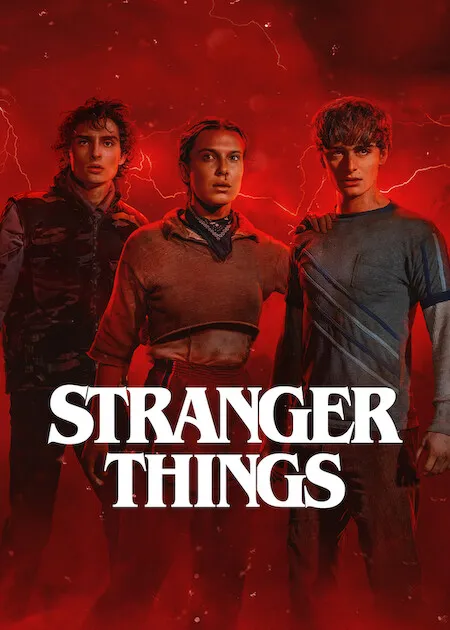
Over the Christmas holidays, Netflix released the final series of Stranger Things.
Since the first series in 2016, we’ve followed the outbreak of a dark, supernatural force in Hawkins, Indiana, the machinations of the US government and the military, and the children and teenagers who band together to confront it all.
None of the subsequent series have delighted me quite as much as the first, but I’ve watched each one since, unable to resist spending more time in Hawkins, Indiana.
I certainly wasn’t going to miss the final series – not least because there is even more suspense around whether long-form TV can end successfully than there is concerning the eventual outcome of things for Hawkins and its beleaguered residents.
Endings - did Stranger Things succeed?
What goes into a successful ending? Not a "happy ending" for the characters of the piece, but an ending that works, that feels fitting and does justice to what has gone before?
As our viewing appetite has grown, we consume our media over a much more expansive period than the one-sitting constraints of a feature film. Several such series have started strongly, but then petered out, or, in other cases, fallen at the final hurdle. The final series of Stranger Things was not an all-out disappointment, but neither was it the triumphant conclusion for which I’d hoped.
Why not? It’s undeniable that Stranger Things has been a victim of its own successes: for one thing, the first series had the narrative courage to shock viewers with deadly peril. As Stranger Things continued, however, some of the characters became such firmly established fan-favourites that they began to survive preposterous situations. For another, the limitations of budget and time in the first series meant that the strange realm of the Upside Down was mysterious in a compelling and curiosity-inducing way, leaving room for the viewers’ imaginations to fill. The more the later series explain, the less room was left – resulting in a less satisfying experience.
But perhaps the reason why Stranger Things didn’t quite stick the landing is that it had moved too far from what made the first series truly great. There, children (who engage in storytelling and imaginative play) find themselves drawn into conflict with forces far deadlier and more terrifying than they are. The adults we might look to for help seem intent on harnessing these forces for their own ends. But – like so many hobbits entrusted with the ring – these children are formed in virtues of courage, loyalty and love which prove powerful in a deeper way.
A Christian's response
For the Christian viewer, this is a thrilling illustration of worldly weakness revealed to be something truly powerful. This strand is arguably never entirely lost in later series of Stranger Things. It is, however, eclipsed by other strands in the story: the wider government conspiracy, the Cold War conflict with the Soviet Union and the introduction of a personal antagonist, to name a few.
The final series had such a clear sense of obligation to the social media discourse and expectations around certain characters’ identities and storylines that it seemed to forget its primary obligation – to the story itself. One particular character arc says much more about the social orthodoxies of 2026 than anything authentically of the period, and the effect was banal and not a little jarring.
What would make an ending that satisfies? Whether it’s a contented sigh after the "happily ever after" of a fairy tale, or the playful open-endedness of a Christopher Nolan film, successful endings crown what went before.
Looking ahead to our promised future
One of the gifts we in the West have received from the Bible is a longing for a satisfying ending, one that resolves loose threads, one in which – to return to Tolkien – everything that is sad comes untrue, and not in a way that feels false. It is worth reading Scripture’s accounts of the end God purposes – in Revelation, of course, but not just there – to see where that sense of an ending has come from.
As we look at the New Creation, we can see that the echoes of Eden have been transposed into a more glorious music: the tree of life is now on either side of the river, the sun and moon replaced by the presence of the God who is light, the gold and precious stones drawn out of the ground to adorn the city. Not only are the bad things banished, but the good things we knew in seed form have come to a full and glorious fruition, and the pain and sorrow we knew turn out not to have been wasted along the way.
We long for an ending like that, even in the stories we tell. And we have the Lord Jesus Christ’s solemn promise that just such an ending is on its way when He returns.
The inability of our most popular, well-resourced and dazzling narratives to end satisfyingly tells its own story. The story of reality, by contrast, will have an ending that will not disappoint.
What was so thrilling about Stranger Things – the possibility of strength hidden in worldly weakness, and a love as strong as death – will turn out to have been thrilling precisely because it had the aroma of an ending that would not disappoint.








Truth, shame & the search for blame
There was a stream of articles and commentary in the weeks leading up to Jason Arday’s resignation as Professor of …