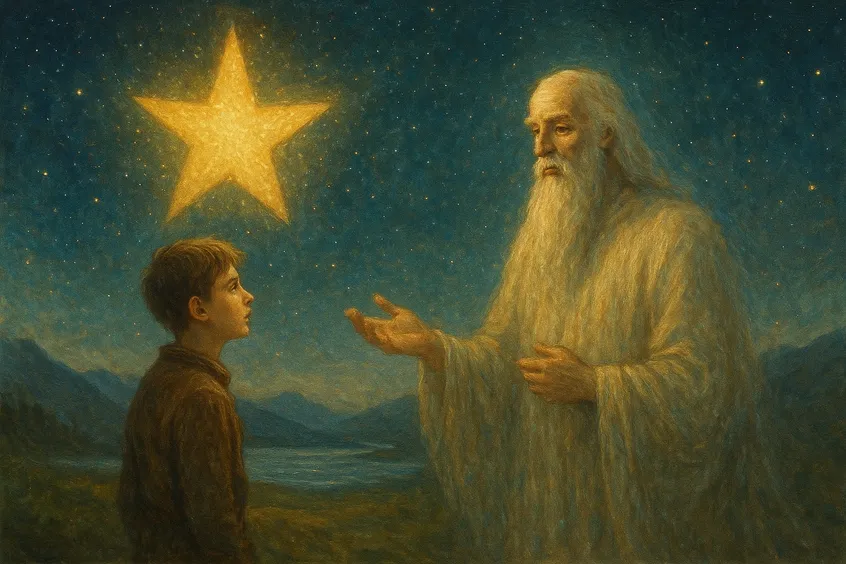
Summer would not have been summer without a good deal of reading (as well as cricket, which you must admit hasn’t been bad this season).
I have recently been enjoying a good deal of C. S. Lewis, devouring the third part of his Space Trilogy, entitled That Hideous Strength, as well as his three lectures published as The Abolition of Man. Both works, written near the end of the Second World War, depict a world threatened by dystopian totalitarianism. I was drawn to these works after reading John Lennox’s outstanding 2084 and the AI Revolution: How Artificial Intelligence Informs Our Future – a book I have strongly urged our congregation to read, in which Lewis is cited very frequently.
Okay... It is only fair to add that Lewis could hardly be described as an "evangelical" – and I’m not sure he would fit all that comfortably into any 21st century Reformed and confessional church setting – but we believe in "one holy catholic church," and Lewis has been a very great gift to that one church. The more I read him, the more I appreciate how prescient and insightful he was.

Lessons from Lewis's Narnia
But let’s travel to Lewis’ Narnia, or more precisely, to the high seas far to the east of Narnia. A short scene from The Voyage of the Dawn Treader comes to mind...
Eustace Scrubb, who begins the tale as a selfish and spoiled brat but is wonderfully transformed after meeting Aslan – having spent some time as a dragon – speaks with a wise old man named Ramandu, the future father-in-law of Caspian. During their conversation Eustace discovers that Ramandu is, in fact, a star. He is baffled by this: "In our world," said Eustace, "a star is a huge ball of flaming gas."
"Even in your world, my son," says Ramandu, "that is not what a star is but only what it is made of."
Is Ramandu right? Can such a sentiment be Biblically verified?
In Job 38v7 we read that "the morning stars sang together" when the universe was first created. Most Biblical scholars down the centuries, including Augustine and Calvin, understood that the stars, which in this verse are paralleled with "the sons of God," are a metaphor for the angels. Lewis’ penchant for medieval cosmology, which he describes in The Discarded Image, and whose loss he lamented, may have got the better of him in this instance.
What does this teach us about God?
But the conversation between Eustace and Ramandu might cause us to reflect carefully on deep questions about truth and goodness, and also beauty. For in our modern Western world, we are living in what many writers have called a "disenchanted" age. Charles Taylor famously traced this narrative in A Secular Age, while more recent authors, such as Rod Dreher in Living in Wonder: Finding Mystery and Meaning in a Secular Age, have developed the theme further. We have lost a sense of the sacred and the transcendent, and boxed ourselves into a mundane, materialistic utilitarianism.
You may not be all that keen on the language of "enchantment" and "mystery," and it is liable to be misunderstood, but my main point is that for the Christian, the knowledge of God elicits praise and wonder because He satisfies the deepest longings of the human heart.
While we can, and should, talk about "the doctrine of God," and while our articulation of that doctrine may push back the frontiers of human language, God Himself is infinitely greater than any doctrine.
But more wonderfully still, our God is personal, relational, covenantal. To know God is necessarily to draw near to God, be with Him – "his forever, only his" – to be taken up with divine beauty. To say with the Psalmist: "My soul longs, yes, faints for the courts of the LORD; my heart and flesh sing for joy to the living God" (Psalm 84v2).
Notice the Psalmist’s "joy." Here Lewis helps us again, with his distinction between "contemplation" and "enjoyment":
- To contemplate, in Lewis’ thought, is to stand back and study something, to examine it from every angle in order to give it careful consideration.
- But to enjoy something or someone, says Lewis, is to be taken right into it, to participate in the essence of its life, to taste and see how good it is by immersion within it.
The two French verbs "to know" illustrate this point; savoir is knowledge of facts, but connaître is knowledge of relationship – personal, participatory, even loving. The "deep, deep love of Jesus" is "underneath me, all around me."
Enjoyment does not cancel out contemplation – it fulfils it. This is undoubtedly true in our knowledge of God. We do not stop knowing facts about Him, but those truths take on a far deeper reality when we come to know Him personally; and we can only know God personally in union with His Son, and through the ministry of the Spirit, who "searches everything, even the depths of God" (1 Corinthians 2v10).
Why am I writing these things? Because of the technocratic, mechanistic, individualistic society that we have become, in which our very humanity is being sucked out of us. We are not a million miles away from the dystopian world of That Hideous Strength.
So many of us know less and less of one another, let alone of God, in that best, relational sense.
Those who trust in man-made devices will eventually become like them (Psalm 115v8).
Perhaps the most alarming aspect of the information-communication revolution, accelerated by the Covid lockdowns, is the way it glues us more tightly to our screens, convincing us that we are "interacting" with others when we are missing out on the face-to-face, heart-to-heart communion we were made for.
The narrative of the Bible is woven around the most glorious paradigm of all. Why is marriage such a prominent motif throughout Scripture? Why does the Bible climax with the marriage supper of the Lamb? Because God Himself comes to know us in that way: personally, covenantally, face-to-face, in living, lasting and loving union. That is the goal of salvation – communion with God Himself in Christ.
For eternal life, as Jesus Himself says, is nothing less than this: "That they may know you, the only true God, and Jesus Christ whom you have sent" (John 17v3).
This piece was originally published by Paul Yeulett as 'Knowing and Enjoying God'
Are men our biggest pastoral problem today?
If someone were to pin me down and ask me the question: “What is the most common underlying cause of …