
Funeral services with no gospel and no hope are now the norm.
Having no service at all is now a popular option. Instead, people are encouraged to use the money saved for a celebratory memorial. It's an extremely successful idea, appealing to death-denying hearts.
As Christians we rightly lament this trend, but it also presents an opportunity to powerfully commend the gospel.
Facing the reality of death
"The light shines in the darkness, and the darkness has not overcome it."(John 1:5) These beautiful words at the beginning of John’s Gospel are about Jesus. Later, John records Jesus saying: “I am the light of the world. Whoever follows me will never walk in darkness, but will have the light of life.” (John 8:12)
The truth of these verses powerfully impacted me over four consecutive days in early December.
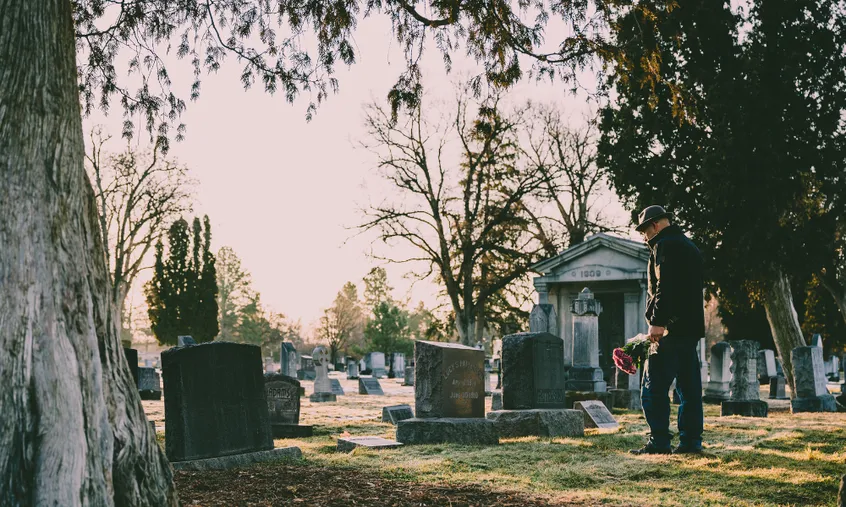
On a still, cold Friday in a bleak Victorian cemetery in Edinburgh, I led a short burial service for a man who had tragically taken his own life. It was a sad way to return to the church where I had been minister for 15 years, though I was glad to go at the request of the family and the support of the church. Their honesty about what had happened was courageous. Not merely sudden death, but suicide. Even as Christians we can be tempted to skirt around the reality of death.
Just the man’s immediate family and closest friends were present at the graveside. He had suffered from depression for many years. Persuaded that his family and friends would be better without him, and experiencing an episode of unbearable hopelessness for which he saw no end in this life, he committed suicide.
This is not true. His family will be affected by what happened for the rest of their lives. Nor is it true that there is no hope in life for a Christian, even in the dark pit of depression and despair. The psalms are full of such testimonies.
Battling with sin
Taking a life, whether another person’s life, or your own, is sinful. Does God forgive this sin? Yes. There is only one unforgivable sin, blasphemy against the Holy Spirit, and suicide is not that.
This dear man was no less a Christian in the darkness of depression. He was no less a Christian in the act of suicide. A Christian is no less a Christian whatever assails them. ‘For I am convinced that neither death nor life, neither angels nor demons, neither the present nor the future, nor any powers, neither height nor depth, nor anything else in all creation, will be able to separate us from the love of God that is in Christ Jesus our Lord.’ (Romans 8:38-39)
The glorious scandal of salvation by grace alone in Christ alone through faith alone, cannot be illustrated more powerfully than through these circumstances.
What a tremendous difference that makes for Christians. At the graveside we heard these words of promise from Romans in the confidence that his soul is now with Jesus in heaven, his mortal remains committed to the ground to be gloriously raised on the day of the Lord. And for those who mourn his loss, to know that there is no separation, is tremendous.
Contrast the comfort of that assurance with the terrible fear of dying without faith, and outside of Christ. There is no relief, only eternal torment in hell. The terrible darkness of depression, yielding to a darker eternal hell. Looking across that graveyard where thousands are buried, how many died safe in Christ?
These are the simple realities of the gospel – to live and die with no condemnation and no separation, or to live and die condemned to eternal separation. The stark simplicity is not harsh. It is a lifeline. To have assurance, to know for sure, makes Christianity different from any religion.
A time of hope
The next day, Saturday, hundreds gathered for a service of thanksgiving. The majority were not Christians, so were evidently shocked and without hope. What had brought them?
He was a man in his fifties; young, kind and gentle. Many came because he had touched their lives. His children’s friends came in support, and the church family were there. His family sat in the front row of the church, with everyone behind them, physically and metaphorically. The love and support in the room was tangible.
Trusting that the Lord brought these people to hear the gospel, how wonderful it would be if through this tragedy, the Lord brings people to saving faith?
Driving back to London on Sunday we made it just in time for a carol service, where we sung these words:
And our eyes at last shall see Him,
through His own redeeming love;
for that Child so dear and gentle
is our Lord in heav'n above,
and He leads His children on
to the place where He is gone.
Standing singing in that church in London, my mind went to the graveside. What a glorious gospel we have to proclaim, to tell the world.
The fourth day was Monday morning, leading the morning devotions at Cornhill. We sing and pray together and one of us preaches a short sermon. On Mondays with the first-year students I’ve been preaching through Mark. Without time to prepare, on that particular Monday I reflected on the events of the weekend. We thought about Romans 8 together, the beginning and end of the chapter – no condemnation, and no separation.
The Church in the UK is facing many challenges, but through the ministries of a whole range of training providers, the Lord is raising up the next generation of preachers and Bible teachers to tell the good news. There is, perhaps, no harder task, yet no more noble task. And no more important task.






He is still good. Do you believe that?
How do you learn to trust again when your trust has been broken, time and time again?How do you …