
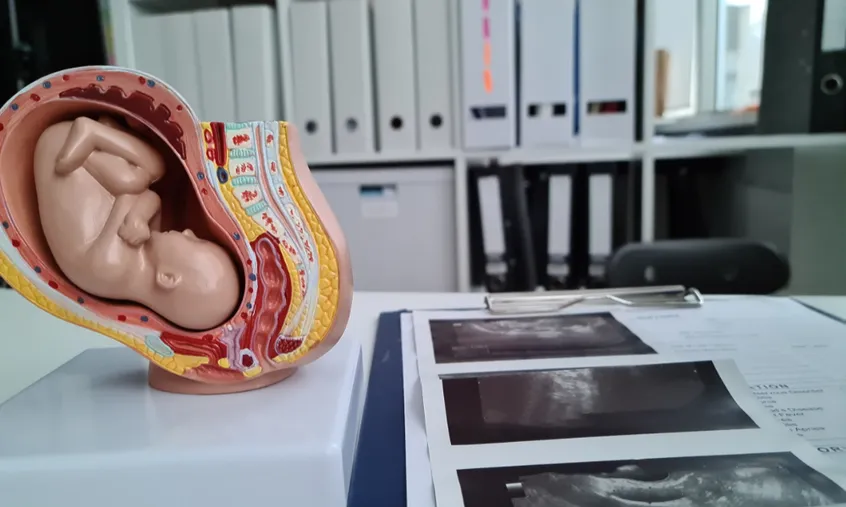
'The slaughter of so many millions of unborn children in the West in the last few decades is one of the great blind spots of our decaying culture,' (en Editorial, September).
Indeed it is – and in the East.
Our hearts grieve over the shedding of such an unimaginable quantity of innocent blood, year on year. I remain thankful as ever that this issue is given so much airtime in this publication. If only it were addressed as often in our pulpits, our nation might be in a very different place.
Exceptional abortions: 2% of cases
But I have to confess there was something in the brief editorial comment that raised my eyebrows:
'(Of course, there are always situations – for example rape, incest and imminent danger to a mother’s life – where we cannot be so black and white, but they should not distract us from the wider tragedy where no such contingencies apply.)'
At a statistical and pragmatic level, perhaps in a sense this right: all the 'hard cases' taken together account for only about 2%, and certainly should not be used as a cover for the other 98%, where the motive for 'abortion' is more straightforwardly 'baby not wanted' – no medical issue whatsoever, no sexual crime involved. In that sense, yes, 'they should not distract us', and indeed in terms of campaigning there is good sense in not allowing them to disproportionately (dishonestly) dominate the debate.
Moral ambiguity and the need for clarity
However, I am concerned that many evangelicals are actually unclear within their own hearts and minds on the morality of the 'hard cases' themselves. I hope to clarify here that we can and indeed must be much more 'black and white'.
To those who might accuse me of splitting hairs here rather than being satisfied that we are largely of one mind on the majority of cases, let me say that these are not hairs, but human lives: 2% still accounts for thousands of children every year in our nation alone. More than knife crime ever kills, more than poverty or Covid-19 or racism or climate change or whatever else we yield our attention and even our pulpits to.
Moreover, there is a moral urgency to getting clarity even on these hard cases, akin to getting the foundations of a building right. If we can’t be sure that all lives matter, it is not after all the sanctity of human life itself that we value, but rather the various qualities that we judge make life worth living. In other words, we become hedonists or utilitarians. Even if we think most lives are worth living and worth protecting, that would only be an accident of statistics and not because we are crystal clear on the image of God.
By way of analogy, it is no good to say that we are strongly against racism and are deeply disturbed by racism – except in the case of racism against Japanese people (to pick an arbitrary example), where we can’t be so hard and fast. To make this exception is wrong in itself and threatens to bring down the whole house of cards.
If we can make one exception, why not another?
Very well then, if we are agreed that this is important to bottom out, let us proceed. Much of the confusion, in my view, stems from the fact that the so-called 'hard cases' are all lumped together as one, when in fact, they relate to very different situations with very different moral justifications attached. We cannot just assume that these are all equally valid.
(By analogy, our culture expects us to embrace 'LGBTQIA2+ inclusivity' notwithstanding the fact that very few of us have any idea what the letters beyond the first few actually stand for, and the fact that some of the letters stand in direct opposition to one another: what do the Ls and the Gs really think about the Ts? We should beware the dangers of 'lumping together'.)
Therefore, we must carefully separate out each of these 'hard cases' and treat them independently of one another. There are, essentially, four: rape, incest, (extreme) fetal abnormality, life of the mother.
1. Rape
Of course we condemn and abhor all sexual crime. Perpetrators should be brought to justice and victims should be given every possible support.
However, we must reject the idea that supporting a woman who has become the victim of sexual crime can ever take the form of intentionally killing her unborn child. We must deny that this wipes away the first trauma, that it helps her towards true healing, or that it could ever be morally justifiable to intentionally kill one innocent human being in an attempt to alleviate the psychological suffering of another innocent human being, whatever the circumstances.
One is reminded of the Biblical principle, 'The soul who sins shall die' (Ezekial 18:20). 'The son shall not suffer for the iniquity of the father, nor the father suffer for the iniquity of the son.'
Biblically, this is very clear, very black and white.
The reason we struggle is that we have been pressed into accepting the world’s definition of 'compassion', we have been led to believe that it is unloving towards the poor mother, who has been the victim of an awful crime, to not kill her baby.
Meanwhile the welfare of the baby is entirely left out of the picture, because the unborn child has been dehumanised in our eyes. Indeed our moral confusion in the case of rape is evidence that we still don’t fully grasp the humanity and preciousness of the child in the womb; since who would argue we should kill toddlers for the sexual crimes of their fathers? Yet we are happy to say, when the child is still in the womb, we can’t be so sure or so black and white. We have followed the world in allowing size or location or level of development to dictate a child’s value. This is foreign to Biblical morality.
2. Incest
Although, interestingly, I don’t think I have ever heard anyone actually spell out the logic of why incest should justify abortion, one can imagine that it is either because incest is (often) also a horrific sexual crime, in which case the situation and treatment above applies, or because incest significantly increases the likelihood of genetic abnormality or poor 'quality of life' in the child, in which case the situation and treatment below applies.
3. Fetal abnormality
In this country, 'abortion' is permitted up till birth for any kind of perceived abnormality, great or small. Downs Syndrome is probably the highest profile example: hundreds of babies every year are killed for having Downs Syndrome. Most evangelicals condemn this.
However, with more extreme fetal abnormality, perhaps where 'quality of life' (a phrase we should be very wary of) is seriously threatened, or where the baby is not expected to survive long after birth, again evangelicals lose clarity.
Once again, this betrays the extent to which the baby in the womb has been dehumanised in our eyes. I am not talking about the culture’s blind spot here, but the Church’s! For who would argue that if a five-year-old is very poorly, with the doctors believing he only has a year left to live, we should apply a torturous lethal injection of potassium chloride to his heart (this is what they do to children in the womb in late term 'abortions', often without anaesthetic) to kill him now? Yet this is precisely what we are entertaining, or advocating, in the case of 'abortion for fatal fetal abnormality'.
As with any child, the best care possible should be given, even if that care is only palliative. To kill in an attempt to alleviate suffering is foreign to Biblical morality.
In 2 Samuel 1 the attempted justification of the Amalekite who killed Saul – 'because I knew that after he had fallen he could not survive' – no matter how compassionate some might judge it to be, was in the end no defence: 'Your own mouth testified against you when you said, "I killed the LORD’s anointed."'
4. Life of the mother
Here we must be clear that we are dealing with a very different situation from the three situations above. Here, we are dealing with the inevitable, unwanted, and tragic loss of a human life, not the deliberate ending of a human life.
I quote from the Life Affirmation website, featured in this newspaper a couple of years ago:
'It is never medically necessary intentionally to end the life of a baby in the womb to save the life of the mother. It may be medically necessary to deliver the baby prematurely in an emergency to save the mother’s life… After delivery, every reasonable effort should be made to sustain and enhance the life of the baby, although, tragically, in some cases the baby may not survive. In other cases, tragically the mother may not survive whilst the baby does. But the aim should always be to preserve as much life as possible.'
An emergency life-saving intervention is very different both in intent and in technique from the deliberate and direct destruction of the baby’s life inside the womb before extraction, to the extent that many would reject the use of the term 'abortion' altogether to describe this procedure, since 'abortion' is the intentional taking of a life in the womb.
Perhaps somewhat misleadingly, such procedures are still listed within the overall 'abortion' statistics, but account for less than 0.1% of the overall figure.
Since these procedures are an attempt to save at least one life rather than lose both, and do not spring from a desire to end the life of the unborn child, we should be very clear in our hearts and minds to separate them morally from 'abortion' generally, even if we continue to use that word to describe them.
Conclusion
In the case of rape, incest, and fetal abnormality, then, we must be clear that whilst they are extreme cases and emotionally very fraught, ultimately the attempted justifications connected to them are social reasons, eugenic reasons, hedonistic or utilitarian reasons (akin to the attempted justification for what we call 'euthanasia'). Our readiness to accept or even to entertain them betrays the extent to which we have followed the culture in allowing the unborn to be dehumanised in our thinking, their value simply assumed to be less than that of older people. Biblically such an evaluation cannot be supported.
As for the case of the life of the mother, we should be clear that there is a world of moral difference between intentionally taking the life of a baby because it is not wanted or deemed worthy of life, and unintentionally suffering the loss of one life during an attempt to save as many lives as possible.
My prayer is that one day very soon the evangelical consensus in this country will move decisively to a new point of clarity:
'Of course, there are no situations – for example rape, incest, fetal abnormality – where we cannot be so black and white: every life is precious and worthy of defending, regardless of circumstances or health. And in emergency medical situations, of course we work to save as many lives as possible, even if sadly not all lives can be saved.'
Until we arrive at this point of moral clarity, I find it hard to imagine the presence of moral conviction and moral courage needed for us to finally enter into the fight for life meaningfully, to work and speak and pray effectively toward the end of this great injustice in our land.





DIY abortion up to birth: A wake up call for the Church?
Britain's upper house of parliament has supported measures to remove women from criminal liability related to abortion.Dave Brennan, …