Christian Nationalism and far-right exclusivism

David Shepherd  |  Comment
Date posted:  30 Oct 2025
Share Add       
Christian Nationalism and far-right exclusivism

Photo: eauk.org

In March 2026, Dame Sarah Mullally will be formally “enthroned” as the 106th Archbishop of Canterbury.

In accordance with long-standing tradition, Mullally will kneel before King Charles and pay homage to the King as Supreme Governor of the Church of England.

“Supreme Governor” (which was first used in the 1558 Act of Supremacy under Queen Elizabeth I) symbolises the monarch’s constitutional role in Church governance. It also avoids the theologically controversial title of “Supreme Head of the Church” that Henry VIII received.

Based on Mullally’s overtly liberal stance, several evangelicals have already expressed their reservations about her appointment. However, it is to her credit that, in her first remarks, she declared that: “Hatred and racism of any kind cannot be allowed to tear us apart.”

In so doing, the Archbishop-designate tapped into the Western tradition of religious freedom that began with the separation of political and religious authority, as articulated in the Peace of Munster that ended the Thirty Years’ War in 1648.

The Peace of Munster guaranteed individuals “the free Exercise of their Religion, as well in publick Churches at the appointed Hours, as in private in their own Houses, or in others chosen for this purpose by their Ministers, or by those of their Neighbours, preaching the Word of God.”

In contrast with church-state separation in Europe, for over 160 years the Act of Uniformity, Corporation Act and Test Acts (enacted in the 1670s during the reign of Charles II) severely curtailed the religious freedom of English non-conformists until repealed in 1868.

In 2012, the Church of England held a Service of Reconciliation at Westminster Abbey in which the then Archbishop of Canterbury, Rowan Williams, described the Act of Uniformity as “a disgraceful deed, because the great majority of the ejected ministers might easily have been retained in the Church by a few small concessions.”

That is why I am surprised that some of those who consider themselves to be the spiritual successors of those early non-conformists have had no problem in demanding the curtailment of freedom of religion for non-Christians.

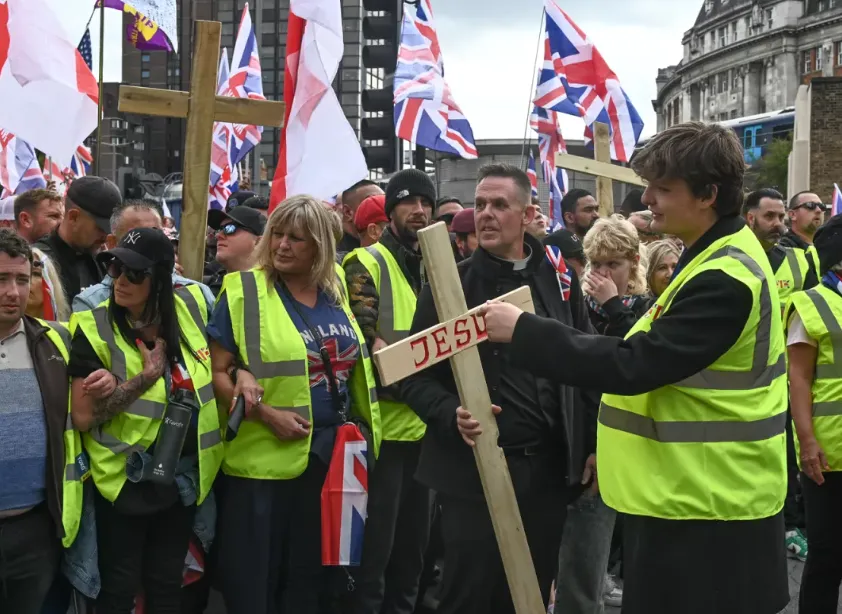
For example, at the recent Unite the Kingdom (UTK) solidarity rally, one of the invited speakers, Brian Tamiki (leader of Pentecostal Destiny church), demanded a ban on non-Christian manifestations of religion to roars of approval from the gathered crowd. He said: “Ban any type of public expression in our Christian nation from other religions. Ban halal. Ban burqas. Ban mosques, temples, shrines. We don’t want those in our countries.”

Yet, surely, this criminalisation of external manifestations of non-Christian belief amounts to an enforcement of and focus on the kinds of religious externalisms that Jesus denounced: “You clean the outside of the cup and dish, but inside they are full of greed and self-indulgence. Blind Pharisee! First clean the inside of the cup and dish, and then the outside also will be clean.” (Matt.23 v25,26)

Furthermore, earlier in Matt.22v21, Jesus’ widely misunderstood reply on the issue of paying taxes to Caesar was a cleverly veiled rebuke of the Herods, who had brought Judaea under formal Roman provincial rule in 6AD.

Significantly, in the same year, that event was marked by Jerusalem minting Roman coinage bearing the inscription: “Tiberius Caesar, son of the divine Augustus.”

So, it was this dilution of Jewish religious identity with the ascendant political power of Rome that Jesus was denouncing when he instructed: “Then give back to Caesar what is Caesar’s, and to God what is God’s.”

That instruction is also applicable to the dilution of Christian identity with ascendant left-wing or right-wing power.

Yet, despite Jesus’ instruction, several prominent Christian Nationalist evangelicals have been quick to deny that their participation in the Unite The Kingdom rally involved any such dilution of their Christian belief with far-right politics.

In fact, they claim that to call Christian Nationalism a far-right movement is a scurrilous accusation.

However, their argument against this far-right characterisation is undermined by their refusal to distance themselves from demands for government to interfere with freedom of religion for non-Christians.

That refusal betrays their support for statutory exclusivism that is central to the far-right worldview.

Unlike mainstream right-wing movements, the “far” in far-right movement is characterised by exclusivist policies that legitimise discrimination against anything or anyone that is not assimilable into a romanticised ideal of overt societal homogeneity (coded as ‘British-ness’ or ‘British values’) because they are perceived as an existential threat.

Also, that kind of exclusivism explains why far-right policy statements on immigration are going beyond addressing illegal immigration to propose the abolition of Indefinite Leave to Remain for legal immigrants.

It is also that kind of exclusivism that explains the public statements assuring that legal migrants from Ukraine and Hong Kong will escape deportation, while refusing to provide similar assurances to legal migrants from Afghanistan (who’ve settled here under ARAP and ACRS).

(Of course, the relative socioeconomic deprivation of certain races can turn the income and wealth criteria that were mentioned into proxies for race).

The far-right agenda also explains why so many at the UTK rally adopted the crusader theme.

In the face of a widespread growing appetite for intolerant far-right rhetoric, we need spiritual leaders who will remind our nation of its hard-won freedoms, including freedom of religion.

So, whatever my disagreement with the Archbishop Mullally on other issues, on this one, I support her 100%.

Share
< Previous article| Comment| Next article >
Read more articles by David Shepherd >>
Comment
The moral case against slavery reparations

The moral case against slavery reparations

Last December, as reported by The Sunday Times, the Shadow Home Office Minister Katie Lam and 26 other MPs …

Comment
Pretend patriots versus true patriotism

Pretend patriots versus true patriotism

Remembrance earlier this month is more than a ritual; it is a sacred covenant that binds generations. For the British …

Give a subscription

Our monthly newspaper is the perfect gift for those who love to think deeply

Give here

Looking for a job?

Browse all our current job adverts

Search