
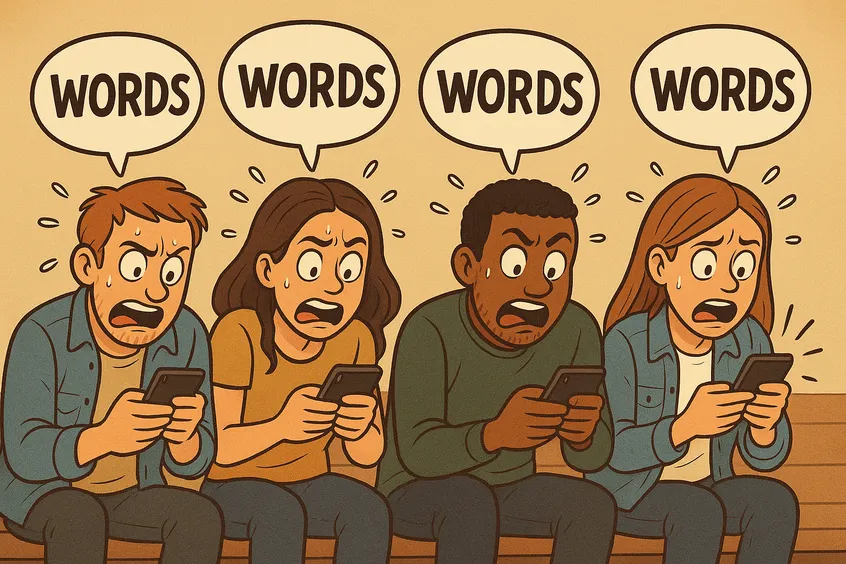
“When words are many,” wrote Solomon – while his wisdom remained with him – “transgression is not lacking, but whoever restrains his lips is prudent” (Prov.10v19). It is a lesson that is especially timely right now.
We have never seen such a proliferation of words as we do today, due largely to the digital communication revolution. The inevitable result is that words become cheapened and debased. In the same way as a cash-strapped government discovers that mass money-printing leads to inflation, so it is with the reckless (mis)use of words. The more people talk – or text, or tweet, or emote, or sound off – the less they truly say. The purchasing power of their words is shrunk.
Lively discussions about “free speech” and its limits are all the rage at present and show little sign of abating. As I write, the comedian Graham Linehan has been apprehended by the Metropolitan Police following tweets which were critical of transgender ideology, eliciting swift responses from the expected quarters: Rowling, Jenrick, Farage, Musk et al. By its very nature, this debate is likely to feed on itself and grow exponentially in volume, pitch and extent; it’s very difficult to restrain people from talking about their incontrovertible human right to talk. In this way human speech becomes ever more untethered, undisciplined and vitriolic.
The only safe remedy is to ask the question: What is speech anyway? Why do words matter?
Words are weighty for this one reason: God Himself is the great speaker of words. Remember the Ten Commandments, literally God’s Ten Words, spoken audibly at Mount Sinai in the hearing of His people (Ex.v.19-20). When God spoke, everyone saw the fire and smoke, heard the thunder, and trembled in fear. God said, in effect: “These are my words. You’d better listen. Words matter.” We can only rightly gauge the value of human words if we begin by thinking about divine words. When we say, “the Bible is the word of God”, do we pause and take in what this means?
But the weightiness of words cascades down to you and me. Whenever we speak we are imitating the speaking God. Dogs bark, cats mew, horses bray, sheep bleat, monkeys chatter, frogs croak, parrots parrot – and can sound uncannily like people – but no animal speaks. Only man, made in the image of God, speaks words. The origin of speech is from above, not from below.
Therefore, when I speak, I am investing my words with weight, with meaning, with commitment. If I say something and then say afterwards, “I didn’t mean what I said”, I shouldn’t have opened my stupid mouth in the first place. Why does James say to us that we should all be “quick to hear, slow to speak, slow to anger”? (James 1v19) Because in this way we show ourselves to be like God, and our words will bless and heal far more if they are like God’s words. Speech is an act of great responsibility.
You might be tempted, after reading all this, to err in the opposite direction – hesitating to speak at all, so mindful are you of the gravity of words that you take up a lifelong vow of silence. Please don’t do that! We are called to speak with one another, to share truth seasoned with love (Col. 4v6).
The great Soviet dissident, Alexander Solzhenitsyn, wrote in an open letter to the Secretariat of the Russian Writers’ Union on 12 November 1969: “It is high time to remember that we belong first and foremost to humanity. And humanity has separated itself from the animal world by thought and by speech. These, naturally, should be free. If they are put in chains, we shall return to the state of the animals. Openness, honest and complete openness – that is the first condition of health in all societies, including our own.”
“Be imitators of God”, says Paul in Ephesians 5v1, “as dearly beloved children”. That means walking in love, and it also means talking in love. So let’s use our tongues – not as lethal weapons, but as instruments for praise and righteousness.




Are men our biggest pastoral problem today?
If someone were to pin me down and ask me the question: “What is the most common underlying cause of …