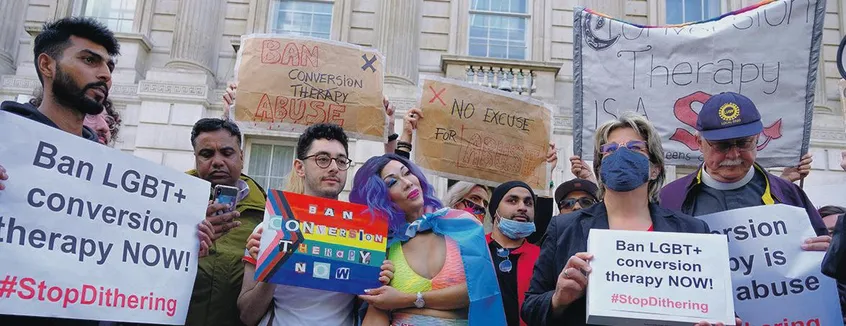
The government has formally announced that it will enact a ban on conversion therapy.
The draft of the Conversion Therapy (Prohibition) Bill currently defines conversion therapy as: ‘any practice aimed at a person or group of people which demonstrates an assumption that any sexual orientation or gender identity is inherently preferable and which has the predetermined purpose of attempting to – (a) change a person’s sexual orientation or gender identity, or (b) suppress a person’s expression of sexual orientation or gender identity.’
Doubtless, this definition will undergo considerable legislative scrutiny. However, as it stands (and notwithstanding any corresponding religious exemptions in the Equality Act), there is a genuine possibility that the law will criminalise any Christian counselling or publication which, for example, encourages the straight-married, who experience same-sex attraction, to remain faithful to their vows of lifelong sexual fidelity, instead of divorcing in readiness for a new life with a same-sex partner.

In her seminal paper, Expressive Ends: Understanding Conversion Therapy Bans, Yale law professor, Marie-Amelie George, (who is a prominent LGBT advocacy lawyer) has explained how anti-conversion therapy laws are aimed at reinforcing the notion of immutable sexual identity (i.e., defined by the American Psychological Association as ‘individual or group membership and affiliation, self-labeling’). She writes: ‘Through these laws, LGBT rights groups are able to emphasise that homosexuality is an immutable characteristic, an issue that has been central to establishing rights claims.’
Nevertheless, she warns: ‘requiring individuals’ sexual identities to be immutable implies that being LGBT would otherwise be invalid, with civil rights depending on an empirical premise that scientists may later prove incorrect.’
In fact, that premise of immutable sexual identities owes more to the legal strategy of gay advocacy groups in the US than to any discovery of science. Not many months after the 1964 Civil Rights Act was passed, a new generation of young lawyers were inspired to apply that law to other causes.
One such lawyer was Bruce Winick. As General Counsel to the American Civil Liberties Union, he sought to amend the Dade County Human Rights Ordinance to prohibit discrimination on the basis of homosexual conduct. While his efforts to end discrimination against lesbian and gay people are laudable, the overall legal strategy went far beyond this to demand preferential affirmative action based on sexual orientation.
In his memoir, Winick described his legal innovation that, ever since, has been part of the blueprint for LGBT advocacy: ‘I decided to use the phrase “sexual or affectional preference” … Prohibiting discrimination based on sexual or affectional preference thus would not violate state law.’
The county commission voted to adopt the amendment. And it was that phrasing that became the model for similar ordinances across the US.
In 1992, conservative groups tabled Amendment 2 in Colorado, in an effort to reverse that state’s law on gay affirmative action. At that time, a survey of Coloradans revealed that, while they were strongly opposed to discrimination based on sexual orientation, they also opposed affirmative action based on sexual orientation.
Although Amendment 2 was approved by a vote of 53% to 47%, the campaign to get it passed did not reject Winick’s concept of an immutable sexual/affectional preference, but, instead, unwittingly endorsed it.
In contrast with this legal notion of immutability, the American Psychological Association has stated: ‘Although affirmative approaches have historically been conceptualized around helping sexual minorities accept and adopt a gay or lesbian identity (e.g. Browning et al, 1991; Shannon & Woods, 1991), the recent research on sexual orientation identity diversity illustrates that sexual behavior, sexual attraction, and sexual orientation identity are labeled and expressed in many different ways, some of which are fluid (e.g., Diamond, 2006, 2008; Firestein, 2007; Fox, 2004; Patterson, 2008; Savin-Williams, 2005;R. L. Worthington & Reynolds, 2009).’
The APA further recommends: ‘We encourage Licensed Medical Health Practitioners to support clients in determining their own (a) goals for their identity process; (b) behavioural expression of sexual orientation; (c) public and private social roles; (d) gender role, identity, and expression; (e) sex and gender of partner; and (f) form of relationship(s)’
Therefore, it is surely a major concern that this ‘best practice’ recommendation will be abandoned by counsellors for fear of it being misconstrued as having ‘the predetermined purpose of attempting to suppress a person’s expression of sexual orientation or gender identity’ and resulting in a fine and criminal record. Yet, such a wrong-headed abandonment of best practice is exactly what happens when ideology trumps science.
And, in terms of dangerous quackery, it is surely ironic that such a perverse outcome bears a striking resemblance to the very practices that the Bill’s drafters are seeking to prohibit.
Churchill & Arday: Double standards?
In 1898, the young Winston Churchill rode with the 21st Lancers at Omdurman, later describing the charge as a desperate …